Housing Matters: Winning Ideas for Policy Impact
EVENT RECAP
Housing Matters: Winning Ideas for Policy Impact
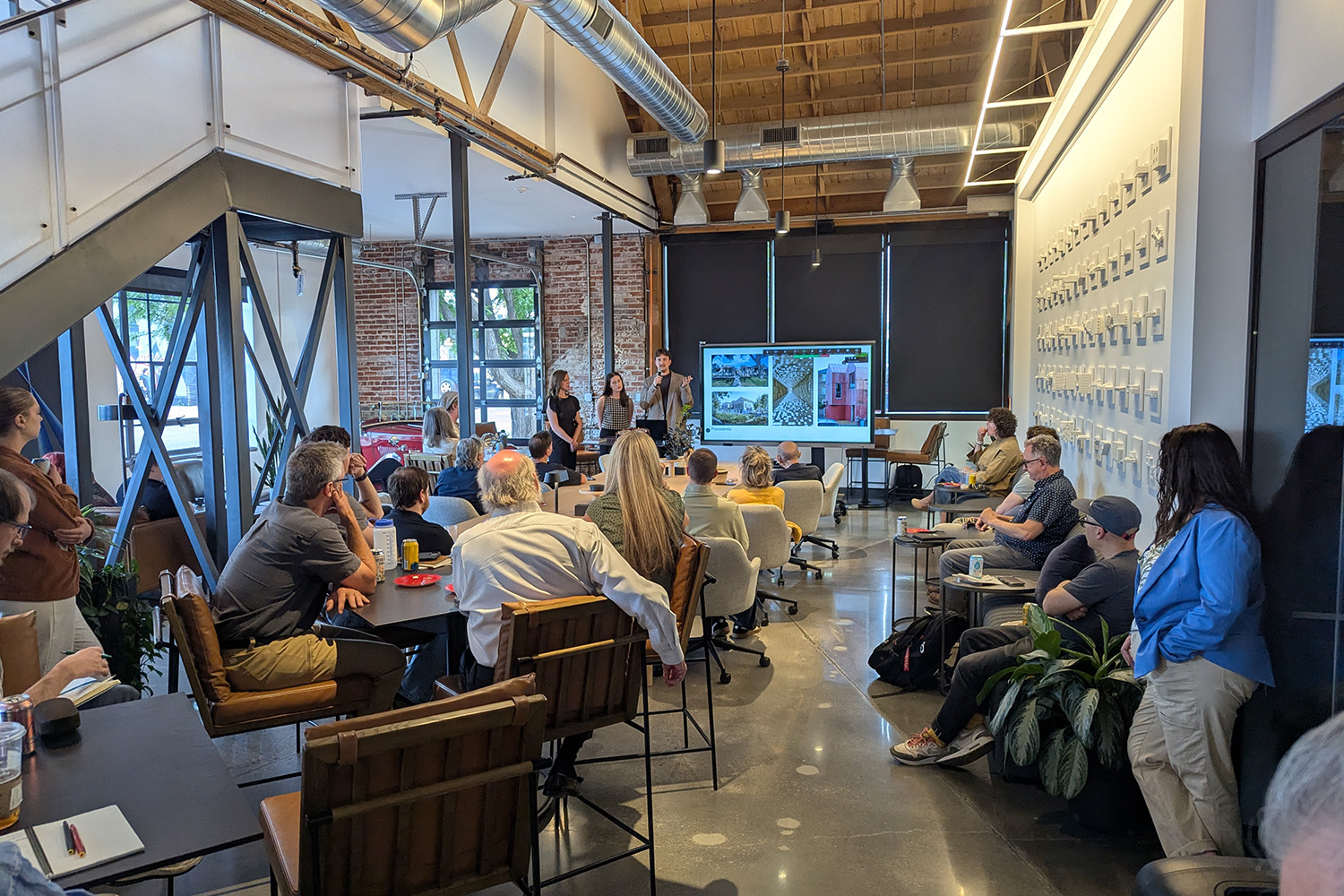
On May 13, 2026, AIA Colorado’s Regional & Urban Design Knowledge Community gathered architects, planners, policymakers, and community members at OZ Architecture for Housing Matters: Winning Ideas for Policy Impact, an evening focused on one pressing question: What is the real impact of a design competition?
Centered around the Denver Affordable Housing Challenge, the event showcased how speculative design ideas can move beyond conceptual exercises and begin shaping real policy conversations in Denver and beyond. Through presentations from three winning teams and a response from the City and County of Denver, the evening explored how thoughtful design can address housing affordability while preserving neighborhood character, expanding housing choice, and strengthening communities.
Thanks to Koning Eizenberg Architecture and Schmidt Design Group for sponsoring this event and to OZ Architecture for hosting!
The event opened with remarks from Troy Fosler, AIA, Principal at Koning Eizenberg Architecture and Chair of AIA Colorado’s Regional & Urban Design Knowledge Community, who welcomed attendees and highlighted the collaborative effort behind the program. Terra Mazzeo, AIA, architect and urbanist and organizer of the Denver Affordable Housing Challenge, framed the competition around four central goals: elevating international perspectives, amplifying emerging voices, leading with design excellence, and generating ideas with real policy potential.
Mazzeo emphasized that the challenge was never intended to remain theoretical. Instead, it was designed to test how architecture and urban design can meaningfully contribute to the future of housing policy in Denver.
The evening’s first presentation came from Australian architect and researcher Damian Madigan, PhD, GAICD, FRAIA, Associate Professor of Architecture at Adelaide University and Registered Architect, who joined virtually from Adelaide to present his internationally recognized “Bluefield Housing” model and his Denver competition proposal, X-MU-X. Madigan described how his work seeks to increase housing density within established suburban neighborhoods without relying on demolition-driven redevelopment.
Rather than replacing older homes, Madigan’s approach focuses on “co-located housing” — adapting existing residential lots to support multiple dwellings while preserving neighborhood character, mature landscapes, and social connections. His proposal demonstrated how a single historic home could evolve into multiple independently owned housing units arranged around shared gardens and community-oriented outdoor space.
Madigan argued that many cities, including Adelaide and Denver, face similar challenges despite their geographic differences: rising housing costs, limited land supply, and a lack of diverse housing types within established neighborhoods. His work ultimately helped influence housing policy reform in South Australia, where co-located housing was recently adopted into the planning code as a permitted form of infill development.
The second presentation, “ReFrame,” came from a team of emerging Denver architects — Meghan Kress, Assoc. AIA, Maggie Krantz, Assoc. AIA, and Sean Pike — who explored how higher-density housing could be integrated into existing neighborhoods through carefully scaled urban design and sustainable construction strategies.
Focusing on a Five Points site, the team proposed a six-unit housing concept organized around shared outdoor space and interconnected pedestrian circulation. Their designs prioritized cross ventilation, passive design, stormwater management, mass timber construction, and flexible living arrangements that could support multigenerational households and aging in place.
Rather than treating affordability and sustainability as competing priorities, the team emphasized that thoughtful design decisions can allow both to reinforce one another. Their proposal challenged assumptions that higher density must sacrifice neighborhood scale, greenery, or quality of life.
The final design presentation came from Radix Design, represented by Alex St. Angelo, AIA, Ozi Friedrich, AIA, and Archer Squire whose proposal “Alley Town La Alma” focused on the untapped potential of Denver’s residential alley network.
Working within the La Alma/Lincoln Park neighborhood, the team identified nearly 400 linear miles of residential alleys across Denver as an overlooked urban asset capable of supporting incremental, neighborhood-scaled housing growth. Their proposal introduced a new “alley house” housing type that would front directly onto alleys, transforming underutilized service corridors into active social spaces.
The project proposed modest zoning reforms, pre-approved design libraries, and incremental development strategies that would empower existing homeowners to add housing while preserving existing structures and neighborhood identity. By focusing on small-scale, distributed growth rather than large redevelopment projects, the team demonstrated how density could be added without displacing existing communities.
The evening concluded with a presentation from Rob Haigh, Senior City Planner with the City and County of Denver, who shared updates on the City’s Unlocking Housing Choices initiative. Haigh explained how Denver is actively studying zoning reforms intended to expand missing middle housing options in low-scale residential neighborhoods while discouraging demolition and improving housing attainability.
He outlined several emerging strategies under consideration, including revised building forms, incentives for preserving existing homes while adding additional housing units, and pathways for allowing more housing types in single-unit residential districts. Throughout his presentation, Haigh repeatedly referenced ideas explored by the competition teams, reinforcing the direct relationship between speculative design work and evolving public policy conversations.
The event concluded with a Q+A audience discussion focused on accessibility, parking, transit, neighborhood commercial activity, public housing, and the future redevelopment surrounding the proposed Denver Broncos stadium district. Speakers emphasized that while no single proposal offers a complete solution to the housing crisis, design competitions create space to test ideas, challenge assumptions, and explore alternatives that might otherwise never enter the policy conversation.
As Mazzeo noted in her closing remarks, the purpose of the competition was not to declare perfect solutions, but to ask “what if?” — what if cities reconsidered outdated zoning assumptions, what if density and neighborhood character could coexist, and what if design leadership helped shape a more attainable future for housing in Denver.
The evening ultimately demonstrated that design competitions can do far more than generate visionary drawings. They can elevate emerging voices, build public dialogue, influence policy thinking, and help cities imagine new pathways toward housing affordability, sustainability, and community resilience.
Denver Affordable Housing Challenge: re FRAME

re FRAME is a Denver Affordable Housing Challenge 2rd Place Prize winning and Sustainability Award submission by a team of Colorado architects.
Colorado architects, the City of Denver, and Buildner, a leading global design competition platform, have announced the 10 winning entries in Denver’s Affordable Housing Challenge.
The competition attracted 148 qualified submissions from around the world. Entrants explored how affordability, sustainability, and design excellence can be combined to create innovative housing solutions tailored to Denver’s local context. Submissions were reviewed by a jury of globally renowned architects, City of Denver leaders, and affordable housing developers.
2nd Place Prize and Sustainability Award: re FRAME (Colorado)
re FRAME delivers a community-focused homeownership model that places six CLT-built homes on a single lot with shared courtyards, adaptable layouts, and sustainable, cost-saving design strategies.
- Meghan Kress, Assoc. AIA, Sopher Sparn Architects, Boulder, CO
- Maggie Krantz, Assoc. AIA, Locus Architecture, Minneapolis, MN
- Sean Pike, Populous, Denver, CO
Below is a Q+A with the winning team, originally submitted to Buildner.
Q. Please share how you three met, where you work now, and what led to your teaming up.
We met during orientation for the Master of Architecture program at the University of Colorado Denver. Although we didn’t have the opportunity to formally work together as a group during graduate school, we consistently leaned on one another for brainstorming, feedback, and design critiques. Since graduating, we’ve gone on to work at Sopher Sparn Architects, Populous, and Locus Architecture. This design competition provided the perfect opportunity to finally collaborate more closely, allowing us to bring together our shared academic foundation and diverse professional experiences into a single design effort.
Q. Brief information about the projects that each of you have been involved with. For instance, what scale have you focused on/preferred, any significant projects you have been involved with that are shaping these early stages of your careers?
Meghan: I have enjoyed the problem solving aspect of projects at every phase. From affordable housing across the country to science facilities in Antarctica, using constraints as an opportunity for creativity has led to meaningful projects that prioritize clients’ needs. It also creates a dynamic career pushing me to constantly ask questions, learn quickly, work collaboratively, and push boundaries.
Maggie: I have worked on projects at a variety of scales, ranging from high-end residential work to adaptive reuse projects, community centers, and park buildings. These experiences have been formative, exposing me to different project types, contexts, and design challenges. Each project has offered opportunities to learn new skills and perspectives, and I continue to build on these experiences as part of an ongoing process of growth and learning.
Sean: While I began my career in single-family residential design, the majority of my professional experience has been in large-scale athletics and event architecture. Notable projects include single-assignment events such as the Men’s Final Four and FIFA FanFest , as well as multi-sport events like the Warrior Games and the Olympics. Working at this scale has taught me the value of simplicity, sensibility, and practicality for both clients and end users, while giving me the freedom to express my design sensibilities through graphics and cartography.
Q. As you’ve chosen this career, what does architecture mean to each of you? What has attracted you to this career path?
Meghan: Architecture is a balance. It is a balance of ideas like artistic expression and pragmatism, the natural and built environment, resources and possibility. It is advocating for a balance of clients’, consultants’, partners’, builders’, and communities’ priorities. I was attracted to architecture because of the collaborative teamwork, creative problem solving, and the positive change a project can make on a community.
Maggie: I chose architecture as a way to make a meaningful impact on the world around me. I am drawn to its ability to improve people’s lives, shape lived experiences, and support a more responsible relationship with the environment. I also value that the profession is one of constant learning; every project presents new challenges, opportunities for creative problem-solving, and a chance to grow, improve, and expand my understanding of design and the world around me.
Sean: I have always enjoyed the concept of how architecture can impact the way people feel. Growing up I had the pleasure of being exposed to nuance planning systems and unique architectural designs, and seeing that propelled me into looking at how we can subvert boundaries in the built environment. I have lived by the statement that if you do what you love you’ll never work a day in your life, and I love designing spaces.
Q. Seeing as this was a collaborative submission, generally speaking what was your process?
Because this was a collaborative submission, our process was rooted in leveraging the diversity of our professional experiences. Each of us works in a different area of the profession, which allows us to contribute complementary skills, interests, and perspectives. While in graduate school, we frequently supported one another by talking through ideas, challenges, and design decisions for our individual projects, so transitioning into a true collaborative workflow felt natural. That established trust and shared design language helped us move efficiently from individual concept development through group refinement, resulting in a cohesive and well-rounded proposal.
Q. Why do you participate in this architecture competition? Planning to enter competitions again in the future?
We’re drawn to architecture competitions because they offer a unique space for creative exploration outside the constraints of day-to-day practice. For this competition in particular, we loved the strong local connection. Since we all live and work in Denver, it felt especially meaningful to engage with a project rooted in our own community in an area of work that we find very meaningful. It also provided a fun, low-stakes opportunity to finally collaborate more directly and test ideas that might not emerge in our professional roles. The experience was energizing and rewarding, and we would absolutely welcome the chance to continue entering competitions together in the future.
Q. What are your overall thoughts on the results of this competition now that you’ve had a chance to review additional submissions?
We were struck by the wide range of thoughtful approaches to addressing affordable housing. It was inspiring to see shared themes emerge across projects at such varied scales – particularly the emphasis on community spaces, innovative construction methods such as CLT, and the creative revitalization of interstitial spaces. We are truly honored that our project was selected as a winner and feel incredibly grateful to be included among such an impressive group of work.
Learn more about the Denver Affordable Housing Competition:
Denver Affordable Housing Challenge: Alley Town La Alma

Alley Town La Alma is a Denver Affordable Housing Challenge 3rd Place Prize winning submission by Denver’s Radix Design.
Colorado architects, the City of Denver, and Buildner, a leading global design competition platform, have announced the 10 winning entries in Denver’s Affordable Housing Challenge.
The competition attracted 148 qualified submissions from around the world. Entrants explored how affordability, sustainability, and design excellence can be combined to create innovative housing solutions tailored to Denver’s local context. Submissions were reviewed by a jury of globally renowned architects, City of Denver leaders, and affordable housing developers.
3rd Place Prize: Alley Town La Alma (Denver)
Alley Town La Alma introduces a new alley-house building type and zoning strategy that allows residents to add small homes without demolition, doubling density while preserving the character of La Alma’s historic district.
- Ozi Friedrich, AIA, Alex St. Angelo, AIA, and Archer Squire, Radix Design, Denver, CO
Below is a Q+A with Radix Design team, originally submitted to Buildner.
Q. Please tell us about Radix Design.
Radix Design was founded in 2016 as a small architecture firm dedicated to work characterized by social benefit, sustainability, and connection to place. Rather than focusing on a single project type, Radix Design seeks out projects that strengthen communities and reinforce the unique character of Denver’s neighborhoods.
Radix Design is based in a historic structure in the Baker neighborhood, right next door to the La Alma neighborhood where our proposal is based. All three members of Radix Design worked intensively on the competition entry: Archer Squire, Alex St. Angelo, AIA, and Ozi Friedrich, AIA.
The word ‘radix’ is Latin for a root vegetable – for instance, a carrot or a radish. For us, Radix stands for practicing architecture that is rooted in place, at home in the dirt; simple, elegant, and green.
Q. Brief information about the projects that you/your company have been involved with. For instance, what scale have you focused on/preferred, any significant projects where the company/ individuals have been involved?
Radix Design loves working on affordable housing, neighborhood preservation, and accessory dwelling units (ADUs). Our design for the Denver Affordable Housing Challenge represents a synthesis of these three interests into a new concept for affordable housing development.
Our most notable current project is the Chrysalis Apartments, with 70 highly affordable supportive housing units based on the principles of Trauma-Informed Design. With a complex package of City and State funding, Chrysalis is currently entering into construction in the Uptown neighborhood of Denver. In addition to our large-scale work, ADUs are a central focus of our practice. This includes highly customized designs tailored to individual clients’ visions, adaptive reuse of historic secondary structures, contextual designs for Landmarked neighborhoods, and supporting an affordable permit-ready ADU program.
Q. What does architecture mean to you and what is the role of an architect in your society?
Radix Design aspires to create:
Architecture of quality, beauty, and warmth.
Architecture which is healthy and beneficial for its inhabitants.
Architecture that benefits the place around it – street, neighborhood, city, land, and people.
Q. Why do you participate in architecture competitions?
This is Radix Design’s first architectural competition. As a small firm, we don’t typically have enough surplus time or budget to support what it takes to produce a quality entry. However, this competition was so close to home, and so immediately related to the things we are passionate about in our everyday work, that we felt it was worthwhile to commit ourselves to a deeply challenging month of developing the competition entry while still keeping the business going.
Q. What advice would you give to individuals who struggle to decide whether it would be beneficial for them to participate in architecture competitions?
If you are a small firm like us who would like to seriously participate in a competition, the first thing you need is patient and understanding clients!
The majority of our work is in ‘highly constrained’ situations (complex zoning, historic contexts, etc.). The open-ended brief of this competition was dramatically different from our everyday work. It allowed us to explore thinking on many levels at once: urban structure, financial reality, livability, and pure design.
Above all, we are excited for the opportunity to present our ideas to the jury and the wider public.
Q. How did you feel about the competition results?
We were thrilled that the competition jurors recognized three distinct proposals that all focus on decentralized, neighborhood-scale affordable housing. Creating new opportunities for neighborhood-scale affordable development is a critical step toward resisting gentrification, sustaining diversity, and working our collective way out of Denver’s affordability crisis. We hope that the competition results help to boost momentum for reforms like the ones Denver is currently discussing in its Unlocking Housing Choices commission.
Learn more about the Denver Affordable Housing Competition:
Denver Affordable Housing Challenge Winners Announced

FOR IMMEDIATE RELEASE
Media Contact:
Jon Bell
Communications Director, AIA Colorado
jon@aiacolorado.org
303.228.3913
Denver Mayor Mike Johnston, the City of Denver, Buildner, and AIA Colorado Reveal
Winners of the International Affordable Housing Design Challenge
Denver, Colorado (December 10, 2025) – Colorado architects, the City of Denver, and Buildner, a leading global design competition platform, have announced the 10 winning entries in Denver’s Affordable Housing Challenge.
The competition attracted 148 qualified submissions from around the world. Entrants explored how affordability, sustainability, and design excellence can be combined to create innovative housing solutions tailored to Denver’s local context. Submissions were reviewed by a jury of globally renowned architects, City of Denver leaders, and affordable housing developers.
“This reveal shows what is possible when creativity, community, and commitment come together,” said Denver Mayor Mike Johnston. “The ideas showcased in this challenge push us to think boldly about how Denver can deliver affordable, sustainable housing solutions for every resident. We are grateful to the architects, partners, and jurors who brought their talent to this effort, and we look forward to turning innovation into real solutions for Denver families.”
Launched on April 10, 2025, the competition called on architects and students to submit ideas that elevate affordability through design, with the goal of generating new models and insights for future housing in Denver. Registration opened in April and closed September 11th. Winning entries will help inform ongoing dialogues about how thoughtful architecture can support equitable growth in the region.
Winning projects have been awarded from a $20,000 prize pool jointly funded by the City of Denver, AIA Colorado, and Buildner. The 10 awards include first, second, and third place, along with a Student Award, a Sustainability Award, and six honorable mentions.
All winning projects can be viewed at Buildner.
“The volume and quality of entries show that architects are eager to bring fresh thinking to the future of housing in Denver,” said Mike Waldinger, Hon. AIA, CEO, AIA Colorado. “This challenge proves that affordability and design excellence do not have to be competing priorities. We’re also proud to see two of the winning submissions from Colorado architects.”
About the Affordable Housing Design Challenge
Launched on April 10, 2025, the competition called on architects and students to submit ideas that elevate affordability through design, with the goal of generating new models and insights for future housing in Denver. Registration opened in April and closed September 11. Winning entries will help inform ongoing dialogues about how thoughtful architecture can support equitable growth in the region.
Colorado architects and City of Denver representatives gathered for the public reveal of the winning entries in Denver’s Affordable Housing Challenge to celebrate the winning entries:


All event photos available to download.
1st Place Prize: X-MU-X (Australia)
X-MU-X reframes zoning as a design tool by showing how a historic Queen Anne home can be reconfigured into multiple equal-ownership dwellings that enable gentle, character-preserving growth in Denver’s suburbs.
- Damien Madigan, PhD, GAICD, FRAIA, Associate Professor of Architecture at University of South Australia, Non Executive Director, The Cottage Homes Incorporated, Brisbane, Australia
2nd Place Prize and Sustainability Award: re FRAME (Colorado)
re FRAME delivers a community-focused homeownership model that places six CLT-built homes on a single lot with shared courtyards, adaptable layouts, and sustainable, cost-saving design strategies.
- Meghan Kress, Assoc. AIA, Sopher Sparn Architects, Boulder, CO
- Maggie Krantz, Assoc. AIA, Locus Architecture, Minneapolis, MN
- Sean Pike, Populous, Denver, CO
3rd Place Prize: Alley Town La Alma (Denver)
Alley Town La Alma introduces a new alley-house building type and zoning strategy that allows residents to add small homes without demolition, doubling density while preserving the character of La Alma’s historic district.
- Ozi Friedrich, AIA, Alex St. Angelo, AIA, and Archer Squire, Radix Design, Denver, CO
Student Award: Can Denver Afford Us? (Vietnam)
Can Denver Afford Us? proposes a flexible modular housing system for rooftops, parking lots, and infill sites that creates walkable, human-scaled neighborhoods without expanding Denver’s footprint.
- Thiên Trí Võ, Gia Bao Luong, duc Tue Nguyen, Phuong Uyên Pham, H? Chí Minh City Architecture University, Vietnam
Honorable Mention: The Missing Middle (Finland)
This proposal demonstrates how rethinking scale, parking, and shared green space on a Denver site can create diverse, human-scaled homes that support walkability, sustainability, and affordability.
- David Gallo, Ep Jerlel, and Maria lomiak, ALA Architects, Helsinki, Finland
Honorable Mention: RE Alley (United States)
RE Alley envisions Denver’s alleys as vibrant community corridors by introducing modular ADUs, shared amenities, and coordinated infrastructure that empower homeowners to create gentle, affordable density.
- Yingzhuo Wang, HOK, Chicago, IL
Honorable Mention: Common Spaces (United States)
Common Spaces offers a low-rise model for affordable density that pairs compact micro-units with generous shared amenities, creating a connected community that fits seamlessly into its Five Points context.
- Matthew Scarlett, AIA, things meet, Long Island City, NY
Honorable Mention: RE-GROUND (United States)
RE-GROUND transforms a former brownfield into regenerative housing by pairing on-site soil remediation with prefabricated CLT and recycled-brick construction to create healthy, sustainable homes.
- Shenglu Qiu, Assoc. AIA, HOK, San Francisco, CA
- Kexuan Shang
Honorable Mention: Parked Grounds (South Korea)
Parked Grounds reclaims downtown parking lots by reusing milled asphalt as building material and introducing terraces, courtyards, and porous landscapes to create affordable, climate-responsive housing.
- Jongseung Lee, JK-AR architecture, Seoul, South Korea
- Habin Park
Honorable Mention: Alleyway Commons (United States)
Alleyway Commons turns underused alleys and backyards in Chaffee Park into a shared civic corridor, enabling modular ADUs and community-led development that expand housing options and neighborhood cohesion.
- Tian Ouyang, Assoc. AIA, Gensler, Chicago, IL
- Yibin Yang, Adrian Smith + Gordon Gill Architecture, Chicago, IL
All winning projects can be viewed at Buildner.
Denver Affordable Housing Challenge Webinar Series

WEBINAR SERIES
Architects Worldwide Invited to Reimagine Affordable Housing in Denver’s Design Challenge
International architecture ideas competition explores how affordability and design excellence can be harmonized to create innovative, high-quality housing solutions tailored to Denver’s specific context.
The competition began April 9th with early bird registration and closes September 18th. Winners will be announced December 10that a media event open to the public, in Denver, the first week of December.
Competition link: architecturecompetitions.com/denverhousing
Buildner, in partnership with AIA Colorado, is hosting a two-part webinar series to support participants of the Denver Affordable Housing Challenge. These sessions feature local experts sharing real-world insights on housing, permitting, and design — helping you better understand the context and challenges shaping development in Denver.
Susan Powers
Designing for Affordability in Denver
Susan Powers, founder and president of Urban Ventures LLC, shares her experience working at the intersection of design, affordability, and community development. She discusses key strategies for delivering housing that meets real needs, while addressing the economic and social challenges unique to Denver.
Jill Jennings Golich
Designing Denver: Framing Our Public Realm
Jill Jennings Golich, Director of Denver’s Permitting Office, offers a behind-the-scenes look at how the city is working to make affordable housing easier to build. She talks through initiatives like the Affordable Housing Review Team and Proposition 123 — focused on streamlining approvals while encouraging inclusive, well-designed spaces.


The City of Denver, The Colorado Chapter of the American Institute of Architects, and Buildner, a leading global design competition platform, have launched an international call for ideas to address Denver’s housing needs with a focus on the role of design excellence. The competition anticipates over one hundred entries to be submitted by a local and global audience of architects engaged in addressing affordable housing, providing Denver with a platform of ideas to consider as the region addresses future affordable housing needs.
Through a jury of respected architects, City of Denver representatives and Councilmembers, and affordable housing developers, submissions will be reviewed and selected based on creatively addressing design excellence, sustainability, demonstrating how affordability and design can coexist.
Building Community
Denver Community Planning and Development (CPD) is responsible for visionary city planning and ensuring safe, responsible, sustainable building. CPD regulates planning, zoning, development and maintenance of private property in Denver. We’re working hard to make Denver a great place to live, work and play!
DenverGov.org/CPD
About AIA Colorado
AIA Colorado is a membership association working to advance the architecture profession in Colorado. Through advocacy, leadership development, education, and resources, the organization supports architecture professionals throughout the state in designing a better world. Our 2,500 members include architects, those working toward licensure, and allied industry professionals.
aiacolorado.org
Interviewees available upon request
AIA Colorado Media Contact:
Mike Waldinger, Hon. AIA
CEO, AIA Colorado
303.228.3915
mike@aiacolorado.org
City and County of Denver Media Contact:
Ryan Huff
Communications Director
Community Planning and Development
City and County of Denver
720.913.1608
ryan.huff@denvergov.org

Virtual Connect: City of Denver’s New Permitting Process

Virtual Connect
City of Denver’s New Permitting Process
This past April 2025, the City of Denver announced the creation of the Denver Permitting Office, aimed at overhauling the City’s permitting and development approval processes to make building easier, fast, and more predictable. Utilizing 280 employees across seven different departments, this office intends to complete all permits within 180 days of city review. As architects, we’re encouraged by the creation of this new office and hope this marks a turning point in the permitting process with faster review times and a more streamlined experience.
Jill Jennings Golich was appointed to the role of Director of the newly created Denver Permitting Office as of April 14, 2025. Previously she served as deputy director for Denver’s Community Planning and Development Department overseeing the areas of policy, regulation and development. From June 2019 – April 2021 she served as Director for Community and Economic Development for Adams County. Prior to that she was at Community Planning and Development with the City of Denver, the Auraria Higher Education Center leading their planning efforts, and began her work as a consultant in the private sector.
Robert Peek is the Director of Development System Performance with the newly established Denver Permitting Office. He previously held the same role within Denver’s Community Planning and Development Department, where his work was sponsored by the Mayor’s Office. Before that, Robert served as a Process Improvement Specialist with the City’s Peak Academy, focusing on streamlining city operations. Earlier in his career, he worked in advocacy and clean energy. Robert holds a Bachelor of Science from Indiana University’s School of Public and Environmental Affairs.
Meet Jill and Robert and hear from them about the changes that have taken place and how we as architects can support the new streamlined arrangements.
Conversation facilitated by AIA Colorado’s CEO Mike Waldinger, Hon. AIA.
Presentation on Denver’s Affordable Housing Fast Track Process
Join city development review staff to learn how Denver is proposing to meet Proposition 123 Fast Track requirements and how this will affect future housing projects.
August 20th, 10:30 – 11:10am
Formal Site Development Plans and Plan Amendments
SDP Submittal Requirements
The Denver Site Development Plan Manual is a customer guide to assembling a site development plan for city review. The manual helps customers provide a comprehensive, standardized, flexible, and clear presentation of the development proposal. Review submittal requirements on this page or click the button link below to download the full manual.
July 23 Event Slides
View the slides from July 23rd’s Virtual Connect event here.
Denver Affordable Housing Challenge Announces Jury
JURY ANNOUNCEMENT
Architects Worldwide Invited to Reimagine Affordable Housing in Denver’s Design Challenge
International architecture ideas competition explores how affordability and design excellence can be harmonized to create innovative, high-quality housing solutions tailored to Denver’s specific context.
June 16, 2025 (DENVER) — The City of Denver, The Colorado Chapter of the American Institute of Architects, and Buildner, a leading global design competition platform, have launched an international call for ideas to address Denver’s housing needs with a focus on the role of design excellence. The competition anticipates over one hundred entries to be submitted by a local and global audience of architects engaged in addressing affordable housing, providing Denver with a platform of ideas to consider as the region addresses future affordable housing needs.
Through a jury of respected architects, City of Denver representatives and Councilmembers, and affordable housing developers, submissions will be reviewed and selected based on creatively addressing design excellence, sustainability, demonstrating how affordability and design can coexist.
MEET THE JURY

Lucy Begg, AIA
Thoughtbarn
Austin, TX

Troy Fosler, AIA
Koning Eizenberg Architecture
Santa Monica, CA

Dean Maltz, AIA
Shigeru Ban Architects
New York City

Katie Swenson, Assoc. AIA
MASS Design Group
Boston

Julien De Smedt
JDS Architects
Denmark

Rozana Montiel
Rozana Montiel Estudio de Arquitectura
Mexico

Andrew Maynard
Austin Maynard Architects
Australia

Kendra Garrett
City and County of Denver

Caeli Hill
City and County of Denver

Gosia Kung
Denver Housing Authority


Susan Powers
Urban Ventures, LLC
Denver
The competition began April 9th with early bird registration and closes September 11th. Winners will be announced December 10that a media event open to the public, in Denver, the first week of December.
Competition link: architecturecompetitions.com/denverhousing
Building Community
Denver Community Planning and Development (CPD) is responsible for visionary city planning and ensuring safe, responsible, sustainable building. CPD regulates planning, zoning, development and maintenance of private property in Denver. We’re working hard to make Denver a great place to live, work and play!
DenverGov.org/CPD
About AIA Colorado
AIA Colorado is a membership association working to advance the architecture profession in Colorado. Through advocacy, leadership development, education, and resources, the organization supports architecture professionals throughout the state in designing a better world. Our 2,500 members include architects, those working toward licensure, and allied industry professionals.
aiacolorado.org
Interviewees available upon request
AIA Colorado Media Contact:
Mike Waldinger, Hon. AIA
CEO, AIA Colorado
303.228.3915
mike@aiacolorado.org
City and County of Denver Media Contact:
Ryan Huff
Communications Director
Community Planning and Development
City and County of Denver
720.913.1608
ryan.huff@denvergov.org
Architects Worldwide Invited to Reimagine Affordable Housing in Denver’s Design Challenge
FOR IMMEDIATE RELEASE
Architects Worldwide Invited to Reimagine Affordable Housing in Denver’s Design Challenge
International architecture ideas competition explores how affordability and design excellence can be harmonized to create innovative, high-quality housing solutions tailored to Denver’s specific context.
April 10, 2025 (DENVER) — The City of Denver, The Colorado Chapter of the American Institute of Architects, and Buildner, a leading global design competition platform, are launching an international call for ideas to address Denver’s housing needs with a focus on the role of design excellence. The competition anticipates over one hundred entries to be submitted by a local and global audience of architects engaged in addressing affordable housing, providing Denver with a platform of ideas to consider as the region addresses future affordable housing needs.
“This competition aligns with Denver’s focus on building an affordable and climate resilient community, and we look forward to building on the momentum of quality design and sustainability that is surfacing across Denver’s affordable housing landscape. Affordable housing and climate resiliency intersect with design excellence, and we’re excited to bring the best and brightest ideas forward.”
– Jamie Rife, Executive Director, Denver’s Department of Housing Stability
Through a jury of respected architects, City of Denver representatives and Councilmembers, and affordable housing developers, submissions will be reviewed and selected based on creatively addressing design excellence, sustainability, demonstrating how affordability and design can coexist.
“Colorado has always been a place known for design leadership and architectural innovation. There is no bigger issue to apply our skills to than affordable housing and no larger stage than an international design competition. We’re looking forward to contributions from the 101,000 members of The American Institute of Architects (AIA) as we all seek to build the affordable, resilient future this great city needs.”
– Mike Waldinger, CEO, AIA Colorado
Buildner is a worldwide platform targeting established architects and engineers as well as students. As seen by the recent Denver Single-Stair Challenge hosted by Buildner, 200 applications were received from around the world with the winning entry coming from Lebanon.
Winning entries will be rewarded from a pool of $20,000 comprised of contributions from The City of Denver, AIA Colorado, and Buildner and include prizes for 1st, 2nd, and 3rd as well as Student Award and Sustainability Award, plus 6 honorable mentions.
The competition begins April 9th with early bird registration and closes September 11th. Winners will be announced December 10that a media event open to the public, in Denver, the first week of December.
Building Community
Denver Community Planning and Development (CPD) is responsible for visionary city planning and ensuring safe, responsible, sustainable building. CPD regulates planning, zoning, development and maintenance of private property in Denver. We’re working hard to make Denver a great place to live, work and play!
DenverGov.org/CPD
About AIA Colorado
AIA Colorado is a membership association working to advance the architecture profession in Colorado. Through advocacy, leadership development, education, and resources, the organization supports architecture professionals throughout the state in designing a better world. Our 2,500 members include architects, those working toward licensure, and allied industry professionals.
aiacolorado.org
Competition link: architecturecompetitions.com/denverhousing
Interviewees available upon request
AIA Colorado Media Contact:
Mike Waldinger, Hon. AIA
CEO, AIA Colorado
303.228.3915
mike@aiacolorado.org
City and County of Denver Media Contact:
Ryan Huff
Communications Director
Community Planning and Development
City and County of Denver
720.913.1608
ryan.huff@denvergov.org
Seats Available on 2 Denver Commissions

Denver Landmark Preservation Commission opening
Denver’s Landmark Preservation Commission is seeking a new commissioner to fill an upcoming vacancy this spring. Commissioners shall attend twice-monthly meetings and periodic special meetings to hear and decide requests for:
- Alterations, additions, signage, site work, zone lot amendments, and new construction within local historic districts and individual landmark sites
- Demolition within historic districts and individual landmark sites
- Historic preservation tax credit certification
- Individual landmark or historic district
If you’re interested in this position, please review the full list of duties and qualifications, then submit a resume or professional biography to Nikolaus Remus. Nominations will be accepted by AIA Colorado through noon on Friday, February 9, 2024. AIA Colorado will send a list of interested members in good standing to Landmark Preservation staff but does not internally evaluate nominations.
Learn more
Denver Lower Downtown Design Review Commission
Denver’s Lower Downtown Design Review Commission is seeking new commissioners to fill the following vacancies this spring:
- Resident of the Lower Downtown Historic District
- General contractor or builder
If you’re interested in this position, please review the full list of duties and qualifications, then submit a resume or professional biography to Nikolaus Remus. Nominations will be accepted by AIA Colorado through noon on Friday, February 9, 2024. AIA Colorado will send a list of interested members in good standing to the commission but staff does not internally evaluate nominations.
Learn more
Design Elevated: Sustainable Urbanism From Colorado


This past April 27, 2023, AIA Colorado was honored to showcase several of Colorado’s leading designers at Design Elevated: Sustainable Urbanism From Colorado. The event was organized in conjunction with the Cities Summit of the Americas, a convergence of Mayors and Civic Leaders from across the Western Hemisphere, hosted by the US State Department. With day two of the Summit drawing to a close, attendees were cordially invited to the History Colorado Center and immerse themselves in an evening of inspiration, as they delved into the minds of the brilliant architects, city planners, and cultural thinkers behind some of the most innovative state projects and programs in our region.
After an introduction from AIA National President Kimberly Dowdell, AIA, explaining the critical roles of architects as partners for progress, each speaker presented their work in 20 slides set to an automatic timer of 20 seconds per slide. Delivered in this “PechaKucha” style, the format provided a fun and quick environment.
As AIA Colorado CEO Mike Waldinger stated in his opening remarks, there is “no act more optimistic than to build.” These presentations highlight just a few of the inspiring and transformational projects underway or recently completed in the Denver Metro Area.
Ignacio Correa-Ortiz, AIA, with RTD, kicked off the evening with his presentation, “Transit and Mobility.” Correa-Ortiz traced the history of public transit in the Denver area, beginning with the sustainability of the First Peoples. The shift to private cars in the post-war era eroded the social fabric and air quality of cities across America, including Denver. Today, RTD and other local urban planners are working on solutions to reinvent a more sustainable and equitable transit network. Denver’s recent investment in Union Station is a model for the future, because “we can only build the future that we can imagine.”
Kathleen Fogler, AIA, and John McIntyre, AIA, from Tryba Architects, presented “Rethinking Urban Renewal.” Urban Renewal has historically represented a process that severs the built environment from its cultural and ecological history. Now, urban projects must be thought of as “akin to gardening – strengthening existing conditions, grafting in new elements, acknowledging the importance of pruning – demolition and removal, but at a scale appropriate to context.” Due to changing technologies, front range cities such as Denver have many opportunities to refresh underutilized industrial spaces with desirable proximity to the urban core. Adapting these buildings rather than tearing them down allows for opportunities of scale not typically seen in ground-up construction. The result is projects that contribute to a more authentic mixed-used urban fabric. In addition to acknowledging built history, “Rethinking Urban Renewal,” also means recognizing natural history, and our role as part of the natural world rather than separated from it.
Chris Shears, FAIA, of SAR+, presented “River Evolution,” which traced Denver’s relationship the Platte River. During Denver’s early history as an industrial frontier town, the Platte was hemmed in by railyards and factories, remaining ignored and polluted for years. In 1975, community leaders turned their attention to restoring the river and its ecology to create a public amenity. This led to the development of the Confluence and Cuernavaca Park, which have become beloved public amenities in the heart of the city. Today, planning efforts are underway to redevelop “The River Mile,” 200 acres of underutilized post-industrial land along the river. Redevelopments include a new typology of public housing from Denver Housing Authority (DHA) called Sun Valley, and rethinking pedestrian connections between Ball Arena and Coors Field.
Cathy Bellem, AIA, of Anderson Mason Dale Architects, presented “Serving the Whole Person,” telling the story of two projects designed in collaboration with Dr. Lydia Prado, currently the executive director of Lifespan Local and formerly Vice President of Child & Family Services at the Mental Health Center of Denver. While in this role, Dr. Prado spearheaded the effort to develop the Dahlia Campus for Health and Well-Being in the Northeast Park Hill neighborhood. Following Dr. Prado’s philosophy that “communities themselves best understand how to improve their own well-being,” Anderson Mason Dale assisted in leading community workshops to gain insight into community needs. Today, the campus is inclusive across all ages, and serves as a community hub alleviating food and health insecurity as well as a mental health resource. The design team has recently broken ground on a similar project in the Westwood neighborhood, where their goal was not build the same building but follow the same process of listening and learning from the community.
Chad Holtzinger, AIA, from Shopworks Architecture, presented “Housing that Heals,” with a focus on projects that emphasize the health and safety of children. He began by presenting research on how childhood trauma manifests into poverty and systematic homelessness. Architects are good at dealing with physiological needs (creating a comfortable built environment) and safety needs (creating a safe physical environment), but how can our profession take it farther by promoting self-actualization, esteem, love, and belonging? With this framework in mind, Shopworks designed calming and safe environments that eliminated typical areas of stress for traumatized individuals, such as secluded corridors or dingy laundry rooms. They used natural materials such as cedar shakes to create intriguing textures and aromatics. Their design process focused on working with experts and local activists to promote a connection to ethnicity and sense of place as a “way to systematically change the way the built environment yields health in our community.”
Alex Garrison, AIA, from Gensler, presented “Adaptive Reuse,” emphasizing that “the most sustainable building is the one you don’t have to build.” Like other presenters, he touched on the idea of breaking the cycle of urban renewal and connecting the past to the future. As his first case study, he presented recent research efforts by Gensler into the many potentials of transforming old office buildings into mixed-use residential. As vacancy rates continue to rise in the Central Business District, Gensler has been contracted by Denver to study potential sites using the algorithm they have developed. They have coined the phrase “Bad Office Makes Good Residential,” realizing that many features of outdated office buildings (smaller floor plates, smaller windows, etc) is exactly what makes them attractive for apartment conversions. Gensler also used their adaptive reuse philosophies on a strategic intervention for Denver Beer Co, transforming an old gas station into a community hub and taproom.
The final presentation of the night was from Terra Mazzeo, AIA, of Stantec, called “High Performing Civic Resources”. Her first case study covered the redevelopment of the Denver Water Operation Complex. The campus’s administration building is one of the highest performing built works in the region, showcasing Net-Zero Energy, LEED platinum certification, and, most significantly, Net-Zero Water. The campus was conceptualized to showcase the conservation of water as a critical natural resource. It achieved Net-Zero Water through natural water detention, extensive rainwater harvesting, expansive areas of natural ecology, and a water recycling system that is on display in the main lobby. Denver Water’s commitment to use their campus as a model for water conservation mirrored their efforts to increase sustainability across the regional water system. They “used architecture to help change policy, and in so doing has illuminated a path towards regional water security.” Mazzeo also presented on the MacGregor Square project, a redevelopment of an entire city block funded by the Rockies Baseball team. Public open spaces, “designed not only for game day, but every day,” form the heart of the project.
AIA Colorado would like to extend a heartfelt thank you to all presenters and Summit Attendees who joined us for a evening celebrating our professions collaborative role shaping the future of our cities. Architects and Planners in Colorado and around the world are engaged citizens who look forward to working with city officials on transformational projects that will increase sustainability and equity across all our urban cores.


