This website uses cookies to improve your experience. We\'ll assume you\'re ok with this, but you can opt-out if you wish. Read More
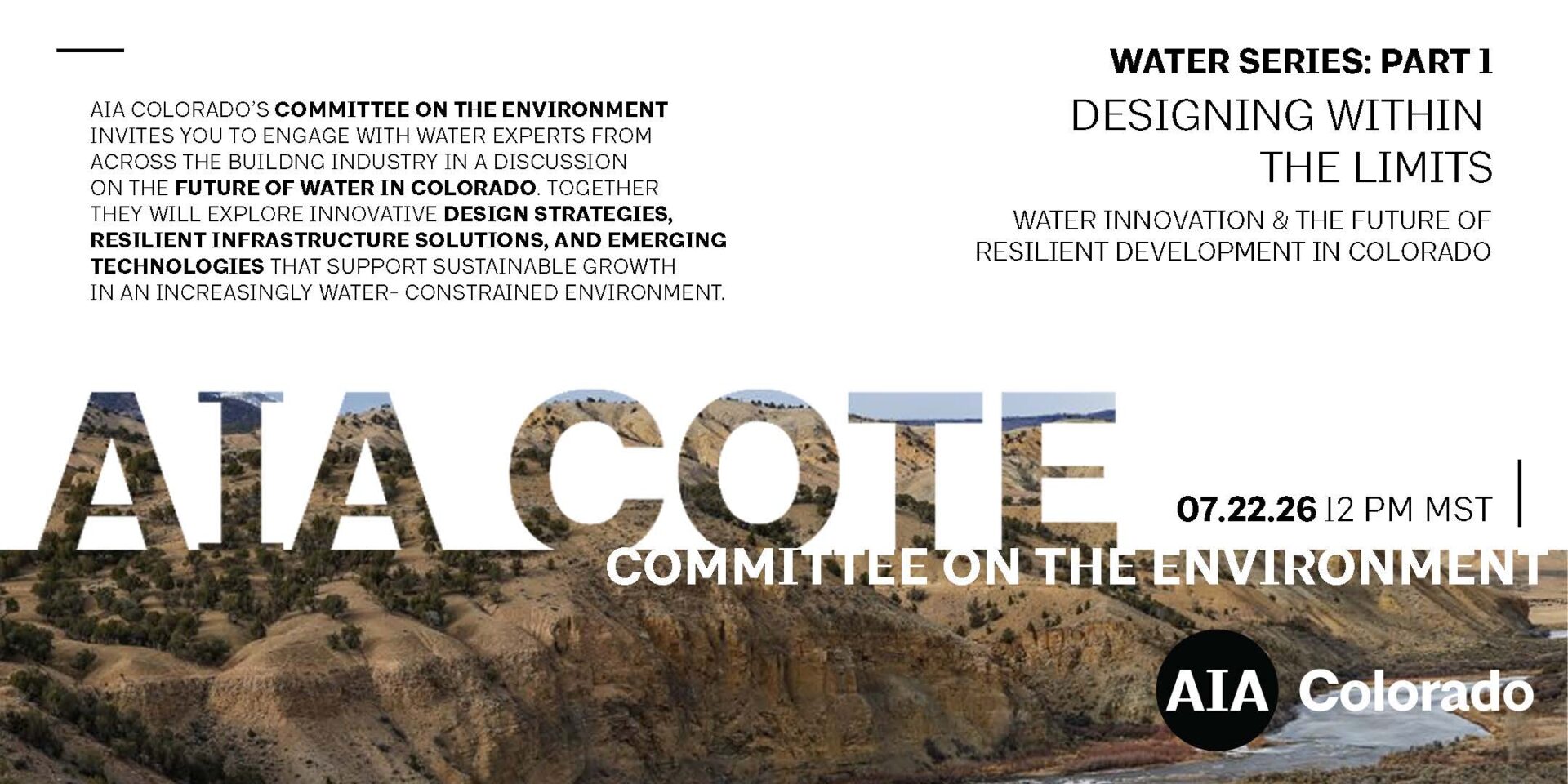
Designing Within the Limits: Water Innovation & the Future of Resilient Development in Colorado
As Colorado faces increasing pressure from prolonged drought, rising temperatures, population growth, and changing water availability, AIA Colorado’s Committee on the Environment (COTE) launched its two-part summer webinar series with a timely discussion exploring the future of water-conscious design.
Created and moderated by committee members Alexis Campion, Assoc. AIA, and Francis Mougne, AIA, the series brings together experts from architecture, engineering, utilities, research, and planning to examine how the design profession can help create more resilient communities.
The online event featured an interdisciplinary panel including Dr. Sybil Sharvelle of Colorado State University, Lauren McNeill of Group14 Engineering, Russ Slade of Denver Water, and Mike Riggs, AIA, of RTA Architects. Together, the panel explored how architects can respond to Colorado’s finite water resources through innovation, collaboration, and long-term planning.
A recurring theme throughout the discussion was that while Colorado’s water challenges are significant, many opportunities already exist within today’s regulatory framework. Panelists emphasized that graywater reuse, rainwater harvesting, on-site treatment systems, and fit-for-purpose water strategies are no longer theoretical concepts, they are practical solutions that can be implemented today on many projects. Several speakers noted that one of the greatest barriers is not policy itself, but a lack of awareness and early coordination among project teams, owners, and local jurisdictions.
The conversation also highlighted the importance of viewing water as a design resource rather than an assumed utility. Panelists encouraged architects to begin conversations about water reuse early in the design process, evaluate building water intensity alongside energy performance, and consider future-proofing projects through strategies such as dual-plumbing systems and infrastructure that can accommodate future water reuse technologies.
Drawing from projects including the National Western Center Hydro Building, the Pikes Peak Summit Complex, and several Living Building Challenge projects across Colorado, speakers shared lessons learned about navigating permitting, water rights, and innovative building systems. While challenges remain, particularly around Colorado’s complex water laws, panelists agreed that demonstration projects are helping build momentum toward broader adoption and future policy improvements.
Russ Slade of Denver Water offered a sobering overview of Colorado’s current drought conditions and the long-term realities of water supply planning. He discussed how climate change, wildfire, declining snowpack, and increasing demand are reshaping water management across the Front Range, emphasizing that conservation, watershed stewardship, and non-potable reuse will become increasingly important components of resilient communities. Denver Water’s investments in forest restoration, recycled water infrastructure, and advanced forecasting technologies illustrate the scale of planning required to secure reliable water supplies decades into the future.
The discussion also explored emerging challenges such as AI data centers, agricultural water use, and the economics of water reuse. Rather than viewing these as isolated issues, panelists encouraged participants to think holistically about circular water systems, watershed health, and designing buildings that can adapt as water becomes an increasingly valuable resource.
Despite the complexity of the challenges ahead, the webinar concluded on an optimistic note. Panelists pointed to Colorado’s culture of innovation, collaborative problem-solving, and growing awareness of water issues as reasons for confidence. As more successful projects demonstrate what is possible, the design community is well positioned to help shape policies, technologies, and buildings that support a more resilient water future.
Sybil Sharvelle One Water & CSU Hydro Building
Dr. Sybil Sharvelle is a Professor in the Department of Civil and Environmental Engineering and is a member of the Environmental Engineering focus area. Her research interests include water reuse (graywater and reclaimed water), integrated urban water management, and waste conversion to energy. Her doctoral work included development of a system for treatment of graywater for potable reuse during space missions. This project led to her current interest in fit-for-purpose water systems, in which she has led projects funded by the Water Research Foundation, USEPA and National Science Foundation. Dr. Sharvelle was a member of the National Research Council Committee for Beneficial Use of Graywater and Stormwater and chaired the NWRI panel for Decentralized Non-Potable Water Systems.
Lauren McNeill Group 14
Lauren McNeill is an Associate Principal with Group14 Engineering – a woman-owned sustainability & energy efficiency consulting firm based in Denver, Colorado. In her 16 years of experience at Group14, Lauren has led over 100 projects in meeting their sustainability goals, including several projects that incorporated creative water reuse: Aspen Distillery, Northglenn City Hall, Yannell Conservation Habitat, and the Hydro Building at National Western Center.
Russel Slade Denver Water
Russ Slade is a Senior Planner at Denver Water with 19 years of experience supporting the utility’s water resources and operations. He spent a decade in the Water Rights group, where he played a key role in adjudicating and defending Denver Water’s water rights. For the past nine years, Russell has been part of the Raw Water Supply team, focusing on the operation and accounting of water rights across Denver Water’s collection system. His work bridges legal, operational, and planning perspectives to help ensure reliable and sustainable water supply management.
Mike Riggs Pikes Peak RTA
Mike Riggs, AIA, LEED BD+C, Principal, has over twenty years’ experience at RTA. Mike has a diverse background while working on a number of K-12, retail, office, and healthcare projects. Mike served as the Project Architect on the Pikes Peak Summit Complex, and he was responsible for the technical execution of the design and construction documents. Mike’s role continued through construction as the lead representative for the design team and he continues in that role through the LEED Certification and Living Building Certification processes, which are still ongoing.
Pursuing Net Zero Water in Colorado: Navigating Water Law, Permitting & Infrastructure Constraints
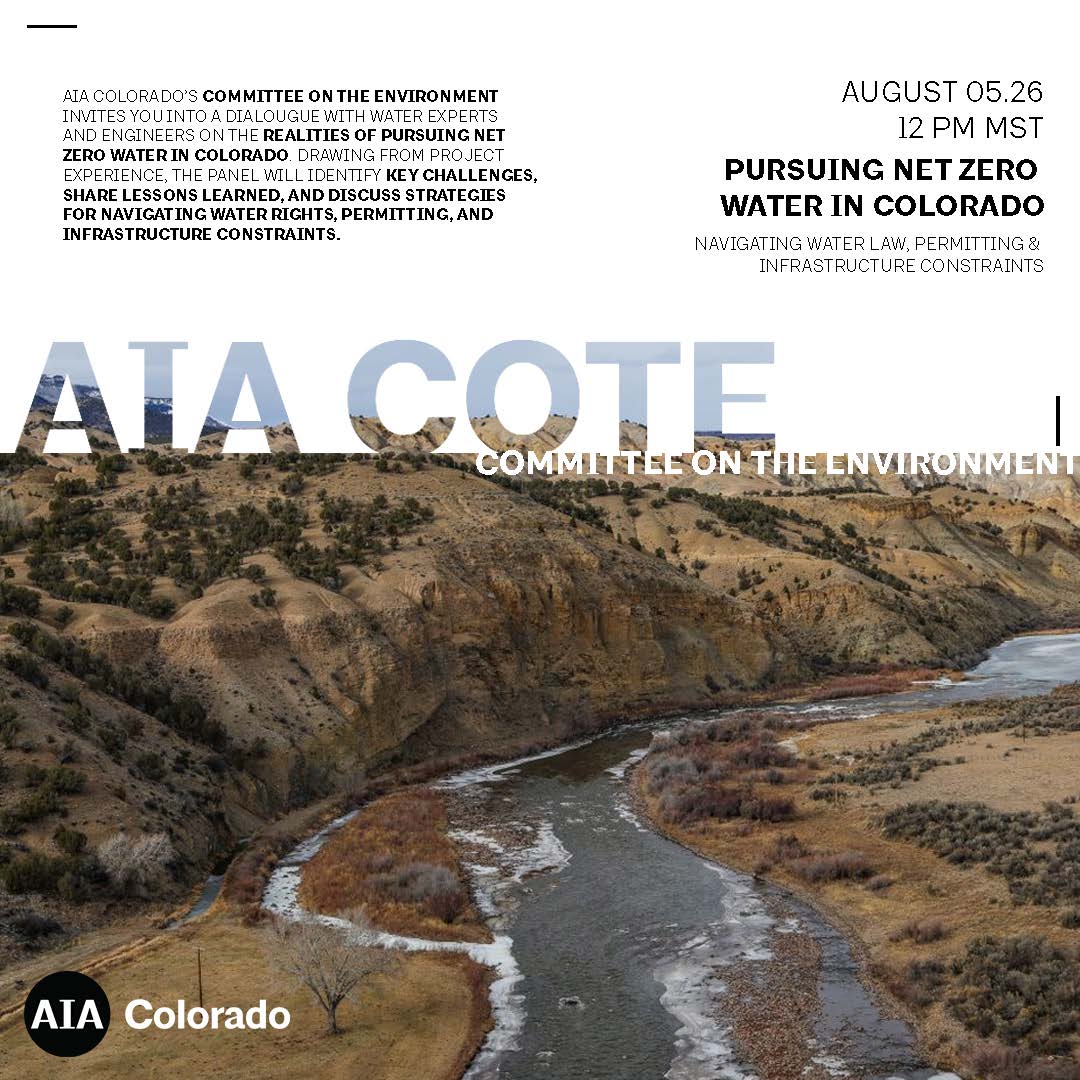
Following a first conversation exploring the future of water-conscious design in Colorado, AIA Colorado’s Committee on the Environment (COTE) continued its two-part summer webinar series by turning to the practical realities of putting those ideas into action.
Created and moderated by committee members Alexis Campion, Assoc. AIA, and Francis Mougne, AIA, Part 2 in the series, Pursuing Net Zero Water in Colorado, brought together experts in water resources, utilities, infrastructure, and engineering to explore how water rights, permitting requirements, infrastructure constraints, and long-term planning shape what is possible—and why architects should begin thinking about water early in the design process.
Committee on the Environment
The Committee on the Environment (COTE®) is a state and national AIA Knowledge Community working for architects, allied professionals, and the public to achieve climate action and climate justice through design. We believe that design excellence is the foundation of a healthy, sustainable, and equitable future. Our work promotes design strategies that empower all AIA members to realize the best social and environmental outcomes with the clients and the communities they serve.
This committee will review AIA’s 2030 Challenge and more to advance AIA Colorado’s imperative of environmental stewardship.