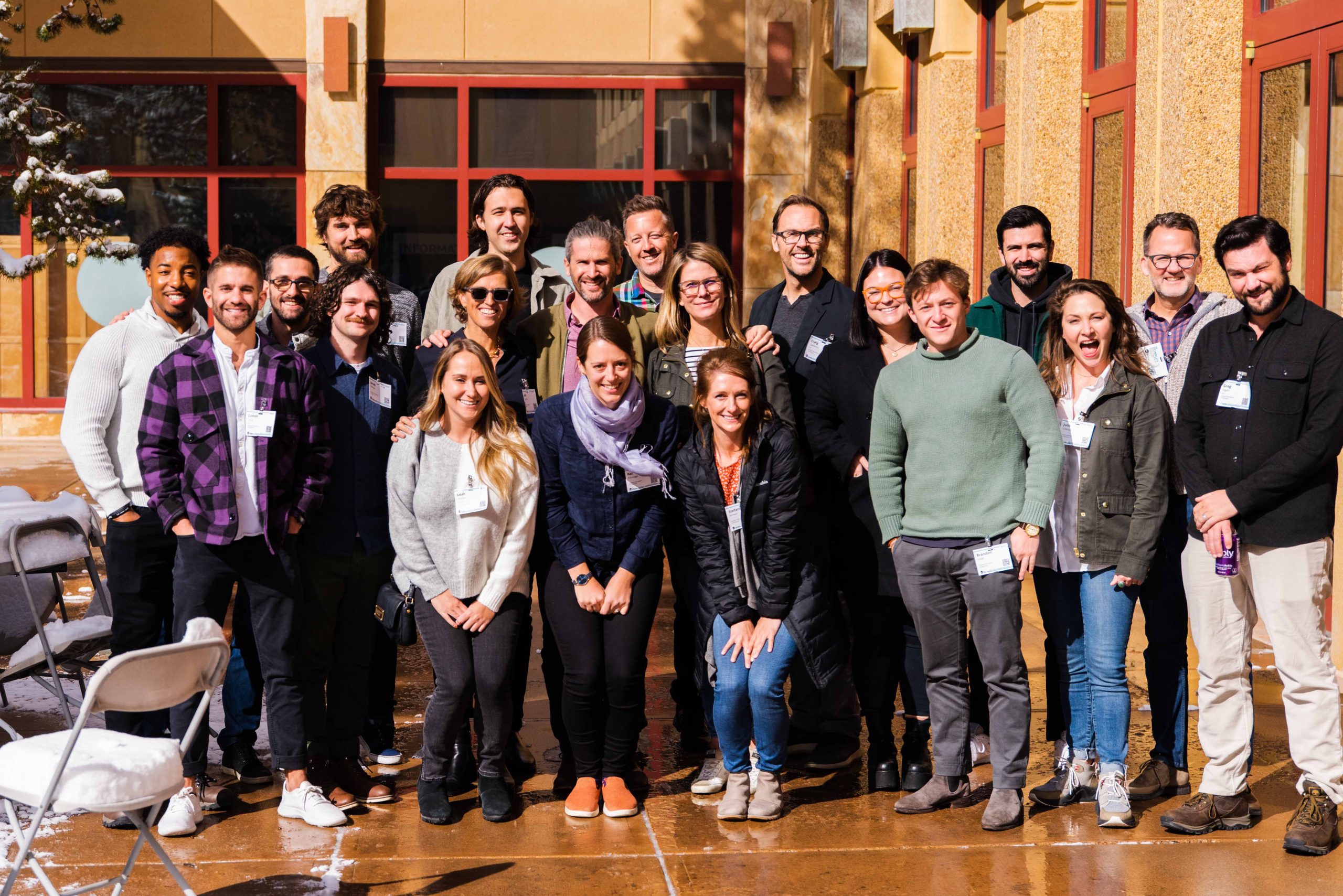
To most, a room full of architects carrying on about climate policy on a cold Monday in January hardly feels like a great evening. It’s hard enough to get a few architects together after work for happy hour, let alone to talk state politics. But the crowd turned out to hear Senator Chris Hansen (District 31) lay out recent policy wins in the fight against the climate crisis and espouse on his vision for how to progress those wins into the future.
Those that are familiar with AIA Colorado’s involvement with the state legislature will be familiar with Senator Hansen. He has met with the Government Affairs Committee and numerous AIA members on a variety of occasions, notably on issues pertaining to embodied carbon in building materials and other bills related to the built environment and changing climate. Senator Hansen has worked hand in hand with AIA Colorado on legislation and consistently seeks input and support from members. In short, the relationship that the architecture community has with Senator Hansen is one that we typically strive for because he gives us a welcoming and informed voice in the state capital.
As Senator Hansen moved through his presentation, he covered some recent policy wins in Colorado, most notably SB21-072 (modernizing the state electric grid) and SB23-016 (statewide greenhouse gas reduction). These were significant steps forward in combatting the climate crisis and were led by Senator Hansen with support from AIA Colorado, among others. As he continued, Senator Hansen covered a broad range of topics, from how Colorado and other western states can work together to create a resilient electric grid based on renewable energy, to strategies that ensure just transitions for communities built around coal plants that are being phased out. He also touched on the need to revise building codes to remove parking minimum mandates in dense areas in which it makes sense and how that can be supported through a more robust and reliable transit network. The room notably perked up at this, as nearly all architects can relate to the struggle to get just a few more parking spots accommodated on a tight deadline.
As the evening came to a close, those in the room were reminded that Senator Hansen is also among the seventeen candidates currently vying to become the next mayor of Denver. And while his past accomplishments, education (from Kansas State to MIT to Oxford), and current work in the state legislature have more than adequately prepared him for the job, it remains an uphill battle with so many candidates involved. Regardless of what happens with the mayoral race and where your personal vote gets cast, it’s hard to not root for someone like Senator Hansen with his firm grasp on complex subjects, ease within a room, and unchecked optimism for the future. However this election turns out, the architecture community will continue to have a robust political ally, whether that ally works from the east or west side of Civic Center Park.
— Drew Allen, AIA, is project architect at AECOM. He serves on the AIA Colorado Editorial Committee, Government Affairs Committee, and is a Denver Local Advisor.
“We have a big year ahead of us that builds on a strong foundation of past success. Members have been clear in showing us what they value most and we have great partners on the staff team. This is a time for optimism and impact!”
– Sarah Broughton, FAIA, President, AIA Colorado
AIA COLORADO NEWS
Welcome, New Volunteers! From Committees to Knowledge Communities and appointed roles, AIA Colorado is proud to welcome almost 100 volunteers from across Colorado who will help advance the architecture profession. Read on to meet the 2023 teams. +MORE
2023 National Council Representatives: We are pleased to introduce the 2023 National Council Representatives:
Strategic Council Representative, Zachary Taylor, AIA
Small Firm Exchange Representative, Emily Renee Adams, AIA
Young Architects Forum Representative, Kaylyn Kirby, AIA
National Associates Committee, Kari Lawson, Assoc. AIA
Meet the class of 2023: Christopher Kelley Leadership Development Program The Christopher Kelley Leadership Development Program (CKLDP) aims to train the next generation of leaders in architecture through a yearlong series of sessions focusing on everything from community leadership to firm management. Congratulations to the 2023 scholars:
Ben Ludeman, Assoc. AIA, 4240 Architecture Yung Hong, AIA, Martin/Martin Pratiksha Achari, Assoc. AIA, AECOM Seth Lehman, AIA, RB+B Architects Kelly Buchanan, AIA, Otak Andriy Grygorenko, AIA, Page Sarah Long, AIA, Treanor H+L Lauren Hiatt, AIA, SLAM Collaborative Lauren Sherman-Boemker, Assoc. AIA, Davis Partnership Architects McKenzie Hengel, AIA, Populous Kierstyn Feldlavy, AIA, SmithGroup Johann Duran-Hunt, AIA, The Beck Group David Allen, Rowland + Broughton Benjamin Champagne, AIA, Craine Architecture Linnaea Stuart, AIA, Arch11 Levi Wall, AIA, Otak
We also wish to recognize and thank the 2023 CKLDP Executive Committee for all their work: Leah Gordon, Assoc. AIA, Chair, Rowland + Broughton Chelsea Wade, AIA, Vice-Chair, Semple Brown Maureen Henderson, AIA, Treasurer, Anderson Mason Dale Jack Reed, AIA, Marketing Director, Page Mark Bever, AIA, Chair-Emeritus, Rowland + Broughton
AIA COLORADO EVENTS
JANUARY 23 Colorado Climate Policy with Senator Chris Hansen Join us for a presentation by state senator and Denver mayoral candidate Chris Hansen on Colorado’s recent efforts to combat climate change.
JANUARY 24 AIA Colorado Conversation Café Join fellow AIA Colorado members for an informal conversation. New Year; New Conversations!
PARTNER NEWS + EVENTS
Denver Landmark Preservation Commission Opening Denver’s Landmark Preservation Commission is seeking a new commissioner to fill an upcoming vacancy this spring. Commissioners shall attend twice-monthly meetings and periodic special meetings to hear and decide requests for:
Alterations, additions, signage, site work, zone lot amendments, and new construction within local historic districts and individual landmark sites
Demolition within historic districts and individual landmark sites
Historic preservation tax credit certification
Individual landmark or historic district
If you’re interested in this position, please review the full list of duties and qualifications, then submit a resume or professional biography to Nikolaus Remus. Nominations will be accepted by AIA Colorado through noon on Tuesday, January 31st. AIA Colorado will send a list of interested members in good standing to Landmark Preservation staff but does not internally evaluate nominations. +MORE
Certified Passive House Designer Course The Passive House Network Certified Passive House Designer course and PHI certification exam for professionals in the Rocky Mountain states of Idaho, Montana, Wyoming, Colorado, and New Mexico begins January 20th. The hybrid format allows students to leverage the benefits of on-demand, live-online, and in-person training. +MORE
NEWS AT NATIONAL
Q&A with AIA’s CEO, President, and President-elect 2023 marks the start of a historic first for AIA – an all-female leadership team. AIA’s CEO/EVP Lakisha Ann Woods, CAE, AIA President Emily Grandstaff-Rice, FAIA, and 2024 President-elect Kimberly Nicole Dowdell, AIA, look to the future of the organization and the profession as they lead AIA’s commitment to building a more equitable and diverse profession and a more sustainable built environment. +MORE
A’23 in San Francisco A’23 – AIA Conference on Architecture is heading to the Bay Area June 7-10, 2023. Save the date! +MORE
Introducing the 2023 Board of Directors We are pleased to usher in the 2023 AIA Colorado Board of Directors, pictured above. The Board of Directors provides stewardship of the nonprofit and is responsible for collaboratively setting the direction of the organization through consensus-driven governance, policy-making, and strategic planning.
This year’s Board will enjoy contributions from several new additions. Please join us as we get to know our newest board members:
Christy Collins is a licensed architect currently working with the City and County of Denver Community Planning and Development team.
Alexander Person is a designer at SmithGroup and current President-Elect of the NOMA Colorado Board.
John Glenn is a Sr. Architect with Davis Partnership with previous experience as the Advocacy Chair for AIA Virginia and Government Affairs Director for AIA Arizona.
Andy Rockmore is a Principal at Shears Adkins Rockmore Architects (SAR+) and has previously Co-Chaired the Practice + Design Conference in 2014 and 2015.
Joey Bahnsen is a licensed architect in Colorado Springs working for RTA Architects and has previously served AIA Colorado as a South Advisor.
2023 CALL FOR APPLICATIONS
ASCEND Mentoring Program The Ascend Program connects emerging architecture professionals with between 1-5 years of professional office experience with mid-career architects who have 10-15 years of experience through mentorship as an intentional first step into the profession. These connections will support emerging professionals in the early stages of their careers, guiding through challenges, setting goals, and developing the skill set to succeed. Ascend groups are organized locally. Mentors and Mentees are invited to apply no later than January 15th. +APPLY
AIA COLORADO EVENTS
JANUARY 13 Happy Hour in Boulder Join fellow AIA Colorado members in Boulder for a social hour and celebration.
JANUARY 13 Happy Hour in Glenwood Springs Join fellow AIA Colorado members in Glenwood Springs for a social hour and celebration.
JANUARY 23 Colorado Climate Policy with Senator Chris Hansen Join us for a presentation by state senator and Denver mayoral candidate Chris Hansen on Colorado’s recent efforts to combat climate change.
JANUARY 24 AIA Colorado Conversation Café Join fellow AIA Colorado members for an informal conversation. New Year; New Conversations!
PARTNER NEWS + EVENTS
Denver Landmark Preservation Commission Opening Denver’s Landmark Preservation Commission is seeking a new commissioner to fill an upcoming vacancy this spring. Commissioners shall attend twice-monthly meetings and periodic special meetings to hear and decide requests for:
Alterations, additions, signage, site work, zone lot amendments, and new construction within local historic districts and individual landmark sites
Demolition within historic districts and individual landmark sites
Historic preservation tax credit certification
Individual landmark or historic district
If you’re interested in this position, please review the full list of duties and qualifications, then submit a resume or professional biography to Nikolaus Remus. Nominations will be accepted by AIA Colorado through noon on Tuesday, January 31st. AIA Colorado will send a list of interested members in good standing to Landmark Preservation staff but does not internally evaluate nominations. +MORE
America ByDesign: Architecture, A Six-Part Series On CBS This is a series you will not want to miss, especially Episode 4, which was filmed at AIA National in Washington, D.C., where AIA Board leadership had the honor of sharing the insight and inspiration of AIA members and the impact you have on society. All architects highlighted in the shows are AIA members. +VIEW SERIES
A’23 in San Francisco A’23 – AIA Conference on Architecture is heading to the Bay Area June 7-10, 2023. Save the date! +MORE
Not all of us could attend the 2022 Practice + Design Conference at Keynote, but thankfully a few AIA Colorado members are able to give us a glimpse into what it was like to attend three of the keynote presentations.
Keynote: “Catalyzing Connection: How Architecture Can Combat Loneliness,” Erin Peavey AIA
We’re Back! What a great feeling it is to engage with other Architecture professionals in one place! This is something that has been lacking the past few years and I’m sure I don’t need to tell you how hard these past few years have been. The Covid-19 pandemic has changed so much in our lives and has taken an extreme toll on all of us. None of us will get through this unchanged.
That’s why I was drawn to Erin’s presentation and was excited to hear what Erin Peavey had to say on the topic of loneliness. Erin has been featured in numerous notable publications, including Psychology Today, and she also hosts her own podcast “Shared Space” where she explores how our lives shape and are shaped by the designs around us.
One of the key take-aways from her talk was that “Design is never neutral; It either supports health or hinders it”. Those are powerful words to keep in mind when sitting down in front of your computer screen every day. We must remember that Architects are public health workers.
Studies show that ½ of all Americans feel lonely. While there’s a difference between social isolation (measured by actual number of contacts with others) and loneliness (a subjective feeling of being alone) proof exists that both are extremely bad for your health. Loneliness has become a national epidemic. The good news is that we can combat this with social connection, which reduces death by 50%…ahem… in person conferences!
We dove into a few interactive case studies that allowed us to review what works best at “Third Places”, or informal public settings such as your local coffee shop, city parks, street blocks, etc. We were asked to grade these based on accessibility, activation, choice, nature, human scale, and sense of place. Using these criteria, it was easy to understand what works for spaces around us and why other open spaces may fail at becoming activated.
Much of what we learned over the past few years is that we are social creatures and whether we are introverted or extroverted we all need human connection. It’s important for us, as Architects, to remember that our spaces must keep those who will be utilizing the space in mind. Additionally, we need to keep fully inclusive designs in mind.
We all come from different sizes, abilities, cultures, and desires and our designs should always incorporate these aspects. Erin’s presentation was a timely reminder that as we emerge from this pandemic, we still, cautiously sometimes, crave human connection. The spaces we design should encourage more honest and sincere human connection.
Caitlin Witte, AIA, NCARB
AIA Colorado J.E.D.I. Co-Chair
Project Architect, Hord Coplan Macht
Keynote: “Testing Biophilic Design,” Kelley Tapia AIA, Samskara Studio
Prior to the Conference, I was unaware of the work by keynote speaker Kelley Tapia, from Samskara Studio. Her approach and discussion about getting back to nature and imagining a brighter world for the future was inspiring and allowed for opportunities to get to know one another in our two different breakout discussions.
I was able to meet my neighbor and understand their “Why” for the importance of sustainability and in turn they recognized my “Why.” If you haven’t watched Annie Leonard’s video “Story of Stuff” it will give you a “Why” if you do not have one.
In our second break-out session we were put into groups of 5, to discuss our “Why” and to recognize the patterns amongst us. We were challenged to come up with a way for our group to change our routine in a way that will help sustain our world for a brighter future and assist the group’s “Why.” In doing so, we realized that you must give something else up to achieve this. For instance, if you bike to work, you need adjust your schedule. If you take the bus, you need to get up earlier. If you go to a farmer’s market over the conventional grocery store, you give up convenience, but in doing so you provide opportunities for small businesses, for locally sourced and in season produce, and less waste from overly packaged products.
I left thinking of the possibilities and the opportunity for regenerative design and the inspiration of working together, learning from the resilience of nature. I now have 5 additional reasons for my “Why” and learned that what was important to one of us, had commonalties between all of us.
Amanda Gonzales
Job Captain, Neenan Archistruction
Keynote: “The Architecture of Healthy Communities,” Katie Swenson, MASS Design Group
I am familiar with MASS Design Group’s work and general design approach from some years ago when I was in school but am not familiar with the speaker directly or any of their recent work. It was great to get reacquainted with their work and their message and I was quite surprised to see them on the schedule for the conference. Have always loved the way they approach design, generating design solutions from a very moral ground, aimed at directly aiding humanity through design.
Katie spoke about acting as a Community Architect. Referencing her books “Design with Love: At Home in America” and “In Bohemia: A Memoir of Love, Loss, and Kindness”, she focused on the power of shelter and the great comfort and healing that can come from having a home, having one’s own space for the people and the things that they love and cherish, as well as having a space that can protect and comfort us when we grieve.
Elaborating, she discussed how developers, municipalities, and architects typically approach Affordable Housing projects and how a subtle change in our definition of these projects, calling them “homes” instead of “housing”, can make a huge impact on the trajectory of the project. Not making the switch could be considered “the first step toward inequity”. It’s such a simple move to make that can really alter the direction of the project.
She implored us to think of other similar moves that are easy to make, ones that would help us start from a far more just and equitable place for all with minimal effort, knowing that these distinctions are much harder to insert retroactively on most projects.
I really appreciated her comment toward architecture as a whole (and I may be paraphrasing slightly), “It always hurts, or it helps. Architecture is never neutral.” This was quite a strong statement for me, and I will definitely be reminding myself of this in my own work.
She also suggested that “Design is fundamentally optimistic,” reminding us that we entered the profession for similar reasons: to do good. I am currently working on an affordable housing project, so all of this resonated quite strongly. We all want to do the most amount of good. There are often limitations and constraints that prevent us from doing this, which can be frustrating, but some good is still better than no good. Her statements were strong and resonated as a call to action for architects to “do better”. Not a bad way to start the first session of the day at 8AM! I was motivated and inspired for the rest of the day. It was a great session.
The need for architects was also discussed. Talking a bit about why are we necessary when a developer or builder can come along and create nearly similar work, likely for less cost. Possibly compounding that argument, architecture can often be viewed as a currency for the affluent. It can easily create more divide and injustice if we are not careful about how we design and how we uphold and project our design when we speak of it.
She then reminded us of our “fundamental optimism”, to remember the good that we can do, our potential, and how architecture and design can also so easily heal if wielded appropriately. She concluded with the affirmation that “we are needed, but we need to be better.” As most of our work is produced for affluent clientele, this hit close to home for me.
Zach Wilson, AIA, LFA
CCY Architects
Keynote: Inspired Design Keynote, Christopher McAnneny AIA, Heatherwick Studio
We were given a deep dive into the human-driven design of Google Bay View. One repeated theme for project success was collaboration. “The concept we developed, we couldn’t have done by ourselves”. Within the project, they had to collaborate with the solar roof tile manufacturer to create a new product specific to their needs. In the field, they utilized the contracting team to help develop innovative solutions for issues that arose during construction. And within the plan, they provided different experiences for different types of collaboration.
For the design, there was already a language in the area of long span structures and it became clear that is what the client needed. A canopy to house human scale, while bringing nature up to and into the building. By harnessing water runoff, they were able to create new natural habitat areas within the site. The building is a 100% fresh air system with geothermal used for the cooling loads.
The plan breaks the program down to house teams or a collection of teams on staggered plates that create different zones and keep connections to views of nature. Within the floorplan, different moments are designed to provide interest, intimacy and warmth. Human scale is achieved using different materials to denote different program elements of the building, and materials have two or three purposes to their selections.
The dust has settled on the 2022 elections and we’d like to let our members know what to expect as we look ahead to the 2023 legislative session here in Colorado.
Races for all four statewide offices (Governor, Secretary of State, Attorney General, and Treasurer) always occur during presidential midterm elections. This year all four Democratic incumbents got re-elected by margins ranging from 10 to 19 points over their opponents. Of these offices, the Governor’s race is by far the most impactful to architects though. Governor Polis is a strong proponent for combatting climate change and for reducing carbon emissions in particular. Not only does Governor Polis have his own legislative agenda, state agencies that matter to us (such our DORA regulatory board, the Colorado Energy Office, and the Office of the State Architect) are executive branch agencies and their work is influenced as well. We’ve seen the Colorado Energy Office gain new responsibilities related to building energy use and will continue to look for opportunities to work together on new legislation and implementation of laws passed in recent years.
This has been a tricky year for predictions with new legislative districts across the state based on the 2020 census. This was also the first time in Colorado that districts were created by non-partisan commissions with specific fairness and competitiveness criteria. Compared to previous decades, there was a much bigger change in district borders and incumbents found themselves with sizable numbers of new constituents. Finally, issues that have historically been tied to the federal government also impacted voter decisions in local races more than in most elections but was difficult to quantify before the votes were counted.
All 65 House seats are up on the ballot every two years and Democrats had a sizable 41-24 majority coming into the elections. This was anticipated to shrink somewhat but instead grew to a 46-19 supermajority in the chamber. Over in the senate, 17 of 35 seats were on the ballot. Democrats started with a 20-15 majority, but Republicans believed that the new districts gave them a real chance at regaining control. However, Democrats won every competitive race and with former Republican Kevin Priola changing parties in August, they now have a 23-12 advantage.
ARCpac and ARCsdc made contributions to 18 total candidates this year, splitting checks between 13 Democrats and 5 Republicans whose expertise and values align with the architecture profession. Candidates we supported won in 14 of these races and we’re well-positioned to build new and strengthen existing relationships.
There was a solid blue wave in Colorado this year, but what does it mean? In the last two years, AIA Colorado has seen a significant increase in climate and carbon bills that align with our sustainability imperative. We’ll continue to partner with legislators on these bills to ensure they understand how architects work and how we can realize shared goals successfully. We will remain vigilant for bills that unfairly increase risk and liability for architects in contracts and construction defect lawsuits that are more likely to get introduced by Democrats. Affordable housing is another topic that we expect to see more of and look forward to opportunities to share our expertise in tackling this difficult subject. We’re setting the stage for a successful architecture licensing bill that we know will be introduced in the 2024 session.
Finally, just like in every election, there will be a lot of new faces in the general assembly in 2023. If you know your state representative or senator, we’d love to hear from you! Personal connections with constituents are one of the most effective ways we can make our voices heard and AIA Colorado can’t do it without help from our members.
— AIA Colorado Advocacy Engagement Director Nikolaus Remus and AIA Colorado lobbyist Jerry Johnson
What happens when you ask the same question to five designers with five different backgrounds? You get five very different answers that will put you in someone else’s shoes. From firm principals to emerging professionals, we’re diving in to better understand—and share—others’ personal perspectives. This is the fifth and final installment of the monthly series—“One Question”—produced by our Justice, Equity, Diversity, and Inclusion (J.E.D.I.) Committee.
In partnership with the Colorado Chapter of the National Organization of Minority Architects, we invite you to see through the lenses of five different practitioners to learn how their unique backgrounds shape experiences in the firm and their approaches to design.
QUESTION NO. 5 Give us an example of how your current or previous workplace has prioritized equity and inclusion in the firm’s culture and/or projects.
Patricia Joseph, AIA, NOMA Associate Project Architect at The Abo Group President-Elect of NOMA Colorado Lecturer, CU Denver College of Architecture & Planning
“There has been a humbling and hopeful shift within architectural firms in our community. We have been included in that shift toward making J.E.D.I. a priority. With the death of George Floyd and the constraints of a pandemic, issues concerning J.E.D.I. could no longer be ignored. We found ourselves in a twilight zone that allowed it to become a priority, many firms and organizations created safe spaces for BIPOC individuals and their allies through various forms of J.E.D.I. committees. We were finally given space to collect and voice our thoughts but not enough power to enact change.
We have not seen enough examples of J.E.D.I. prioritized through projects yet. Yes, project teams are becoming diversified or winning projects through diverse hires. But where are the stories of the project team matching the diversity of their client or the project community? We should be providing architectural services that consider equitable solutions for the client and the project community. Few examples exist, especially when compared to how much we prioritize sustainability, accessibility, or energy conservation over equity and inclusion.
We have committees, employee resources groups, and many POC being promoted to diversity chair roles, white little at the high-level has changed. POC, especially black people, are not seeing the fruits of having J.E.D.I. committees in place or being promoted to higher levels of leadership. Firms should continue to have these support groups not only as a resource to employees, but as a catalyst for leaders to enact change. Without this level of prioritization, we will continue to have the uneasy feeling that the hype around J.E.D.I. is fading.”
Sarah Broughton, FAIA AIA Colorado President-Elect Principal, Rowland+Broughton
“Our firm is committed to equity and inclusion in our culture and career development. We understand that each team member is unique and has varying access to resources and privileges. By providing fair opportunities for all team members based on their individual needs, we foster an environment where people can bring their whole selves to the work, have open collaboration, transparency and understanding. Part of my leadership role is working with the individual and the team to identify where more support may be needed to help each team member feel comfortable, confident, and safe. I believe that this approach to our culture results in better design, impactful projects and more fun!
At the core of equity and inclusion at R+B is operating with transparency. First, we conduct semi-annual wellness surveys and share the results with our team. We openly invite team members to participate in firm committees, including J.E.D.I. and Sustainability Committees. Through both surveys and committees, we elicit feedback from the entire team and make recommended changes. Part of our transparency is demystifying the profession and supporting each team member through a workforce education program. This includes weekly “lunch and learns” for professional growth, a professional development program, and robust mentorship program. The AIA Colorado Practice and Design Conference is back in person this year and we are excited to invite and sponsor all 40 of our team members to participate. Lastly, by making our role descriptions accessible to all, both on our server and on our website, it encourages team members to discuss and create goals for career advancements and leadership positions, reviewed semi-annually.
Everyone on our team contributes and makes us whole. Our firm’s diverse cross-level representation is important to our success. Our team is 46% female and 50% of our executive team is female. We believe in elevating from within and all promotions are listed internally first before being posted. Wage equity is prioritized and is achieved through pay equity analysis, strategic salary banding for fair hiring practices and merit increases and listing salaries on job postings. Benefits are inclusive and accessible to all team members, including family health insurance and spousal health for all types of couples. Two years ago, through the recommendation of our J.E.D.I. Committee, we implemented a floating holiday to celebrate diverse holidays.
I am proud that our firm’s commitment to equity and inclusion was recognized with the Just Label in 2022. We have done a lot in our 19 years of firm life to create a supportive culture and continue to listen, learn and grow each year. I am humbled by our team and everyone’s deep care for each other and willingness to openly participate. We work hard and play hard together!”
Kari Lawson, Assoc. AIA AIA Colorado Associate Director Designer, TreanorHL
“The biggest cultural change for equity and inclusion at my workplace was the formulation of a J.E.D.I. committee in the wake of the 2020 social justice movement. I witnessed a shift in focus to align with projects and clients that prioritize equity, diversity, and inclusion. There was also more emphasis in partnering with diverse and minority consultants. Before 2020 there were boilerplate statements referencing the fair employment act as a standard for DEI. Any company can claim allyship in this way by simply following the law. Allyship can be empathetic and passive while an agent brings the action. In these 2 years since, I’ve observed a movement away from allyship and towards agency by making a commitment to uphold equitable and unbiased practices.
An institution or company’s commitment to DEI is not outlined purely in a policy, statement, or action plan. It’s repacking the values of empathy, representation, and support. Measuring diversity and inclusion is complex and nonlinear; actions speak louder than metrics. It takes building critical consciousness by seeking to diversify multicultural perspective and analysis. A successful tool was creating a connection point that increased the avenues for voices to be heard. Our internal forum provided a means to instigate dialog via sharing tips, educational books/podcasts, and strategies. There is an emphasis on connecting the links between big societal problems in everyday actions. Our group added Juneteenth as an official work holiday to align with a holistic view brought on by the impact of the social justice movement. In some way we’ve created a catalog to identify plans to take real action, as well as nurture and execute reform through opportunities for everyone involved to get educated.
There is a huge importance of learning from educators; DEI is no exception in this regard. The program takes budget, executive buy-in, and integration at all levels. We’ve consistently invited DEI consultants and specialists to educate our group in wholesome narratives. This speaks to an investment in training/coaching and developing cultural competence. There’s also championing of pay equity, advancement opportunities, and occasions to find diverse candidates through networking and actively recruiting at HBCUs. I’m fortunate to have a CEO that values and supports people doing the work of these initiatives.
Prioritizing equity and inclusion takes a range of traits, experiences, and backgrounds at different levels. It’s more than diverse leadership and filling a quota. We ignore embodied experiences and we miss important somatic and qualitative data when we quantify diversity by metrics only. Awakening a collective feeling where different voices are valued, accepted and supported cultivates a sense of belonging and pride in the work culture.”
Victor Gonzalez, Assoc. AIA, NOMA AIA Colorado J.E.D.I. Committee Member + Editorial Representative Davis Partnership Architects
“In what I have seen, some firms have developed better frameworks than others on how to think critically when it comes to engaging equity and inclusion in the firm’s culture. I think one of the better ways of incorporating this type of work has been through establishing internal J.E.D.I. committees. This demonstrates a firm’s acknowledgment of inequality throughout the profession and their action to possibly do something about it. One of the major things a committee like this can provide is their retention rates in regards to BIPOC folk and how they set up those individuals towards licensure. This is the tiniest of seeds that need to be planted throughout all firms that truly want to see their culture shift towards a more inclusive one.
As J.E.D.I. committees become successful internally within firms, I believe that If we truly want to see a shift and change in the diversity of this profession there needs to be a standard set for everyone to follow and a sense of accountability. In doing so these internal J.E.D.I. committees established throughout firms can host a series of goals and report back their efforts to entities like AIA and NOMA. This would not only benefit the profession as a whole, but also the world around us by becoming more inclusive, sustainable, accessible, and equitable. We can’t let the movement that the summer of 2020 created fade, there needs to be a constant refueling and calibration of what we are trying to accomplish.”
Wells Squier, AIA AIA Colorado President Principal, Anderson Hallas Architects
“I believe wholeheartedly that our work as architects is strengthened by the diversity, experiences, differing backgrounds and values of those with whom we work and collaborate. I also believe the uniqueness of individuals with whom we work directly influences a firm’s culture and quality of design. Regarding our firm, which is and has historically been a woman owned small business, we believe that we can achieve better design and project outcomes for our clients by facilitating open design discussions that are fully inclusive of all staff. We regularly hold firm-wide design dialogues and specific project charrette meetings, as well as design critiques, welcoming any and all input from the collective team. It is from these discussions that some of our most successful project design concepts and outcomes have emerged. I believe strongly that this approach has also directly contributed to enhancing our firm’s culture, specifically because of the diversity, differing perspectives and personal points of view that each of our team members bring to our firm and these discussions. Another important result of this approach is increased trust and respect among those on our team, resulting in prioritized equity and inclusion by all.
Our firm focuses almost exclusively on projects in the public sector, and those projects that aim to provide services and experiences which enhance the communities they serve. We immensely value and embrace the opportunities these projects provide to engage directly with community members and clients of all backgrounds, as so much of our work includes broader community outreach. Through these opportunities and the interactions that they provide, we collectively feel as though we are contributing to a greater good. This ultimately feeds our collective passion as a firm, respect for one another and defines our firm’s culture.”
We invite you to read or revisit previous questions in this series:
We’d like to extend our sincere gratitude to our One Question participants for their vulnerability and humility. This series will culminate in a live panel discussion reflecting on this project at the AIA Colorado Practice + Design Conference, November 2-4, 2022, in Keystone.
The Architects of Colorado Political Committee (ARCpac) and Architects of Colorado Small Donor Committee (ARCsdc) empower architects to play an active role in the election process. Through these efforts, AIA Colorado members can collectively donate to candidates who fight for issues on behalf of architects. In 2022, we supported 17 state legislative candidates that align with our values and support the architecture profession.
Policies and issues at the state capitol that affect architects don’t neatly align with political party platforms and in Colorado, a strong majority of bills that do pass have bipartisan support. We proudly support candidates on both sides of the aisle and across the states. Here are this year’s contribution recipients:
ARCsdc Legislative Champions
2022 Legislative Champions are our strongest allies running for reelection and through ARCSdc receive larger contributions:
Rep. Tracey Bernett (D), HD-12 (Louisville)
Rep. Shannon Bird (D), HD-35 (Westminster)
Rep. Cathy Kipp (D), HD-52 (Fort Collins)
Senator Kevin Van Winkle (R), SD-30 (Highlands Ranch)
ARCpac Contribution Recipients
Recipients of ARCpac checks can be legislators who we’ve successfully worked with or first-time candidates who have a strong alignment with our advocacy agenda:
Katie March (D), HD-06 (Denver)
Marc Snyder (D), HD-18 (Colorado Springs)
Monica Duran (D), HD-23 (Wheat Ridge)
William Lindstedt (D), HD-33 (Broomfield)
Jenny Willford (D), HD-34, (Northglenn)
Naquetta Ricks (D), HD-40 (Aurora)
Rep. Kurt Huffman (R), HD-43 (Highlands Ranch)
Julie Amabile (D), HD-49 (Boulder)
Mike Lynch (R), HD-65 (Wellington)
Rob Woodward (R), SD-15 (Loveland)
Tim Walsh (R), SD-20 (Golden)
Rep. Kyle Mullica (D), SD-24 (Thornton)
Robert Rodriguez (D), SD-32 (Denver)
If you have any questions about any of these races, please contact Advocacy Engagement Director Nikolaus Remus, AIA
What happens when you ask the same question to five designers with five different backgrounds? You get five very different answers that will put you in someone else’s shoes. From firm principals to emerging professionals, we’re diving in to better understand—and share—others’ personal perspectives. This is the fourth installment of the monthly series—“One Question”—produced by our Justice, Equity, Diversity, and Inclusion (J.E.D.I.) Committee.
In partnership with the Colorado Chapter of the National Organization of Minority Architects, we invite you to see through the lenses of five different practitioners to learn how their unique backgrounds shape experiences in the firm and their approaches to design.
QUESTION NO. 4 Recall a moment when you witnessed unjust behavior. How did you act then and how might you act differently today?
Wells Squier, AIA AIA Colorado President Principal, Anderson Hallas Architects
“I only recall a few instances early in my career of witnessing unjust behavior. Since then, I have been fortunate with regard to the character and integrity of those whom I work with most closely and feel the injustices witnessed years ago were actions of long-standing stereotypes throughout the history of our profession that we are actively working to break down today. These examples relate mostly to internal corporate power struggles but also perceptions of gender bias.
In retrospect, it is frustrating that there was not the awareness that there is today with regard to J.E.D.I. initiatives, and that those in the positions with the power to implement positive change did not recognize or prioritize this need. I have learned to express my concerns about this realization much more strongly, but at the time it wasn’t something that was as clearly in focus as it is today (at least for me personally as someone just starting my own career following graduation). Fortunately, my more recent professional experiences have included much greater diversity and equality. This, along with our collective introspection as a profession as it relates to justice within the workplace, has heightened my (and hopefully our collective) awareness, where I am now significantly more conditioned to consciously look for any instances of inequity or inappropriateness, not just within the workplace but also as it relates to prospective clients or broader team members with whom we may collaborate.”
Patricia Joseph, AIA, NOMA Project Designer at Cuningham President-Elect of NOMA Colorado Lecturer, CU Denver College of Architecture & Planning
“If you were to ask me this question when I started my career in Architecture I wouldn’t be able to jump into conversation about a specific experience. At that time, I had enough emotional intelligence to be uncomfortable or upset, but not enough to identify the injustice itself. Fast forward to today and I can pinpoint several injustices that I have experienced, and I can recall the various ways I had to address them. Understanding what unjust behavior is and being able to identify it can feel similar to subconscious bias. However hard it may be to see, it is very real for the receiving person.
Most recently, the leadership within NOMA Colorado have heard far too many stories of unjust behavior from our emerging professionals and recent graduates. In response to these reports we have been able to engage in raw, straightforward communication with those responsible to address the behaviors directly. While we are addressing the unjust behavior, we are also thinking ahead, thinking about prevention. NOMA Colorado truly cares about making our organizations a safe and empowering place for our local professionals. We will not ignore the stories we hear from our members. We’re standing our ground and will not promote firms that disregard injustices within their communities.
We all have come a long way in terms of witnessing injustices and being able to do something about it. However, there is more work to be done, the era of complacency is gone, and we all have the responsibility to react appropriately. It’s 2022, if “you see something, you say something”.”
Sarah Broughton, FAIA AIA Colorado President-Elect Principal, Rowland+Broughton
“My circle of influence has been crystallizing and I continue to understand my voice and advocate within our profession for a better tomorrow. As a firm leader, along with my partners, we are laser focused on running an equitable firm based on just practices. We are a proponent of the Equal Pay For Equal Work Act mandating visibility with pay and opportunities. Our firm lists salaries with all job postings and provides strategic and equitable compensation amongst the team positions. Equal pay for equal work is paramount and is our backbone, creating balance and equity. We internally and externally post all promotional opportunities available within the firm and the transparency has resulted in talented yet unexpected team members rising to the top. I am vocal about our policies with other leaders and have witnessed their organizations making a change to be a more just workplace.
Valuing our work with clients is a just behavior we continue to defend. Over the last nineteen years, we have been asked multiple times in RFPs and interviews to perform services for reduced fees or for free. This is unjust and when agreed to erodes the equity for our team and our profession. Agreeing to undervalue our work results in unsustainable internal work demands to make up for the unbilled time.
Recently, we were asked to participate in a RFP for an exciting project we had been following for months. Part of the request included presenting design ideas at the interview. This is old behavior that must change. In our response of regret, we took advantage of the opportunity to educate the client about why it is an unjust policy and a disservice to the profession to ask for free work. We used our voice to speak up and make change. Our response gave a message to our team and to our client that together we can shape a different future.
Professional and personally, I try to always recognize and correct my own biases or unjust behavior. Our workplace has evolved, and my behavior also has. For example, I used to rely on nearby teammates to help with unexpected requests. This action does not give equal opportunity to the entire team and I am now purposeful about reaching out to someone I don’t “see” often and engage them to work together. I encourage the entire team to acknowledge and respect each others’ skills and strive to give equal opportunities to members at every level. I hope to foster a culture of openness and opportunity, where there is no room for unjust actions.”
Kari Lawson, Assoc. AIA AIA Colorado Associate Director Designer, TreanorHL
“Injustice may be seen in all aspects of our society, and it is ingrained in our attitudes toward diversity and inclusion. These intersections form the fabric of our work/life dynamic, while in the background is a culture that fosters complicity in sustaining the status quo. As a BIPOC living and working in the United States, I’ve witnessed injustice in various forms, involving philosophy and/or overt prejudice. The safest approach was often to endure it or leave, but dealing with these difficulties in real time necessitates personal honesty and accountability, gained by experience.
Microaggressions are an interwoven part of our society. Unfortunately, implicit bias and stereotypes are commonplace when speaking from a position of comfort. “You’re articulate for a black person,” “You’re the exception because xyz,” or even a comment about my hair texture are examples of slights in conversations. This type of comfort makes it convenient to invalidate and refuse to acknowledge experiences. The emotional labor frequently falls on the marginalized group, so through introspection, I’ve learnt to pick my battles. There is an unsettling feeling of self-doubt when unpacking those comments. Is it because of my age/race/gender or is it because I’m not excelling at my tasks? How do I react in a way that doesn’t play into stereotypes? Changing people’s mind is not a sustainable objective but continuing a genuine narrative about accountability can be.
It’s ordinary to witness abuse of authority. It’s especially disheartening when there’s a sense of comfort in maintaining oblique narratives that establish a false sense of impartiality. In the year 2020, it became unacceptable to remain silent in the face of rampant police brutality. After 2020, many organizations recognized the value of forming a diversity committee and addressing injustice. In some cases, rather than encouraging actual progress, there was a diminishing value placed on authentic experiences, which undermined those initiatives. It’s promoting a “not all cops” mindset and refusing to support or engage with Black Lives Matter. From Emmett Teal to George Floyd, there has always been time for dialogue, but today there are true consequences for not participating in the effort to change.
There is no escape from the spectrum of racism; so, I emphasize the value of seeking places where differences are embraced and appreciated. I want to be associated with those who have the ability and desire to stand publicly against injustice. I recognize that my identity politics puts me on the front lines of navigating these events, but with every experience comes growth for the future.”
Victor Gonzalez, Assoc. AIA, NOMA AIA Colorado J.E.D.I. Committee Member + Editorial Representative Davis Partnership Architects
“One of the unfortunate experiences I have witnessed was when some fellow students were hosting an exhibition on anti-racist spaces. Two professors who were not attached to the project caught my attention as they purposefully went into the exhibit space with an agenda. Their agenda was not to “debate” the content, but rather try to “disprove” the student’s methodology and overall work.
It was clear that the professors showed up to the exhibit without taking any time to read through the content and reflect upon the work that was displayed. Instead, they immediately jumped to the students and demanded they explain their work. It was obvious that these professors did not want to take the time to actually think through or try to understand the exhibition. The professors would jump in and out of the conversation, playing devil’s advocate.
Reflecting on this situation, I’m disappointed that I did not intervene and start asking the professors questions about the exhibit itself. I believe doing so would not only have helped them start thinking about the work, but also probably help them realize that their approach towards the students was not correct. Looking at this incident from an even bigger picture it is clear that there was an unconscious bias towards the students of color as they were approached by two white professors. Since then, I have lived with the regret of not doing anything and often think of the result had I intervened. I learned from this experience and now I abide by the motto: “doing something is better than doing nothing”.”
We invite you to read or revisit previous questions in this series:
We’d like to extend our sincere gratitude to our One Question participants for their vulnerability and humility. Next month is our live panel discussion reflecting on this project at the AIA Colorado Practice + Design Conference, November 2-4, 2022, in Keystone.
Whether you like politics or not, it deeply affects our profession. On Thursday, August 18th, as part of “Building Denver: Visions of the Capital City” exhibition event series, History Colorado Museum hosted a rare (apparently only second ever) discussion with the most recent majors of Denver: Federico Peña (1983–1991), Wellington Webb (1991–2003), Senator John Hickenlooper (2003-2011), and Mayor Michael Hancock (2011–present).
Framed by “A Great City”, the last exhibition section, it depicts the changes starting during the 1980s, and highlights the commencement of major reforms steered by former Mayor Peña. Peña, whose prime vision was for historic preservation, also encouraged citizen participation, raising expectations and starting a new era of involvement. Although the city we’re living in is the result of public policies made long ago, the past thirty-nine years witnessed the combination of decisions that made Denver the thriving city it is today.
The conference, with these four personalities on stage, couldn’t happen in a better environment. In the History Colorado Museum atrium, a diverse audience was excited to listen to past and present leaders. Their differences and commonalities never set them apart. Mr. Peña became the first Hispanic mayor of Denver at 36 years old, defeating the old establishment. His tenure inspired Mr. Webb, the first African American mayor of Denver, to make his unlikely door-to-door campaign successful. Senator Hickenlooper called himself the only white of the team, yet brought the perspective of a small business owner with a vision to support a highly entrepreneurial city. Finally Mayor Hancock, a former Peña’s intern, city council member, and a public servant since young age, highlighted how equity and justice along with strategic leadership has been a key element of his and past tenures. They all questioned the city we’re currently building, and pointed out the need to protect its people and keep its neighborhoods diverse.
The camaraderie exhibited during the conversation displayed how building upon previous policies was the formula of success. After thirty-nine years of deliberate transformation, will a new era begin? What will be our role both as citizens and architects?
When you are invited to drive up to Grand Lake on a late summer Friday, it’s hard to say no. In mid-August, I was fortunate enough to tag along on the AIA Colorado board retreat and water conservancy tour organized by Scott Munn, director of AIA Colorado West. Scott grew up spending his summers at a family cabin on the historic Grand Lake, and now calls the nearby community of Granby home, where he splits his time between his award-winning residential architectural practice and the many outdoor activities and attractions available for residents and visitors to Grand County.
Retreat attendees were President Wells Squier, President-Elect Sarah Broughton, Associate Director Kari Lawson, Denver Director Julianne Scherer, North Director Scott Rodwin and AIA Colorado CEO Mike Waldinger. The purpose of the tour was to learn more about the critical importance of water management and conservancy in Colorado. Although 80% of the Colorado population resides on the eastern side of the continental divide, 80% of our state’s water is collected on the western side. The result of this imbalance is decades of impressive engineering projects that have worked to divert water to Front Range cities.
(left to right) Scott Rodwin, Mike Waldinger, and Sarah Broughton learn about Colorado’s waterways at The Headwaters Center
We began the day with a private tour of the Headwaters Center in Winter Park. Opened to the public in 2019, the Headwaters Center is a 21,000 sq ft multipurpose building with event space and an innovative museum that aims to educate visitors on the history, wildlife, and conservation efforts of the Colorado river network. Clad in stunning reclaimed barn wood on a stone plinth, the building’s rustic exterior anchors the building to the natural beauty of its site on the banks of the Fraser River. It is designed to be completely off the grid, running off solar energy (stored in over 300 car batteries!) and natural gas backup generators. The Headwaters Center can host public or private events in its outdoor amphitheater, private terrace overlooking the Rocky Mountains, or the 4,400 sq ft “Barn,” a spacious banquet hall that showcases the same reclaimed barn wood as the exterior of the building.
After a quick peek at the event spaces, we gathered in the lowest level of the Headwaters Center to begin our private tour of the “River Journey.” The interactive exhibit, designed by ECOS Communications in Boulder, introduces visitors to the history and ecology of Colorado waterways, with an emphasis on the local Fraser River, a tributary of the Colorado river. The exhibit emphasizes the importance of conservation and careful management of water in Colorado through captivating exhibits and video-based games that will engage any learner, young or old. My personal favorite was a trout survival video game, where visitors are tasked with helping a trout survive the dangerous trip upstream by navigating around various obstacles and dangers. (It was harder than it looked.) Throughout the tour, I was impressed with how the exhibit balanced moments of levity with moments of thoughtful reflection. The tour ended with a visit to the “Think Tank,” a meditative space in a full-scale water tank, centered around a pool of water that is continuously refilled by a slow drip of water from above. Scraps of droplet shaped paper cover the walls, filled with handwritten reflections and musings from visitors to the museum.
After the museum, our group drove to Grand Lake, the historic headwaters of the Colorado River and the largest and deepest natural lake in Colorado. As a result of the Colorado-Big Thompson Project, Grand Lake is now a part of the West Slope Collection System, which provides the Front Range with most of its water. Under natural conditions, water from Grand Lake would flow west to the nearby Shadow Mountain Reservoir and then south to Lake Granby Reservoir. When water is needed on the Front Range, the Farr Pumping Plant, an impressive brutalist structure on the shores of Lake Granby that extends nearly 140 feet underground, reverses the flow so that water is pumped east out of Grand Lake through the Alva B. Adams tunnel, which runs underneath Rocky Mountain National Park.
The town of Grand Lake is primarily a summer community which retains a sense of nostalgic charm. The public access waterfront and marina were bustling with tourists and annual summer residents on the day we visited. During lunch, Scott educated us on the fascinating history of the Grand Lake Yacht Club, which claims to be the highest elevation yacht club in the world. It is also the custodian of a prestigious Lipton Cup, awarded annually during regatta week, that was donated by the flamboyant sportsman Sir Thomas Lipton in 1912 after the club’s founders took him out for drinks in Denver and greatly exaggerated the scale of their little yacht club. (They had a membership of four when they incorporated in 1902 and raced in rowboats with homemade sails.) By 1912 membership had increased enough to warrant the need for a clubhouse. The modest bark-clad structure was completed in 1913 and still stands today.
After lunch, it was finally time to get out on the water. With Scott as our captain and guide, our water conservancy tour culminated in a pontoon ride on Grand Lake. As we circled the beautiful alpine lake, Scott pointed out significant structures among the many beautiful homes that line the shores. The homes range from carefully preserved fisherman’s cabins from the early 20th century to mansions built by some of the most prominent families in the US. New structures on the lake are subject to strict zoning regulations to protect the integrity of the waterfront.
Many thanks to Scott for organizing this event. AIA Colorado board members were able to spend an afternoon learning about a critical Colorado resource and experience a part of the state that many had never had a chance to visit. If you are ever lucky enough to make it up to Grand County on a beautiful Friday afternoon (or any day of the week), make sure to take a moment to appreciate how this historic headwaters provide life and industry to so many across the site.
This website uses cookies to improve your experience. We\'ll assume you\'re ok with this, but you can opt-out if you wish.
Read More
Cookies are small text files that can be used by websites to make a user\'s experience more efficient. The law states that we can store cookies on your device if they are strictly necessary for the operation of this site. For all other types of cookies we need your permission. This site uses different types of cookies. Some cookies are placed by third party services that appear on our pages.
Necessary cookies help make a website usable by enabling basic functions like page navigation and access to secure areas of the website. The website cannot function properly without these cookies.
Marketing cookies are used to track visitors across websites. The intention is to display ads that are relevant and engaging for the individual user and thereby more valuable for publishers and third party advertisers.
Preference cookies enable a website to remember information that changes the way the website behaves or looks, like your preferred language or the region that you are in.