
Fall 2026 • Signature Updates
2026
Practice + Design Conference
Share Your Expertise
The 2026 Practice + Design Conference Call for Presentations submission window closes this Friday!
This year’s theme, The Work of Tomorrow, explores how architects embrace uncertainty with optimism, shaping the future through innovative ideas, evolving practices, and forward-thinking design.
Share your expertise and shape the profession. Presenting at the Practice + Design Conference is an opportunity to share the lessons, ideas, and innovations you’ve gained through practice while helping fellow architects navigate the challenges and opportunities ahead. Selected presenters will also receive a featured recap article shared with AIA Colorado’s membership and imagery for future use, extending the impact of your session well beyond the conference.
Submit your presentation by Friday, July 31, 2026, at Noon, here.
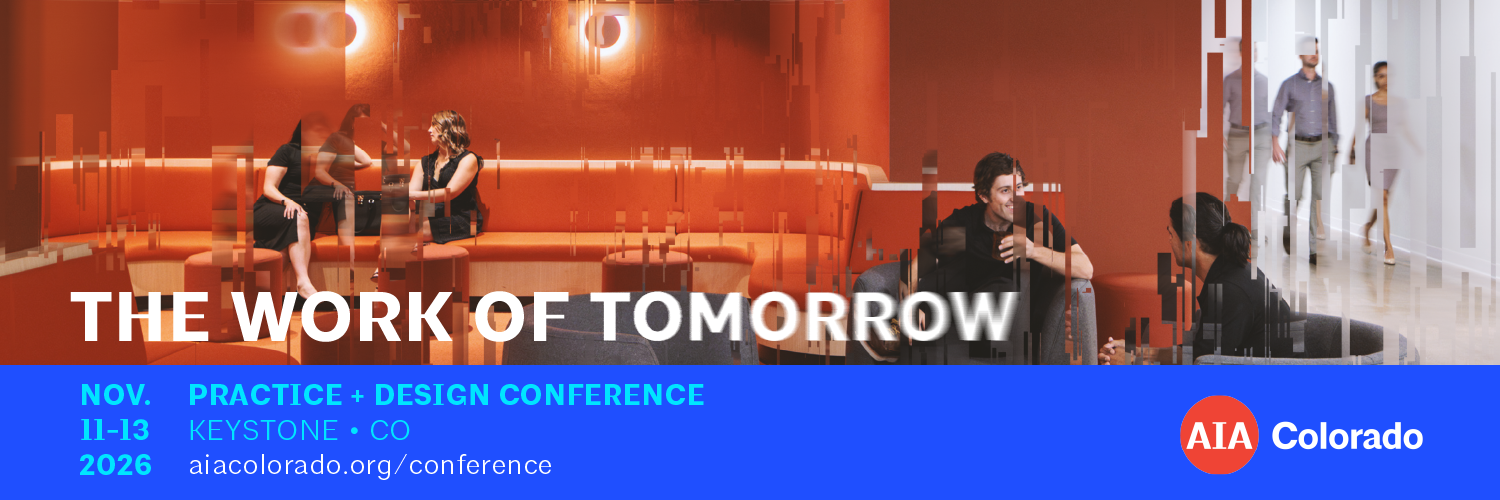
Early Conference Registration Now Open
Early Registration is now open for the 2026 Practice + Design Conference, The Work of Tomorrow, taking place November 11–13 in Keystone.
We’re thrilled to welcome this year’s keynote speakers:
- John Ronan, FAIA
- Stephen Kieran, FAIA
- Robert Ivy, FAIA
- Florian Idenburg, Intl. Assoc. AIA and Jing Liu, AIA
- Angela Brooks, FAIA and Larry Scarpa, FAIA
The conference schedule will continue to grow in the coming weeks, so check back often as new sessions are announced.
Planning to attend or exhibit? Conference pricing is now available, Expo Hall booths are open, sponsorship opportunities await your brand, and the conference hotel room block is accepting reservations. We encourage you to book early as the discounted room block has sold out in previous years.
Practice + Design Conference info and updates can always be found at aiacolorado.org/conference. Reserve your conference registration, at Early Registration prices, here.
Wednesday’s session
New this year is The State of the State of Colorado, a Wednesday kickoff session included with conference registration, starting at 3pm and followed by a happy hour.
Featuring experts in economics, demographics, resilience, and public policy, this timely program offers a data-driven look at the trends influencing Colorado’s built environment and the future of architectural practice.
Learn more about this session and the presenters here.
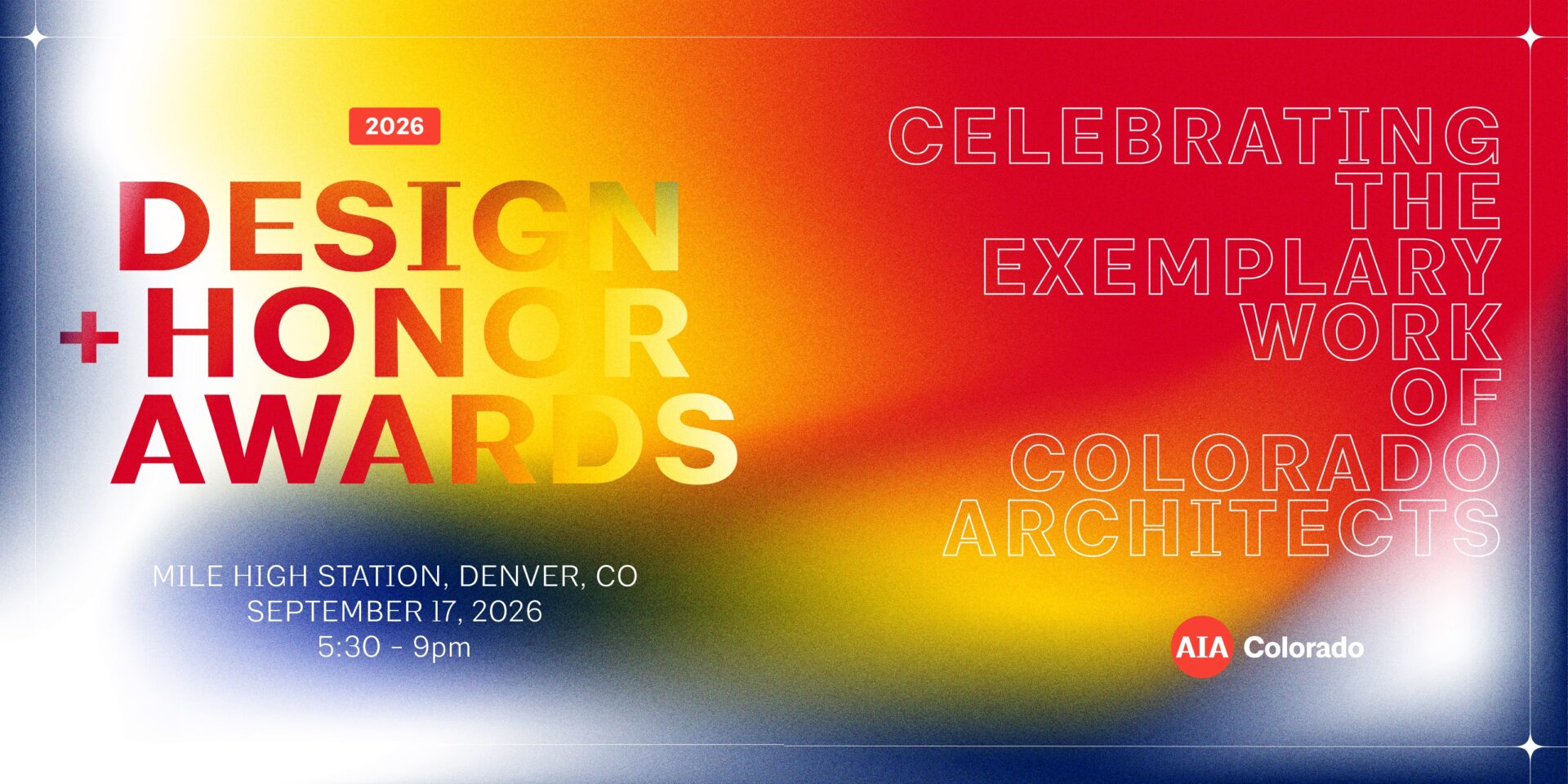
AIA Colorado Design + Honor Awards Celebration
More than an awards ceremony, this is a celebration of Colorado’s architecture community and the people, ideas, and partnerships that continue to shape the built environment across our state.
Thursday, September 17, starting at 5:30pm, join colleagues, clients, collaborators, emerging professionals, and industry partners for an unforgettable evening at Mile High Station as we recognize the recipients of the 2026 Design + Honor Awards while celebrating the collective creativity, leadership, and impact of the architectural profession.
Enjoy craft curated cocktails, an exceptional culinary experience, and a live performance by Extreme Strings, creating an energetic backdrop for reconnecting with old friends, making new connections, and celebrating together.
Grow your impact by sponsoring the event. More info available here.
Tickets include catered cuisine and your first two craft beverages. We look forward to celebrating with you!
Keynote: Hank Koning, FAIA, Julie Eizenberg, FAIA

Keynote: Friday, November 14, 2025, 2:45pm, Keystone Conference Center
Superpowers
At the AIA Colorado Practice + Design Conference, Hank Koning, FAIA, and Julie Eizenberg, FAIA, presented the keynote “Superpowers,” showcasing how architecture can address societal challenges through innovative design.
They discussed their work on the University of Melbourne’s Student Pavilion, a centerpiece of the student precinct competition designed to combat social isolation and improve mental health. Located near a tram stop, the pavilion incorporates adaptive reuse strategies, precast concrete, and sustainable features like LEED Platinum dining commons. Its design fosters community and inclusion, offering informal spaces for activities like knitting circles and Vietnamese cooking clubs, as well as a summer house-inspired rooftop space for gatherings. The pavilion’s unique design includes a porcupine railing system for safety and ornamentation, and its nickname, “The Pav,” reflects its popularity among students.
KoningEizenberg | Amp Media
KoningEizenberg | Amp Media
The speakers also explored project-based learning environments in the Santa Monica Malibu Unified School District, emphasizing inquiry-based, interdisciplinary collaboration. Their designs integrate net zero building principles, wildfire-resistant landscaping, and flexible spaces that adapt to changing educational needs. They highlighted the importance of connecting students to the natural environment, such as the ocean and mountains, while ensuring accessibility and resilience. Features like skateboard and surfboard racks further enhance the connection between students and their surroundings.
Affordable housing was another focus, including their collaboration with the Little Tokyo Service Center on a mixed-use development at Metro Plaza in East Hollywood. This LEED Gold-certified project combines permanent supportive housing with community spaces, retail, and transit access, addressing the needs of one of LA’s densest neighborhoods. They also reflected on their early work with the Community Corporation of Santa Monica, which preserved affordable housing and supported low-income families. Their designs incorporate features like accessory dwelling units (ADUs), sliding screens for privacy, and messy urbanism concepts to enhance livability.
Koning and Eizenberg emphasized the importance of challenging formulaic approaches, engaging communities, and advocating for quality of life in design. Their projects demonstrate how architecture can empower communities and improve lives through thoughtful, innovative solutions. By leading with quality of life, challenging outdated codes, and embracing experimentation, they showcased how architects can wield their “superpowers” to create enduring, impactful spaces.
KoningEizenberg | Amp Media
KoningEizenberg | Amp Media
Key
Takeaways
Embrace Modest Materials for Maximum Impact
Creative use of inexpensive materials like pegboard can provide both functional and aesthetic value, supporting the idea that houses should be places where people make things together and create meaningful experiences.
I am in love with pegboard. Have been for a long time… I think of a house as a place where you do things, you make things together, you hang out together, you make a mess together. There’s something that has a lot of power in it, in the use of it.
Reject Uniformity in Favor of Cultural Diversity
Question why campus and housing developments maintain uniform character when user populations are diverse. Design should reflect and celebrate the variety of people who will inhabit the spaces.
Everyone was curious on our team is why campus buildings had such a uniform character when the student body was so diverse. And that was sort of a starting point.
Project-Based Learning Requires Flexible, Connected Spaces
Modern educational architecture must support inquiry-based, student-directed, interdisciplinary collaborative work by moving away from siloed traditional classrooms to distributed, interconnected learning environments.
Traditional schools are siloed. Distributed organization is a feature for interdisciplinary work together. And we develop these four sets, one or two on each level that facilitate that kind of learning.
Build Trust Through Deep Community Engagement
Creating inclusive spaces requires developing trust, offering ease, and ensuring fit between place and people through community engagement at the front end, middle, and end of projects, along with social and physical resonance.
We learned early on that to make places where outsiders feel welcome, we needed to develop trust, offer a sense of ease and deal with fit relative to place and people… it means community engagement at the front end, in the middle and at the end, certainly it means social and physical resonance.
Sustainability in Fire-Prone Areas Demands Creative Solutions
In wildfire zones, architects must innovate beyond traditional approaches, using PV panels for shade where trees can’t be planted and designing with fire-resistant materials while maintaining user comfort and functionality.
In Southern California, if you have an outdoor area and you don’t have shade, you failed. It won’t be used… Very limited tree selection you can have in the wildfire area. So what we’re doing is the PV is providing the shade that we couldn’t use a tree to achieve.
Design Strategies for Equity: Choice, Discovery, and Transparency
Effective inclusive design employs specific architectural strategies including choice (personal empowerment), discovery, activity, and transparency. These elements should be consciously integrated rather than used instinctively.
It’s about choice, a very important aspect of personal empowerment, discovery activity, transparency… It’s the things that we all use without sometimes thinking about why we’re using it. But we’ve become much more conscious about it.
Turn Code Constraints into Design Opportunities
Rather than seeing building codes as limitations, architects can use prescriptive requirements as creative starting points, transforming regulatory constraints into distinctive design solutions.
Sometimes you get stymied by the code. And sometimes the code is like this fantastic opportunity. So we start this project… We drew this diagram and there it is. And we said, wow, that’s kind of an interesting shape… Looks like a barn. That’s good. Look, let’s go with it.
Break Housing Density Formulas with Cross-Grain Thinking
Challenge conventional ‘donut’ building models by orienting structures to capture natural breezes, create longer views, and provide more corner windows, improving both environmental performance and resident experience.
We shifted that model to what we call a cross grain model. We get beautiful breezes from the ocean. And the Donut model doesn’t allow the breezes through. It doesn’t allow the breezes into the courtyard. So we turned it around, said, we want these breezes.
Participate in Policy Change Through Board Service
Architects can drive systemic change by serving on planning commissions and boards where policy is made, directly influencing the regulatory environment that shapes design possibilities.
Sit on boards and commissions. That’s where you change policy. Advocate for design quality not just for more housing or for more this or more that. Because good housing without the design quality is not enduring.
Lead with Quality of Life in Every Design Decision
Quality of life must be the primary driver from the beginning of any project, not an add-on consideration. This foundational approach shapes all subsequent design decisions and ensures meaningful outcomes for users.
So we think you need three powers superpowers for better design outcomes always lead with quality of life. It doesn’t preclude you from meeting all the other things but if you add it on after you can’t do it.
KoningEizenberg | Amp Media
KoningEizenberg | Amp Media

Keynote: Thursday, November 13, 2025, 9am, Keystone Conference Center
Slowing Down
Michelle Delk, a landscape architect and partner at Snøhetta, delivered the keynote session “Slowing Down” at the AIA Colorado Practice + Design Conference, sharing her journey and the firm’s innovative approach to design. Delk, also a Professor of Practice at the University of Pennsylvania, reflected on her upbringing in rural Iowa, which instilled a deep appreciation for the land and shaped her career. Snøhetta, founded in 1989, operates across four continents and is known for its interdisciplinary collaboration, blending architecture, landscape, and cultural narratives. Their first major project, the Alexandria Library in Egypt, set the tone for their work, emphasizing the relationship between landscapes and buildings.
Delk highlighted the importance of cultural landscapes, shaped by indigenous histories, and infrastructure’s role in connecting and dividing spaces. Her early career at Civitas in Denver and observations from Vancouver Island informed her perspective on designing dynamic and flexible environments. Snøhetta’s projects often adapt overlooked spaces, such as the Calgary Library’s land bridge, which reconnects divided city areas, and the Willamette Falls River Walk, which restores public access to a historic site. The firm’s transformation of Ford’s Dearborn campus introduced biodiverse parks and sustainable mobility solutions, while Gotham Park revitalized forgotten areas near the Brooklyn Bridge.
Michelle Delk | Amp Media
Michelle Delk | Amp Media
Recent projects include the Jostle Art Museum expansion, which reoriented visitor access and created immersive gardens, and the Blanton Museum in Austin, where canopy structures provide shade, collect stormwater, and unify the campus. At 550 Madison, Snøhetta redesigned public spaces, adding inviting outdoor rooms, reclaimed materials, and high-quality public restrooms. Temporary installations, like the Guggenheim Ramp 6 garden walk and Venice Biennale teeter-totter, demonstrate Snohetta’s ability to shift perceptions with minimal interventions.
Delk concluded with the Theodore Roosevelt Presidential Library in North Dakota’s Badlands, a project that integrates sustainable design and ecological restoration. The library’s design reflects the geological uniqueness of the Badlands, with rammed earth walls, a grassland roof, and a boardwalk that immerses visitors in the prairie ecosystem. Sustainability goals include net-positive energy and water, achieved through geothermal wells, solar arrays, and low-carbon concrete. Initiatives like the Native Plant Project and adaptive grazing techniques involve community members in restoring the prairie. Delk emphasized the importance of slowing down to appreciate landscapes and create spaces that inspire connection, joy, and environmental stewardship.
Michelle Delk | Amp Media
Michelle Delk | Amp Media
Key
Takeaways
Design for Slowing Down
In our fast-paced digital world where people lose concentration after eight seconds, design has the power to invite people to slow down and truly experience places. This approach can help people connect more deeply with their environment.
So much of what I’ve talked about so far is about calling attention to how we can design with what is already in place around us… this article in Time magazine about how people generally lose concentration after eight seconds… I want to talk a little bit more about how design can invite people to slow down.
Balancing Seriousness with Joy
Design can address serious environmental and social challenges while still creating joyful, playful experiences. The combination of serious purpose with joyful interaction creates stronger communities and more resilient responses to challenges.
So we invited people to be serious. We asked them to consider the impact that we each have on the world around us. But we also asked them to be joyful and to interact and be playful because we really don’t need to sacrifice one for the other. We recognize that sharing joy brings us together, and that leaves a web that’s much stronger when pushed to a challenge.
Site Planning as Creative Foundation
Site planning deserves recognition as one of the most creative moments in design work. It’s the phase where designers first imagine how to build relationships between buildings, landscapes, and contexts, yet it often doesn’t receive the credit it deserves.
Site planning is one of the most creative moments in the work that we do. It’s when we first start imagining how we can build these relationships.
Buildings and Landscapes as Dance Partners
Rather than blurring the distinction between buildings and landscapes, successful design explores the relationship between them. Like dance partners, they work better together, with neither necessarily taking the lead but both contributing to a unified experience.
I don’t really think anyone wants blurry vision… our work is not necessarily about erasing a distinction between buildings and landscapes, but really about exploring a relationship. And I think of this in a way as dance partners where there may not even necessarily be a lead, but we’re better together.
Interdisciplinary Collaboration from Day One
Snøhetta’s foundational approach involves architects and landscape architects working together from the very beginning of projects, not as separate disciplines brought together later. This collaborative methodology starts with developing shared ideas that drive the thinking together at the starting point.
Maybe what’s key is that we start from the very beginning of the project. So this, this is a foundational approach where we develop the ideas that drive the thinking together at that, at that starting point.
Regenerative Land Management as Design
Land management should be considered integral to design, not separate from it. The Theodore Roosevelt Library project demonstrates how ecological restoration, native plant propagation, and adaptive grazing become part of the ongoing library experience and conservation education.
Together with our ecologist Res, we were advocating for land managed to be seen as part of design, that this would be integral to the regeneration of the prairie and creating a healthy landscape.
Adaptation Over Erasure
Rather than acting as agents of erasure, designers should work as editors who carefully preserve, repurpose, and minimally add to existing contexts. This approach can reveal overlooked landscapes and develop climate-resilient, equitable solutions.
So I think of us as designers, in this case acting as editors. We really looked at the forgotten or the overlooked, and we were very careful about what we removed. We repurposed as much as we could, and we very minimally added elements to stitch this together.
Landscape as Library
Natural landscapes can serve as repositories of knowledge and history. The Theodore Roosevelt Library concept treats the Badlands as a library where each geological layer represents a chapter, demonstrating how the landscape itself becomes the primary educational experience.
We started to think about the Badlands itself as a library and that each layer is a chapter in a book… the third idea is that the landscape is the library. That the main building is one of many moments within the larger experience.
Transforming Perception
Small, temporary interventions can significantly shift how people experience and perceive spaces. Simple installations using traditional landscape design elements like framing views and playing with light can create transformational moments without permanent changes.
So we proposed that we could just use very traditional elements of landscape design and think about framing views, layering textures, playing with light and shadow to temporarily alter how people move as they wander through the museum and reach this upper level.
Good Ideas Come from Anyone
Effective design processes involve clients, community members, and experts from the beginning, with every person at the table actively contributing regardless of their design discipline or role. This inclusive approach opens up design thinking beyond traditional boundaries.
We often talk about good ideas can come from anyone. It doesn’t matter what your experience or your background is. And I think this is one way that we can work together to dissolve some of these perceived boundaries between design disciplines and open up design thinking.
Keynote: Mark Bacon, AIA

Keynote: Thursday, November 14, 2025, 9am, Keystone Conference Center
The Generous Middle: Amplifying Equity in Unexpected Places
Mark Bacon, AIA, delivered a compelling keynote session, “The Generous Middle: Amplifying Equity in Unexpected Places,” at the AIA Colorado Practice + Design Conference, showcasing how architecture can amplify equity and dignity in overlooked regions like Nebraska. Often dismissed as “flyover states,” the Midwest’s vast landscapes, hay bales, and endless horizons inspire empathetic, restrained design rooted in connection and care. Nebraska’s slogan, “It’s not for everyone,” humorously reflects its understated appeal, which Bacon argued holds immense potential for meaningful architecture.
Mark Bacon, AIA | Amp Media
Mark Bacon, AIA | Amp Media
Bacon illustrated this philosophy through several projects. The Niobrara Valley Preserve visitor center, located 16 miles from the nearest paved road, blends into its environment with COR-TEN louvers that subtly move in the wind and charred cedar cladding harvested on-site. He shared the story of Bumper the bison, whose resilience mirrors the spirit of the region. Sandy Creek Public School reimagines traditional classrooms as flexible, activity-based environments inspired by modern workplaces, fostering partnerships with local industries like agriculture and healthcare.
The Columbus Community Building serves as a civic hub, combining a library, city hall, and children’s museum under one roof. Its “front porch” design invites interaction, embodying generosity through shared space. Similarly, the Chadron student housing project uses simple materials and thoughtful design to create a sense of belonging for students on the edge of campus, with glowing gable ends serving as beacons of security.
Bacon also discussed the adaptive reuse of Lincoln’s Central Library, transforming a concrete mall into an extroverted civic space with mass timber construction, rooftop terraces, and a pavilion for community events. The Museum of Nebraska Art (MONA) in Kearney, a 2025 AIA Colorado Design Award of Excellence project, bridges past and present, incorporating mass timber and local materials to honor the state’s agrarian heritage. Its redesigned sculpture garden and ceiling geometry, inspired by migrating sandhill cranes, reflect the interplay between permanence and transformation.
Throughout the session, Bacon emphasized listening deeply to communities, designing with empathy, and elevating the familiar into the profound. He celebrated the latent energy of the “generous middle,” where architecture amplifies equity and dignity in unexpected places, leaving behind enduring spaces that connect people and elevate their expectations.
Mark Bacon, AIA | Amp Media
Mark Bacon, AIA | Amp Media
Key
Takeaways
Restraint as Aesthetic and Ethical Practice
Architectural restraint should be viewed not as limitation but as empathy made visible, where careful editing and material choices demonstrate care for community and context rather than designer ego.
Restraint as care. So in a world obsessed with more and more and more and more try to edit, edit, edit, and making sure that restraint isn’t seen as absence, but more empathy made visible. And that quiet clarity which makes our work endure.
Equity as Everyday Design Practice
True equity in architecture comes through consistent daily practice rather than slogans, ensuring every community deserves to be listened to and receives design that lasts and elevates their dignity and pride.
So really, equity as everyday design, not necessarily as a slogan, but as practice, something we continue to refine and do and do over and over again. So the generous middle reminds us that every community we design in deserves to be listened to, to make sure that it lasts and to make sure that it lifts right, brings their expectations up, their pride.
The Generous Middle as Design Philosophy
The ‘generous middle’ represents both a geographic and philosophical approach to architecture that values presence over spectacle, emphasizing empathy, care, and craft rather than attention-seeking design.
So this is what we call the generous middle, an invitation to experience the unexpected, a way of practicing architecture rooted in empathy. And here, architecture isn’t about spectacle, it’s about presence.
Listening Over Authorship in Design Process
Successful architecture begins with deep listening rather than immediate design solutions, prioritizing understanding of place, people, and stories before sketching the first idea.
And listening over authorship, trying to begin every project not by sketching the first idea that comes to our mind, but listening first, connecting the people to the place and the stories beneath the surface. And we think that’s when the best design happens.
Adaptive Reuse as Community Transformation
Transforming existing buildings from introverted to extroverted spaces can revitalize civic life, as demonstrated by converting a closed mall into an active library that engages with street life and community needs.
And our idea was to take an opaque building, not participating in any sort of civic life, and open it up to the street level and connect you to the rooftop and really turning the buildings inside out, making it go from an introverted to an extroverted building.
Connection Over Isolation in Architectural Planning
Rather than creating perfect isolated objects, architecture should focus on relationships and connections between people, programs, and communities to become an extension of the community itself.
And that idea of connection over isolation. So not trying to create perfect objects, but more about the relationship and the connection between them, between people, programs and communities. And when we design for that connection, we think that our architecture becomes an extension of those communities.
Subverting Low Expectations Creates Opportunity
When expectations are low due to location or context, architects have greater freedom to exceed expectations and create meaningful impact by elevating both client and community aspirations.
People expect little from the middle. And when expectations are low, that’s when our possibilities increase, because these are moments when we have to lift our own expectations, because we may not be having high expectations placed on us.
Making the Invisible Visible in Museum Design
Breaking traditional museum hierarchies by making typically hidden spaces like art storage and preparation areas visible to visitors creates new opportunities for engagement and education about curatorial processes.
But we were actually able to invert that logic and make what is typically invisible visible. And those art prep spaces, the art storage, because like most museums, they have way more in the collection than they can actually exhibit. But this becomes a moment where you can actually see their collection and see how they’re curating the next show.
Flexible Learning Environments Replace Traditional Classrooms
Modern educational architecture should mirror contemporary workplaces rather than conventional classrooms, using movable furniture and open collaboration studios that allow students to define their own learning environments.
This cutting edge technology blends the flexible environments to create an atmosphere closer to a modern design studio rather than a traditional classroom… none of the class, most of the classrooms were not defined by four walls and a door.
Place-Based Material Selection Builds Authenticity
Using local materials creates emotional connections beyond mere aesthetics, with choices like on-site harvested cedar or colors matching local wildflowers demonstrating deep respect for place and context.
There’s local, familiar materials that. Not just about the material itself, but the emotion that they evoke… even trying to match the color of paint to the wild flowers that grow throughout the sandhills, just giving a nod to its place.
Mark Bacon, AIA | Amp Media
Mark Bacon, AIA | Amp Media

Keynote: Thursday, November 13, 2025, 2-3:15pm, Keystone Conference Center
Where Do We Go From Here? Automation + Curiosity + Connection + Enchantment
David Zach’s keynote session, “Where Do We Go From Here? Automation + Curiosity + Connection + Enchantment,” at the AIA Colorado Practice + Design Conference examined the evolving role of automation, curiosity, and human connection in architecture. Zach explored the Gartner Hype Cycle, illustrating how innovation progresses through inflated expectations, disillusionment, and productivity. He shared the Google car’s failure to navigate human interactions at a four-way stop and referenced Alan Turing’s Turing Test to highlight AI’s growing complexity, including its ability to create other AI systems. Concerns about algorithmic governance were raised, with Zach quoting Peter Drucker’s “If you can measure it, you can manage it,” and Kevin Kelly’s idea of racing with machines, exemplified by the centaur model of human-computer collaboration.
Matthew Crawford’s “Why We Drive” highlighted the human desire for autonomy, contrasting with AI’s efficiency-driven future. Zach critiqued modern architecture’s lack of warmth, quoting Melissa Pierce’s observation that many buildings feel cold and Cameron Sinclair’s assertion that “the most sustainable building is a building that is loved.” He suggested the current era of disruption might be a Renaissance, urging architects to rediscover timeless principles. Ian Leslie’s “Curious” emphasized the need for diverse curiosity, while Billy Faircloth’s TEDx talk on two-by-fours showcased the potential of emerging materials like mass timber.
David Zach | Amp Media
David Zach | Amp Media
Zach stressed the importance of tactile connections in design, referencing Johanni Palasma’s “Thinking Hand” and critiquing the reliance on digital tools. He shared his experience moderating a Vinyl Institute conference and critiqued the utopian Skycar City project, advocating for the inclusion of philosophy and theology in design to address deeper questions of humanity. Roger Scruton’s views on beauty and the critique of disposable infrastructure were discussed, alongside the concept of post-audience architecture and the enduring appeal of Art Deco and Art Moderne styles.
Personal anecdotes, such as Zach’s buttons initiative during the pandemic, illustrated the power of connection and creativity. He invoked Martin Buber’s “I and Thou” to emphasize the immeasurable value of human interaction and Annie Duke’s “Thinking in Bets” to highlight the importance of safe failure. The session concluded with a call to balance measurable outcomes with immeasurable values, fostering curiosity, connection, and enchantment in design while embracing the playful negotiation of the future.
David Zach | Amp Media
David Zach | Amp Media
Key
Takeaways
Maintain Tactile Connection in Design
The shift to digital tools has broken the sensual and tactile connection between imagination and design objects. Architects need to ‘get dirt under their fingernails’ to truly understand materials and maintain the thinking hand.
Johanni Palazma in the Thinking Hand said the use of the computer has broken the sensual and tactile connection between imagination and the object of design… you need to get dirt under your fingernails to truly understand what is it we are working with.
Expand Your Curiosity Beyond Your Comfort Zone
Architects must cultivate diverse curiosity alongside their specialized knowledge. Connecting dots from varied experiences drives creativity, and the key question becomes ‘what else needs your curiosity?’
Steve Jobs said, creativity is just about connecting the dots. A lot of people don’t have very diverse experiences, so they don’t have enough dots to connect… What else needs your curiosity?
Beware of Algorithmic Governance Drift
There’s a dangerous tendency to let computers take over decision-making processes due to distractions and busyness. This requires maintaining transparency, explainability, and accountability in automated systems.
There’s something called algorithmic governance drift. I put it in red because this is the dangerous thing about AI. It deals with when we’re dealing with regulations, distractive distractions, busyness that we let the computer takeover… When we are setting up some kind of system, we have to ask, is there transparency? Can you explain it? And is there accountability?
True Open-Mindedness Requires Closure on Solid Ground
Genuine open-mindedness isn’t about perpetually keeping your mind open, but about being willing to close it on something solid after careful consideration. Many people are only open-minded about things they already agree with.
The purpose of an open mind is to close it on something solid. If you always have an open mind, is your brain going to fall out? We have to make decisions.
This Disruption May Be a 21st Century Renaissance
Current technological disruption and confusion might actually be the early stages of a new Renaissance. Like the Italian Renaissance, what seems scary and disruptive from within may be viewed as an amazing period of discovery and innovation in retrospect.
Maybe all of this that’s going on right now, all this confusion, all this disruption, maybe this is Renaissance. Maybe these are the early years of a 21st century Renaissance. If you look back at the Italian Renaissance, you think, wow, that was amazing… If you were in that time looking forward, you were scared to death because it was the end of the world as you knew it.
Prioritize Human Connection and Conversation
In an increasingly digital world, architects must intentionally create more opportunities for face-to-face conversation and human connection. This includes taking breaks, sharing meals, and engaging with people beyond digital interfaces.
We need more conversations. 20% more conversation in your lives. It means looking away from your phone and being engaged… When you break bread, you break barriers. We the average American worker, all of you, average American worker, spends less than 15 minutes having lunch.
Focus on Your Unique 20% That Can’t Be Automated
While 80% of current work may be automatable, architects must identify and develop the unique 20% of their skills that machines cannot replicate – the human elements that add irreplaceable value.
It has been said that 80% of what you do can be better done by a machine or by somebody with lower skills and lower pay. You want to survive, you want to thrive, you got to figure out what’s the unique 20% that can’t or shouldn’t be automated.
Beauty is a Deep Human Need in Architecture
There’s a fundamental human need for beauty that shouldn’t be ignored in architectural design. The most sustainable building is one that is loved, and architects should defend artistry as part of their core professional responsibility.
Sir Roger Scruton said there was a deep human need for beauty, and if you ignore that need in architecture, your buildings will not last… Cameron Sinclair at one of the AIA national conventions said, the most sustainable building is a building that is loved.
Embrace the Paradoxes Inherent in Architecture
Architecture is fundamentally about managing paradoxes – form and function, strength and beauty, art and science. Architects must learn to dance with these contradictions rather than resolve them, as this tension creates the richness of great design.
Here’s the paradox stuff. And architects get this more than most people. But think about all the paradoxes out there. Form and function, strength and beauty, art and science…. and Fred and Ginger. They’re the perfect metaphor to dance with them. Dance is artistry. It is two equals that come together and play, and it looks like art.
Navigate Fads, Trends, and Principles Strategically
Successful architects must distinguish between momentary fads, temporal trends, and eternal principles. The strategy is to play with fads, work with trends, and live by principles – though most people are seduced by fads and resistant to principles.
Think about the distinction between fads, trends and principles… you play with fads, you work with trends, you live by principles. Easier said than done, because mostly we are seduced by fads, ignorant of trends and resistant to principles.
David Zach | Amp Media
David Zach | Amp Media

Friday, November 14, 1:15pm, Keystone Conference Center
Colorado’s 2025 Single-Stair Bill Spurs Code Reform Movement
At the AIA Colorado Practice + Design Conference, the session “Colorado’s 2025 Single-Stair Bill Spurs Code Reform Movement” brought together Jesse Adkins, AIA, Sean Jursnick, AIA, Jeff Evans, and Keaton Hodges to discuss the transformative potential of single-stair housing in addressing Colorado’s housing shortages.
SAR+ Architects’ design competition showcased innovative housing designs, inspiring Governor Polis to sign the Colorado Smart Stair Bill. Sean, as co-chair of the AIA Housing Committee, emphasized curiosity and collaboration in advocating for housing diversity and affordability.
Single-Stair Bill Spurs Code Reform Movement | Amp Media
Single-Stair Bill Spurs Code Reform Movement | Amp Media
The speakers critiqued the International Code Council’s enforcement-driven process, with Stephen Smith’s advocacy and a Stockholm syndrome analogy highlighting systemic limitations. Denver’s adoption of mass timber provisions and pressurized stairwells were noted as advancements in safety, while Denver Fire raised concerns about smoke inhalation over fire risks. Case studies, including a Cap Hill housing study and Globeville affordable housing project, illustrated single-stair housing’s potential to revitalize urban spaces. Discussions also addressed tenant safety, social equity, and the role of insurance companies in code reform.
QR code survey results and post-occupancy evaluations underscored the importance of data-driven innovation, urging architects to engage actively in shaping building codes for a safer, more inclusive future.
Single-Stair Bill Spurs Code Reform Movement | Amp Media
Single-Stair Bill Spurs Code Reform Movement | Amp Media
Key
Takeaways
Federal Projects Demonstrate Alternative Regulatory Approaches
Federal government projects, which serve as their own authority having jurisdiction, demonstrate how removing traditional building department oversight allows for more innovative, performance-based design solutions through direct engagement with qualified professionals.
The great thing about working with federal government in Federal Projects or DoD or Department of Energy is they are their own AHJ Supremacy is the term we use in the code community. But it’s amazing what you can do when you remove the building department out of the process.
Young Professionals Bring Fresh Perspectives to Code Reform
Younger architects who question established norms rather than accepting them as immutable can drive innovation and change, bringing valuable user perspectives as actual residents of the housing types being discussed.
When I came into this field, I didn’t even think to question, are these codes right? Is this what, what they should be? It wasn’t a question that was going through my head when I came into the industry. It was, okay, these are the codes. This is what I have to design under.
Curiosity Drives Unexpected Professional Opportunities
Starting with simple curiosity about housing differences led to significant professional growth, policy engagement, and career development opportunities that weren’t initially anticipated, demonstrating how questioning established norms can open new paths.
If you had told me a year or two ago that I’d be up here talking about code reform, I would have laughed because I just didn’t think that was going to be the direction that things would go. But I slowly learned kind of the ins and outs of how the industry worked.
Everyone Deserves a Seat at the Code Development Table
The current code development process should be more inclusive, allowing insurance companies, architects, and other stakeholders with relevant expertise to have meaningful input rather than limiting decision-making to enforcement officials alone.
I think everybody should have a seat at that table. And that’s the great realization that I’ve come to, to throughout this whole curiosity of this process is everybody deserves a seat and you have one too.
Legislative Success Requires Visual Advocacy Tools
The design competition showcasing potential single-stair housing projects served as a powerful advocacy tool for policymakers, leading to Colorado’s SmartStair bill and demonstrating how architects can influence policy through compelling visual presentations of possibilities.
We basically said, what if we turn this into a design competition for architects? And that design competition was an advocacy and education tool for policymakers that are interested in this change. And we could just give them a book of beautiful new housing options that just leap off the page that they want to bring to their communities.
Architects Are Excluded from Building Code Voting Rights
Despite being required to comply with building codes, architects cannot vote on code changes – only government enforcement officials (building inspectors, fire officials) have voting rights in the ICC code development process, creating a disconnect between expertise and decision-making authority.
The official vote as to whether or not a proposed code change gets adopted into the code is voted on by a very select group of people. Those people are ICC jurisdictional members. They’re the fire code officials, the building officials and the building inspectors. I cannot vote on the code if I am not an enforcement official.
Building Codes Aren’t Written in Stone
Building codes evolve continuously and architects have successfully influenced major changes before, such as the introduction of mass timber construction, proving that organized professional advocacy can achieve significant regulatory reforms.
It’s important to acknowledge that the building code has evolved over time. It’s taken into account technology and responded to like improvements in life safety in various ways. And the more that we can bring a conversation on performance or data and evidence into the conversation on the evolution of the code, then the better outcomes that we’ll have in the end.
Single-Stair Housing Enables Diverse, Compact Development
Single-stair residential buildings, common globally but restricted in the US, allow for more diverse housing types on smaller lots with better unit layouts, natural light, and ventilation compared to the standard double-loaded corridor approach required by current US building codes.
Units clustered around a single exit that’s quick to exit and can fit on a small footprint. That’s really key. The standard product being built in the US is wide, fits on large lots. The single stair product on the right fits on a lot more lots, could fit on single family home lots previously, can infill small lots across cities.
Collaboration with Fire Departments Enables Code Reform
Successful code reform requires early collaboration with fire departments and building officials to address their specific concerns and ensure they have the capacity and confidence to enforce new provisions safely.
Denver’s going to allow type 3 construction and also non -combustible construction types. A few other additional requirements they felt were appropriate, things like limiting outlets and stairwells, things like that, but nothing really changing the fundamentals of the state bill.
Enforcement vs Innovation Creates Code Development Problems
The current code development system prioritizes enforcement over innovation, with enforcement officials making decisions about scientific and technical matters they may not be trained to evaluate, unlike other regulated industries where experts drive innovation.
We have to ask permission of the firefighter. You have to ask permission from a firefighter or a building inspector before your design can be approved. Is that the way it should be? It’s not the way it is in almost any other industry that I can think of where we need expertise to help innovate and create and push.
Process & Presentation
Friday, November 14, 1:15pm, Keystone Conference Center
Process & Presentation
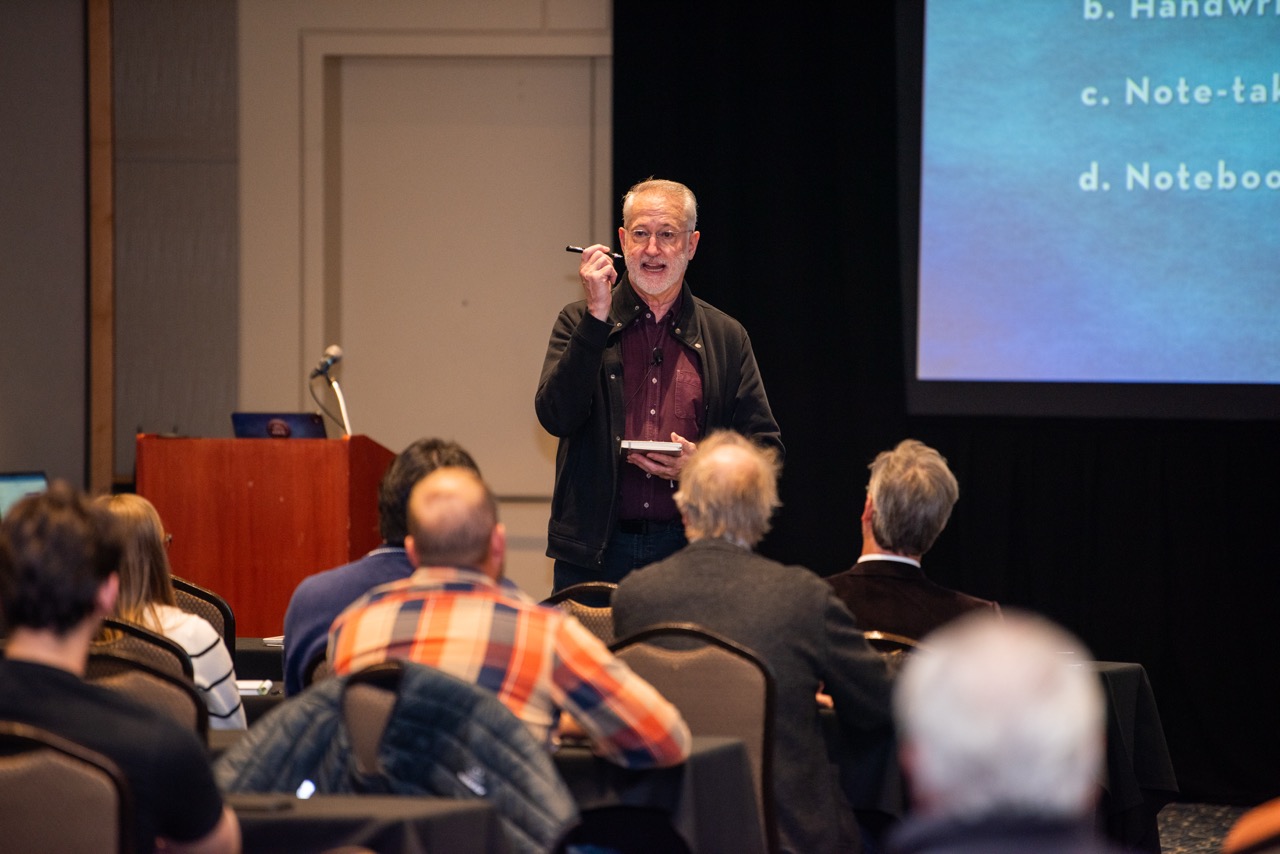
David Zach, presenting at the AIA Colorado Practice + Design Conference during the Process & Presentation session, delivered an engaging exploration of design, communication, and technology. He emphasized the importance of quotations as encapsulated ideas that connect to broader concepts, encouraging attendees to create their own intellectual web. Drawing from his experiences with architects, landscape architects, and the Society for Experiential Graphic Design Wayfinding, Zach highlighted the significance of understanding context and navigation in built environments.
Zach contrasted the experience of reading on Kindle devices versus physical books, noting how physical books foster deeper engagement and memory retention. He shared his use of tools like Readwise and Reader for organizing research and his preference for E-ink devices like the Boox Palma, particularly after cataract surgery heightened his sensitivity to screens. His research library, organized into sections like philosophy, business, and literature, reflects his belief in the intellectual value of books and the Cabinet of Curiosities concept.
David Zach | Amp Media
David Zach | Amp Media
The session explored the importance of handwriting and note-taking, with Zach referencing Yahani Plazma’s “The Thinking Hand” to illustrate how manual engagement activates distributed brain functions. He encouraged attendees to embrace mind mapping and future wheels for exploring alternatives and synthesizing ideas. Zach shared his experiences with AI tools like Claude, demonstrating their potential to enhance human creativity while cautioning against over-reliance. He described using AI to refine his talks and rediscover valuable concepts, such as cadencia, which he incorporated into his presentation.
Zach showcased personal projects, including an Art Deco kitchen and bathroom designed with salvage materials, emphasizing the importance of understanding materials and processes to connect with the design world. Anecdotes, such as being critiqued by Lord Norman Foster and his challenging introduction to a school board, illustrated the value of adaptability and resilience. Practical presentation tips included voice modulation, audience engagement, and handling technical challenges gracefully, with Zach advocating for improv training and the “Yes, and” concept to build rapport.
Throughout the session, Zach emphasized the importance of audience research, understanding the ecosystem, and maintaining authenticity in presentations. He shared his use of buttons as physical leave-behinds and humor as a tool to reduce fear of the future. His dynamic approach to speaking, blending spontaneity with thoughtful preparation, left attendees with actionable insights on enhancing their communication and creative processes.
Key
Takeaways
Create Physical Spaces That Inspire Thinking
Surround yourself with books, curiosities, and meaningful objects to stimulate creativity and thinking. Research shows that just being around books makes you smarter, and physical environments influence cognitive performance.
Research shows just being around books makes you smarter. So how many of you have books that you’ve never read? Of course, but you still know about that book. You have a sense of what’s in that book… I love the concept of Cabinet of Curiosities and this is how museums in Europe originated.
Find Your Amiable Host for Networking Success
Introverts can overcome networking challenges by identifying and partnering with naturally outgoing people who can make introductions and open doors to meaningful connections.
I would find an amiable host. So if you’re going to go have to spend a lot of time with people who are present at a conference, find somebody that other people like… have them be your host. They would take me around, introduce me to people. And it took all the effort of trying to talk to people.
4% Rule: Don’t Try to Please Everyone
Accept that 4% of any audience will show up intending to dislike you. Don’t waste energy trying to convert them – focus on the 96% who are open to your message.
4% of any audience shows up with the intention of hating you. They show up angry. Do not try to cheer them up. They want to be angry. And I remember one time there was a guy the whole time like this, never cracked a smile, never changed the expression, came up afterwards and said, that was the best damn speech I’ve ever heard.
Your Talk Begins Before You Enter the Room
Successful presentations start with thorough preparation and understanding of your audience’s ecosystem. Research who will be there, their competitors, strengths, and weaknesses to show up fully prepared.
When does your talk begin? When you walk in the room, sort of. It’s when you walk out of your room. When you leave your house, you leave the room because you are always on stage when you are the keynoter… Are you doing research about who’s there, who’s in that firm? Who are the firms you’re competing with? What are their strengths? What are their weaknesses?
Always Have Multiple Backup Plans
Technical failures are inevitable, so prepare redundantly with multiple dongles, phone backups, and printed slides. Test equipment at least an hour before your presentation and be ready to present without technology if needed.
Department of Redundancy Department. So they have little dongles like USB C to HDMI. I always carry at least two. Always have it backed up on my phone, and I always have a printout. And I have at times had to say, okay, we don’t have slides.
Build Your Knowledge Web Through Diverse Curiosity
Develop a interconnected web of knowledge across multiple disciplines to better serve clients and understand their context. This requires intentional curiosity and reading beyond your immediate field.
Consider doing your own web in order to be interesting to your client. In order to understand the context in which your client is working, you need to have a web of ideas. And again, because of your training, you’re better prepared to have that web.
Physical Books Beat Digital for Deep Learning
Reading physical books leads to better comprehension, empathy, and retention compared to digital reading. Books are synthesized rather than just summarized, requiring more thoughtful engagement.
People who read online consider themselves smarter, but it has shown that they are less empathetic. We tend to scam online. We tend to be more attentive with books. Books are contained… Things in articles tend to be summarized. Books are synthesized.
Master the Art of Graceful Problem-Solving
Audiences don’t judge you for technical problems or disruptions – they judge your reaction to them. Maintaining grace under pressure and using improv techniques can turn problems into opportunities for connection.
There’s going to be problems. Again, people will not judge you for something going wrong. They judge your reaction to it. And the number of times where something has been disrupted and somebody has come up and talked about the notion of grace under pressure.
Collect and Curate Ideas Throughout Your Career
Build a systematic approach to collecting quotations, ideas, and insights over time. These become valuable resources for presentations and thinking, as quotations often encapsulate complex ideas that connect to broader concepts.
I’ve been collecting quotations since junior high… you look for things that are worth remembering. And quotations quite often encapsulate an idea that connects to so much more… I have a database with over 5,000 quotations.
Use AI to Extend, Not Replace, Your Thinking
AI should be used as a collaborative tool to enhance human intelligence rather than as a replacement for original thinking. The key is maintaining agency over the creative process while leveraging AI’s capabilities.
My concern is a lot of people are going to get distracted, busy, and so they’re going to let the AI do it for them. That is a horrible response… I’m supposed to write it, you’re supposed to help me… use it to extend your brain.
Practice Simulation Lab

Friday, November 14, 1:15pm, Keystone Conference Center
Practice Simulation Lab
The Practice Simulation Lab session at the AIA Colorado Practice + Design Conference, led by Alexandra Oetzel, AIA, and Seth Duke, AIA, was a dynamic and condensed workshop inspired by the GAPS Practice Innovation Lab. Supported by the AIA College of Fellows and AIA Ohio Architects Forum, the session aimed to simulate the creation and management of architectural firms under diverse conditions. Participants, grouped into teams of 4-5 individuals, began by crafting a firm manifesto, focusing on values such as ecological, political, pedagogical, or ethical priorities. Teams also considered ownership structures like ESOPs and S Corps, firm sizes, and operational strategies.
Practice Simulation Lab | Amp Media
Practice Simulation Lab | Amp Media
The workshop introduced challenges to test adaptability and strategic thinking. One scenario involved contributing to a $500 million innovation district at high altitude, requiring firms to address thin oxygen, optional WiFi, and liability coverage. Another challenge simulated a construction disaster, prompting discussions on legal obligations, PR strategies, and rebuilding trust. The final scenario focused on succession planning, exploring mentorship, leadership continuity, and responses to retirement or untimely demise of founding members.
Participants shared their firm names, values, and strategies, showcasing diverse approaches such as vertically integrated firms, community-focused housing projects, and distributed design-build companies. The session emphasized creativity, collaboration, and long-term planning, with speakers encouraging attendees to apply these principles in their professional lives. Resources and contact information were provided for further exploration.
Practice Simulation Lab | Amp Media
Practice Simulation Lab | Amp Media
Key
Takeaways
Simulation-Based Learning Accelerates Practice Development
Interactive workshop simulations that compress real-world practice challenges into short timeframes help architects explore firm formation, risk management, and succession planning in a safe environment, enabling rapid iteration and learning from diverse approaches.
This is a workshop… We’re going to be under some simulated conditions and constraints that you will have to respond to… This is a safe space. Think about what your expertise is.
Distributed Practice Models Leverage Geographic Diversity
Distributed architectural practices with multiple small offices (10-20 people each) can combine local expertise with shared knowledge, particularly when located near universities to facilitate research partnerships and post-occupancy evaluation studies.
We are a distributed group of design build companies. Each office is about 10 to 20 people… We are located near universities around the country. So we are doing a lot of post occupancy evaluation and research into how the construction went, which we’re feeding into a relationship with university
Build Practice Foundations Through Three Core Elements
Successful architectural practices require establishing three fundamental components: a clear manifesto defining values and vision, specific expertise areas and knowledge-building goals, and concrete organizational structures including ownership, leadership, staffing, and location decisions.
Succession Planning Requires Cultural Transformation
Successful succession planning involves shifting from founder-led identity to team-driven, mission-focused practice. This requires developing leadership continuity plans, transparent communication with staff and clients, and preserving core values while empowering new generations of leadership.
You need to shift ultimately from this sort of founder led identity to a team driven, mission focused practice… your focus over time is going to be on preserving, creating or developing a culture, a culture that potentially changes, that is always looking at empowering new generations of leadership.
Professional Liability Scales with Project Size and Scope
Taking on larger projects significantly impacts professional liability exposure, requiring higher coverage limits and sometimes project-specific insurance policies. Firms must carefully consider their scope of work and partnering strategies when scaling up to major projects.
Your insurer is going to require of course a higher coverage limit and sometimes even project specific policies as you move forward.
Specialized Expertise Enables Strategic Project Selection
Firms should clearly define their areas of expertise and specialization to make strategic decisions about project scope and partnerships. Understanding what you don’t specialize in is as important as knowing your strengths when approaching large-scale opportunities.
Think about what your expertise is. What are you specializing in? What are you not specializing in? What knowledge are you trying to build and share? Who are the partners that you’re building your firm with?
Employee Ownership Models Enable Sustainable Growth
Employee Stock Ownership Plans (ESOPs) and similar collective ownership structures provide alternatives to traditional partnership models, supporting both succession planning and collaborative decision-making while maintaining firm values and culture over time.
Restorative Design Integrates Research and Construction
Restorative design practices focus on improving both environmental and construction industry outcomes through significant project research, post-occupancy evaluation, and partnerships with academic institutions to develop better building models and methodologies.
We are focused on restorative design and we mean that in a way that is also about the construction industry. We do significant research in our projects… We’re trying to really work on building a better model of building.
Legal Obligations Follow Contractual Relationships
Architects’ legal obligations are primarily to fulfill contract terms with owners, not contractors. While contractors generally cannot sue architects directly for breach, they can file equity claims if they can prove design errors, making clear scope definition and professional relationships crucial.
Your legal obligation is to fulfill the terms of your contract with the owner, not the contractor. Since you have no direct contractual relationship with the contractor, they generally can’t sue you directly for a breach contractor.
Vertical Integration Addresses Housing Affordability
Firms can tackle affordable housing challenges through vertical integration, combining developer, architect, and builder roles. Innovative approaches include long-term land leases with municipalities and capital reserve programs that transfer well-maintained projects back to communities.
We started with attainable housing that’s really our foundation… thought would be to try to work with local municipalities where we get a long term land lease for a dollar, say 50 years, we turn the project back over to that entity free of charge. Basically would have a capital reserve program to maintain it.
The Power of Small + Simple: Achieving Big Impacts for Net-Zero Projects

Friday, November 14, 10:30am, Keystone Conference Center
The Power of Small + Simple: Achieving Big Impacts for Net-Zero Projects
At the AIA Colorado Practice + Design Conference, the session “The Power of Small + Simple: Achieving Big Impacts for Net-Zero Projects,” presented by Tom Hootman, AIA, Scott Bishop, Assoc. AIA, and Saeed Amirchaghmaghi, explored the Smith Road Office Building as a replicable model for achieving Net Zero energy in small-scale architecture. This 5,000-square-foot pilot project, completed in 2024 for Denver Parks and Recreation, demonstrated how intentional design can meet ambitious sustainability goals. Studio Completiva is the architect of record and Form & Flow the building performance consultant.
Guided by the City of Denver’s Net Zero energy definition, the project prioritized energy efficiency, all-electric systems, and renewable energy integration. The team employed an integrated design process and a passive-first approach, focusing on climate-responsive orientation, robust thermal envelopes, and energy-efficient materials. Tools like Ladybug Tools and Autodesk Forma supported performance modeling, while energy targets were set based on roof PV capacity.
The Power of Small | Amp Media
The Power of Small | Amp Media
Construction challenges, including a mineral wool shortage, led to material substitutions like Tyvek weather barriers and foam insulation. Cascadia clips reduced thermal bridging, while passive strategies such as solar heating, cross-ventilation, and thermal mass enhanced energy efficiency. The building achieved 94% spatial daylight autonomy, supported by operable windows, low-power lighting systems, and simple, cost-effective interiors.
The mechanical systems featured a geothermal array with seven boreholes, dedicated outdoor air systems (DOAS), and energy recovery ventilation (ERV) for improved air quality. Lifecycle cost analysis revealed geothermal as the most cost-effective option, aligning with Denver Parks and Rec’s long-term goals. Embodied carbon reduction was achieved through wood construction, recycled cladding, and low VOC materials.
Energy model results showed the building’s performance closely matched predictions, with PV panels set to achieve net-positive energy generation. Maintenance feedback indicated successful operation, supported by the Egauge dashboard for real-time monitoring. The project served as a prototype for Denver Parks and Recreation, inspiring future Net Zero designs for larger facilities like recreation centers.
This session underscored the replicability of these strategies, offering architects a practical toolkit for achieving sustainability in small-scale projects. By leveraging integrated design, passive-first principles, and innovative systems, the Smith Road Office Building exemplifies how thoughtful architecture can drive impactful climate action.
The Power of Small | Amp Media
Amp Media | Amp Media
Key
Takeaways
Use Performance Modeling for Early Design Decisions
Tools like Ladybug in Grasshopper enable rapid evaluation of passive strategies without full energy modeling. This allows architects to test solar gains, shading effectiveness, and thermal performance during schematic design when changes are still cost-effective.
Doing a full energy model is too time consuming. It takes too long. And looking at the EUI of like, subtleties of like the how much overhang do you have really? Is too much noise, you want to dial into what. What are you impacting? So in this case, it’s very literal. This is the summer months. Anytime the temperature is over to 75 degrees, we know the exact solar radiation amount hitting the each of those penetrations.
Passive Design Over Active Systems
Investing in passive strategies like climate-responsive orientation, high-performance envelopes, and building science fundamentals creates a foundation that reduces mechanical system requirements and provides long-term value throughout the building’s life.
Passive design, climate responsive design, orienting your building, those simple things that we should be doing, that sometimes we’re not. But also paying attention to building science… all that really trumps the active systems, right? But it also sets the stage for really different active systems and smaller active systems.
Wood Framing Doubles Thermal Performance
Switching from steel to wood framing eliminates thermal bridging and can double the effective R-value of wall assemblies while often reducing costs. This simple change provides significant energy and embodied carbon benefits for small commercial buildings.
When you put R19, R21 in a cavity, you’re not getting an R21 wall. But you might be getting an R7 wall with steel thermal bridge, the conductivity of steel. So you’re not getting a lot of value for that. We use wood… we could actually save money by going wood, why not? And of course we get an embodied carbon benefit… But we also double our value in that cavity.
Lifecycle Analysis Drives System Selection
Evaluating mechanical systems through 25-year lifecycle costs including maintenance, not just first cost, often reveals that higher-performance systems like geothermal provide better long-term value, especially when combined with PV.
We got some first cost estimates from our cost estimator and we estimated some maintenance costs with a mechanical engineer over a 25-year period and did a lifecycle analysis… It turned out you have the lowest cost is just a very inexpensive air source heat pump… The second lowest cost was the geothermal with PV.
Simple Finishes Enable Performance Investments
Choosing simple, elegant interior finishes like polished concrete floors and exposed ceilings frees up budget for high-performance envelope and systems while providing thermal mass and celebrating structural elements.
There are no fancy finishes. Not having that many fancy finishes helped us to compensate for having bigger windows or having a more robust HVAC system. But even with those simple finishes, we were able to achieve a lot because when we have that concrete floor, its actually polished, so it brings the daylight in, but it also acts as a thermal mass.
Interior Air Sealing Outperforms Exterior Barriers
Atomized acrylic sealant applied from the interior can achieve better air barrier performance than traditional exterior methods like Tyvek, often at no additional cost while providing measurable results through blower door testing.
Studio Completiva had recent success using a atomized acrylic sealant. So they spray it from the interior… our target was 0.2. So that’s a CFM per square foot of envelope at 75 pa of pressure… we actually were able to hit 0.15. We were able to get it even a bit better. That was a nice move. And there was no cost change to do that.
Shoebox Massing Simplifies Thermal Control
Simple rectangular building forms make it easier to create continuous thermal envelopes and control heat loss. Complex geometries create more opportunities for thermal bridging and air leakage, increasing both energy use and construction costs.
What is a shoebox mass? It’s essentially a simplified version of your building… with a simple rectangle, simple mass, and want to emphasize that it makes it easier to control your thermal envelope. With a passive first approach, you want to wrap your building like you would a jacket.
Post-Occupancy Monitoring Validates Performance
Installing simple, cost-effective energy monitoring systems like eGauge enables real-time performance tracking and validates energy models. The Smith Road building performed within 12% of predicted energy use in its first year.
Within the zero energy project, it doesn’t end with design, it has to be operated as one. So they need to be paying attention to energy and having a simple dashboard… This is actually another Colorado product called eGauge that I particularly like because it’s so simple and it’s really cost effective, especially in small building.
High-Performance Windows Enable Passive Strategies
Investing in windows that exceed code requirements (U-0.14 vs code baseline) with non-conductive frames enables effective passive solar heating in winter while maintaining comfort, supporting natural ventilation strategies year-round.
Exterior windows have a U value of 0.14 and solar heat gain coefficient of 0.28, which is way better than the code. It actually meets the passive house prescriptive requirement… if you go with like uPVC in this case or fiberglass, you reduce that thermal bridging.
Material Choices Reduce Embodied Carbon
Simple material substitutions like calcium silicate masonry instead of CMU, recycled plastic composite cladding, and wood framing can significantly reduce embodied carbon without complex lifecycle assessments or major cost impacts.
So that wasn’t necessarily in our scope of work. It was a zero energy building. We didn’t do a whole building life cycle assessment. We didn’t invest in that. But we made decisions based on embodied carbon throughout the whole project. And it’s really not that hard. There are Environmental Product Declarations on everything. We use DC3, easy tool to compare and find products.
AIA-Practice+Design-Conference-2025_AmpMedia-8006 Large |
Amp Media | Amp Media

Friday, November 14, 10:30am, Keystone Conference Center
Anywhere Specific: The Power of Collaboration
Rick Sommerfeld, AIA, Director of the ColoradoBuildingWorkshop, presented “Anywhere Specific: The Power of Collaboration” at the AIA Colorado Practice + Design Conference, showcasing the program’s ethos, achievements, and innovative approach to architectural education. The Colorado Building Workshop, a Masters of Architecture program at the University of Colorado Denver, has completed 22 community-based projects, constructing 54 structures with 61 community partners over 17 years. Faculty members Will Koning and Andy Paddock, alongside collaborators like Scott Lawrence (University of Idaho) and JD Signum (Sawhorse 7), have been instrumental in its success.
Sommerfeld emphasized the program’s focus on societal issues, including food deserts, human waste, forest fires, and overfishing. Notable projects include the Longs Peak privies, addressing waste management in high-altitude backcountry locations, and a research station in Antarctica, supporting scientists studying pinnipeds, seabirds, and krill. The program’s ethos is encapsulated by Renzo Piano’s quote on the unity of science and art, inspiring students to integrate context, material, and structure into their designs.
Erik Sommerfeld, AIA | Amp Media
Erik Sommerfeld, AIA | Amp Media
Operating near the Continental Divide, the program has tackled diverse climates, from the high deserts of Bluff, Utah, to the extreme elevations of Leadville, Colorado. It has pioneered innovative solutions, such as Engelmann spruce CLT panels for wildfire mitigation and rodent-resistant cabins for Cottonwood Gulch Expeditions. The program’s 19-week timeline includes intensive spring semester work and a three-week summer build, fostering collaboration among engineers, contractors, and material representatives.
Sommerfeld shared the program’s evolution, from humble beginnings with $25,000 budgets to complex endeavors like business incubators in Denver. Balancing budgets through project funding, tuition, and donations, the program operates as a self-sustaining entity within the university. Its commitment to addressing societal issues while fostering creativity and innovation has made it a hallmark of architectural education, preparing students for real-world challenges in diverse contexts.
Erik Sommerfeld, AIA | Amp Media
Erik Sommerfeld, AIA | Amp Media
Key
Takeaways
‘Mundane’ Typologies Contain Complex Architectural Problems
Projects that seem mundane or that traditional architecture firms wouldn’t pursue often contain sophisticated design challenges and societal issues. These projects provide valuable learning opportunities while addressing real community needs.
We really focus in many ways on these mundane typologies, project types that architects wouldn’t do, as a way to bridge between what is an educational model and then ultimately the profession that they’re going to be entering into. So a lot of these projects are really underfunded or would be things that maybe architecture firms wouldn’t be taking on, but they aren’t really mundane problems in many ways.
Design-Build Programs Must Be Financially Sustainable Businesses
Successful academic design-build programs require careful financial management across multiple revenue streams including project funding, student tuition, university fees, and donor support. The program must operate profitably to be sustainable long-term.
I am in fact, running a kind of design firm and construction firm within the university. It is a business. It needs to be profitable in some ways. It doesn’t need to take from the university, it needs to give back to the university. And I’m doing that through charging the clients money for the projects themselves.
Successful Projects Generate Repeat Client Relationships
Quality work that solves real problems leads to clients returning with additional projects, creating sustainable business relationships and validating the effectiveness of design solutions.
So that’s always heartwarming that our students did a good enough job, that we have clients that are kind of calling us back… they want us to come back and do the same thing that those cabins that they have now… And apparently, they’ve been really successful.
Science and Art Require the Same Energy and Language
Technical problem-solving and creative design are not separate disciplines but complementary approaches that enhance each other when integrated effectively in architectural practice.
I thought it was sort of important to bring in this quote from Renzo Piano, which succinctly puts it that he can’t see any sort of separation between those two functions. And in many ways, they speak the same language and they require the same energy. And we push our students many ways to take that on as well.
Extreme Projects Provide Extraordinary Learning Opportunities
Taking on projects in challenging environments like Antarctica pushes students and faculty to develop innovative solutions while creating unforgettable educational experiences that demonstrate the power of architecture to serve communities anywhere.
Unfortunately, because of the way that the school year worked, they still had a year left in their education. But I did get an opportunity to reach out to the alumni of the program and give them an opportunity to apply to be some of the construction crew that went down… So these are some of the lucky individuals that applied to be part of that program and got to spend four weeks each time in Antarctica, building in this, incredible place.
Mock-ups Are Essential for Testing and Learning
Physical mock-ups serve multiple purposes: testing construction methods, educating students, bringing in consultants for guidance, and proving concepts before full-scale construction. They’re particularly valuable for identifying failures early.
In this particular case, we had a snip panel construction, structurally non insulated panels… And it was a failure, like epic, epic failure. But it failed at the mock up level. It failed in the university. And we were able to pivot to prefabricated wall framing.
Community Collaboration Creates Educational Villages
Effective design-build education relies on building a community of professionals including engineers, contractors, and material representatives who contribute their expertise. This collaborative approach mirrors how communities come together to educate and support development.
We’ve engaged numerous engineers and contractors, material reps, to basically come and educate students. Almost like a village comes together to sort of educate or raise a child.
Project Complexity Should Grow Gradually Over Time
Successful design-build programs develop their capabilities incrementally, starting with simple projects and gradually taking on more complex challenges as the team’s skills and reputation grow.
The projects that we started with were very humble. And I think it’s really important to kind of understand that this didn’t happen over overnight. This is over a 17 year period… some of our first projects were as simple as working on the Boulder Museum of Contemporary Art for just about four or five thousand dollars.
Extreme Logistics Require Complete Prefabrication
Projects in remote or extreme environments demand comprehensive prefabrication strategies where every component is planned, tested, and packaged before arrival on site. This level of preparation is essential for project success.
We would prefabricate everything with the students in Denver, every last nut, bolt, screw, piece of flashing, and then we would ship it all the way to Livingston Island… It all had to fit on a 16 foot Zodiac because we needed to figure out a way to break these pieces down and get it to the site and then rebuild it in as little as four weeks.
Engineering Collaboration Enables Architectural Innovation
Close collaboration with structural engineers can transform architectural concepts into structural systems, creating opportunities for innovation that neither discipline could achieve alone.
Our engineer got really excited about the idea that these steel plates, while architectural in our minds as architects holding the rock, could actually be part of the structural system and that we could move beyond the sort of gravity system… and start to think about how in folding architecture… we could begin to understand how those lateral loads could transfer from one wall to the other wall and essentially stiffen the entire box.