Nothing brings people together in the architecture and design community like… well physically being together. As many of us try to convince our peers that being in the same room from time to time has its merits, the Denver Local Advisors group of AIA Colorado has taken it upon itself to provide multiple tours of recently completed, or under construction, projects around the city.
Colorado Convention Center expansion tour
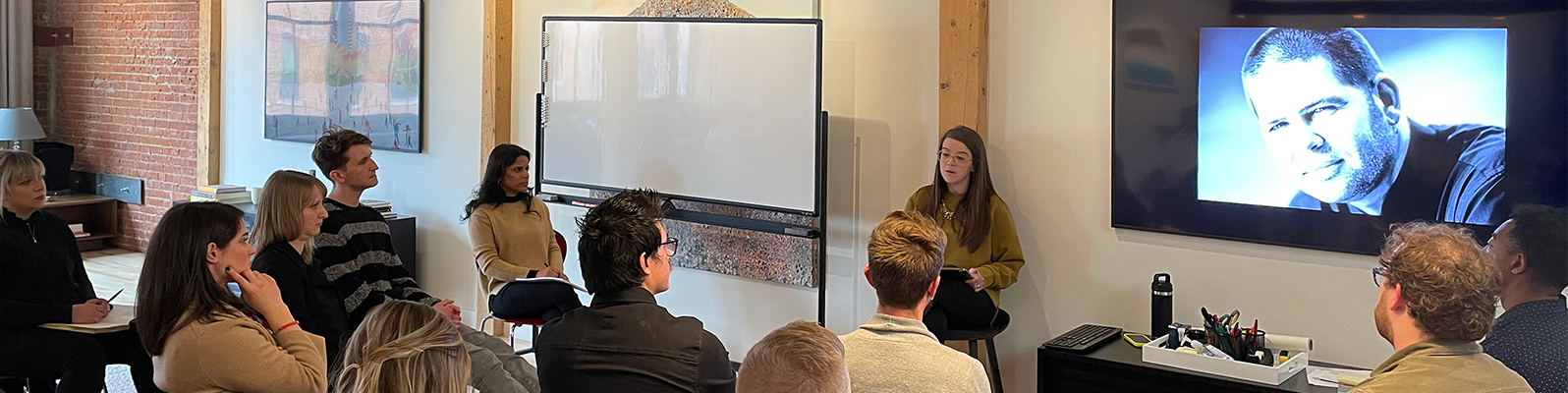
Most recently, the group visited the active construction site of the Colorado Convention Center expansion. The contractor team led a group of about thirty architects, aspiring architects, engineers, and other industry partners through the building that is nearing completion and spoke to the logistical hurdles that they had to overcome, such as building over an active parking garage while wedged between the Convention Center, which continues to be used on a weekly basis, and a major arterial thoroughfare through downtown Denver. In just about an hour, the group had ventured through multiple exhibit and pre-function areas, the “largest kitchen west of the Mississippi”, and across multiple staging and overlook points. Of course, the only way to round out the afternoon was with a group happy hour at a nearby beverage establishment.
National Western Complex tour
These sorts of gatherings have been gaining momentum here in Denver over the summer. What began on a rainy day in May to tour the recently completed City Heights dormitory on the Auraria Campus was followed by a tour through the National Western Complex in June. These events have provided opportunities for behind the scenes looks at various high-profile projects around Denver, but also allowed people the chance to mingle with their counterparts that they haven’t seen since before the pandemic and given younger aspiring architects the chance to make a dent in their AXP hours.
For the Denver Local Advisors, the focus this year has been on bringing people together and highlighting some of the incredible work being done around this every-changing city. The group has taken steps to provide platforms for people to showcase their work and come together to be inspired by current and future work. The group plans to expand its efforts to include other prominent projects currently under construction and to also highlight larger scale plans that will dramatically alter the landscape of Denver with future events on a (hopefully) monthly basis.
In the meantime, if you or your office would like to have a project featured by this group, please contact AIA Colorado to get on the schedule. Keep an eye on the bi-weekly newsletters for more opportunities to tour these excellent projects and to come together as a Denver architecture community that continues to grow, evolve, and coalesce around this great city and region.
News from the Colorado Chapter of The American Institute of Architects | 07.19.23
THE WEEK IN WORDS
“So much of your career and your life is an accumulation of your experiences.”
— Sarah Broughton, FAIA, Principle at rowland+broughton, 2023 AIA Colorado President.
Sarah was recently highlighted in AIA National’s weekly 60-second “Future Focused” video series. The series features female architects and designers’ favorite work, as well as the leadership, mentorship, and vision they are pursuing for an increasingly diverse and equitable profession. The videos share the stories of women, men, and firm leaders who are elevating women and changing the profession to make it a vocation of choice for anyone interested in the design field.
AIA COLORADO NEWS
Practice + Design Conference Expo Hall Vendor Application Now Open to Premier Partners and Allied Members
Know a company that serves your firm and clients really well? The AIA Colorado Practice + Design Conference expo hall and event sponsorship online sign-up page is now open to our Premier Partners and Allied Members as a benefit for their continued support of AIA Colorado. This opportunity to secure a booth, register for a learning lab, or become a conference sponsor is available through August 15th, at which point if there are opportunities still open, we will make them available to a wider industry audience.
If a firm is not currently a Premier Partner or Allied Member, there is still time to sign up as one of our industry partners and secure a booth, submit for a learning lab, or sign up for conference sponsorship.
Lastly, if you’re interested in viewing the 2023 Engage Practice + Design Conference prospectus, you can view it here.
DORA Architects, Engineers, and Land Surveyors Board Transition
The State Board of Licensure for Architects, Professional Engineers and Professional Land Surveyors says a grateful farewell to Stephen Powell, AIA and welcomes Christy Riggs, AIA. Three architect members sit on the Department of Regulatory Affairs board alongside peer professionals in other design disciplines. Stephen is a former South Section AIA President and an active volunteer in his community for groups involved in child advocacy and affordable housing. Thank you, Stephen!
Governor Jared Polis appointed Christy Riggs who steps into the role with continuing architect board members Stephanie Morales Ostasuc, AIA and Nan Anderson, FAIA. For the first time in Colorado history, the three architect seats are held by women. Christy Riggs is a long-time South Section volunteer and previous South board member, who also regularly represents the architecture profession on Colorado Springs area boards and commissions, in addition to running her own practice.
These volunteer jobs are not for the faint of heart—requiring hundreds of pages of material to review and hours-long monthly meetings. The architecture community appreciates the commitment these board members make to maintain the integrity of our practice. AES Board Home
AIA COLORADO EVENTS
Tour of Colorado Convention Center Expansion
Thursday, July 20th, join the Denver Local Advisors Group for a tour before construction wraps and the space is opened to the public, followed by happy hour at The Corner Office. The Colorado Convention Center has served as a hub for downtown Denver and the Mountain West for over thirty years. In 2015, voters approved an expansion to the facility that hosts over 230 events on an annual basis. Please RSVP in advance.
Academy of Architecture for Health Networking Event
This July 27th, join the Academy of Architecture for Health Knowledge Community for a happy hour networking event hosted at Page’s office. Open to AIA Colorado members. Please RSVP in advance.
On September 19th, join AIA Colorado as we unveil the recipients of the 2023 Design + Honor Awards and celebrate the exemplary work of Colorado architects. We sincerely hope that your whole team, clients, friends, and family can join in the celebration. It will be a fantastic event and we’re looking forward to it!
Event sponsorship is available and we invite you to view the event prospectus.
This past June, utilizing the Fisher Travel Scholarship, Sean Jursnick, AIA, Architect at SAR+, was able to spend two weeks in Denmark and Sweden examining smart cities and carbon-reduction efforts. The trip provided an opportunity to build connections with Danish and Swedish architects, visit innovative projects, and ultimately find ways to contribute to AIA’s efforts to promote carbon reduction.
The ACADIA Board of Directors and the College of Architecture and Planning at the University of Colorado Denver are excited to announce the 2023 conference Habits of the Anthropocene: Scarcity and Abundance in a Post-Material Economy which will be held in person in Denver, CO from October 26-28th, 2023.
A major update for 2023 includes the explicit labeling of “high impact” action items into each principle. This provides architects with an overview of recommendations, understanding that they are not necessarily able to adopt every single best practice. These high-impact items are categorized in a way that centers the four outcomes of the Framework: if architects can only do one thing, here are brief suggestions to design zero-carbon, resilient, equitable, and healthy projects.
NCARB Releases Annual Data Report on State of Architectural Licensure
The findings in NCARB by the Numbers are pulled from NCARB’s database of over 128,000 licensure candidates and architects, making this annual report the most comprehensive source for licensure statistics. Explore data on the number of licensed architects, gender and racial diversity, and attrition along the path to licensure.
Student Loan Forgiveness, Repayment Programs are Critical
Korey White, AIA, reacts to the recent U.S. Supreme Court decision on student loan relief and shares how the burden of college debt has impacted her career. Read More
New Survey Results Highlight Evolving Trends in Home and Property Design
Home sizes are stabilizing, and clients are looking for value in upgrades. For more infomation, read the Press Release and view the Latest Survey Results
Women’s Leadership Summit
Registration is open for Women’s Leadership Summit 2023! This premier event is designed for ambitious women who want to unlock their full potential, make a lasting impact on their careers, and lead change in architecture and the allied professions.
Join AIA members in Boston September 12–14, 2023, to meet, network with, and learn from an extraordinary lineup of renowned speakers, trailblazing leaders, and industry experts—and earn up to 45 AIA LUs.
We’re proud to highlight one of AIA Colorado’s Premier Partners, JVA, Incorporated, and look forward to their ongoing support and involvement serving Colorado’s architecture community.
JVA, Incorporated is a consulting engineering firm with offices in Boulder, Fort Collins, Winter Park, Glenwood Springs, and Denver, Colorado. Since 1956, JVA has provided engineering services to architects, owners, building departments, and general contractors in Colorado and nationwide. Our Structural, Civil, and Environmental engineering departments offer highly skilled engineers who complement your experience to fully meet your design and construction needs. We take pride in our commitment to provide excellent service.
Each year, the Architectural Education Foundation (AEF) funds Travel Scholarships for AIA members to support professional development and broaden Colorado’s design discourse.
This past June, utilizing the Fisher Travel Scholarship, I was able to spend two weeks in Denmark and Sweden examining smart cities and carbon-reduction efforts. The trip was an important opportunity to build connections with Danish and Swedish architects, visit innovative projects, and ultimately find ways to contribute to AIA’s efforts to promote carbon reduction.
The most visible part of AIA’s carbon-reduction effort being the AIA 2030 Commitment, which includes over 60 signatory firms in the state who are committed to reaching carbon neutrality by 2030, including Shears Adkins Rockmore Architects, in Denver, where I am a project architect.
Unexpectedly capturing the spirit of the travel scholarship, the trip also led to a viral tweet about a Stockholm mass timber high-rise, broadcasting photos of the project and my trip to a wider audience than I ever expected. Viewers and commenters included Swedish architects and a Swedish life safety expert. Through the social media connection, the life safety expert and I have engaged in ongoing conversations about the details of Swedish building code that are different than approaches to the code in the U.S.
I was able to visit three cities during my trip to Denmark and Sweden: Copenhagen, Aarhus, and Stockholm. Each city maintains strong environmental attitudes, committed to becoming carbon-neutral in the near future.
Copenhagen, Aarhus, and Stockholm are unique because they were each recently selected to participate in the EU Mission Cities effort. As part of the Mission Cities program, designated cities will accelerate the transition to climate-neutrality by 2030 and serve as inspiration for all European cities to become climate-neutral by 2050. The EU Mission Cities effort is an important precedent for Colorado since the state has similar aggressive climate goal and the state’s Climate Action Pan pledges a 90% reduction in carbon emissions by 2050. Leadership by architects will be key to achieving success in reducing Colorado’s emissions goals for the built environment and the three cities I visited offered many lessons to learn about carbon reduction efforts.
Copenhagen was named the 2023 World Capitol of Architecture by UNESCO and the designation highlights how architecture, city planning, and culture can work together to shape urban development.
Through Copenhagen’s Danish Architectural Center (DAC), I was able to attend an architect-led walking tour to learn first-hand about Copenhagen’s attitudes on development and sustainability. Copenhagen was recently ranked #1 on the list of most livable cities and the tour offered details on how much of the city’s success is the result of an effort to bring people back to the city after an economic recession and loss of residents in the 1980’s.
Copenhagen was the first capitol city to make a carbon neutrality pledge, however their efforts towards a more sustainable city began decades ago. Leadership in the city recognized that the key to bring people back to the city was to make a more livable urban environment by cleaning up their harbor and reducing automobile traffic. Copenhagen in the early 1980’s was a place where wastewater was pumped directly into the harbor, historic plazas were used as parking lots, and hundreds of cyclists were killed in accidents on the streets of the city. Thanks to successful community, transportation, and infrastructure efforts, the city underwent a massive environmental cleanup while focusing on development of transportation infrastructure. In 2002, two milestones were achieved on the city’s path to resurgence when Copenhagen opened both its first underground Metro line and its first public harbor bath, designed by Bjarke Ingels Group (BIG). These projects marked an evolution in Copenhagen’s attitude toward a livable city.
Copenhagen has continued to focus on transportation infrastructure. In 2020, after a new City Circle Metro line opened with 17 new stations, resulting in 85% of city residents now live within 600 meters of a rail station. ARUP designed the 17 new metro stations using minimalist inspiration. The firm used a gigantic ‘kit-of-parts’ to find efficiencies and achieve cost savings to create a series of light-filled station with distinctive facades.
Showing how Copenhagen has prioritized transportation options, bicycle and public transportation are the top 2 preferred commuting options in the city. Copenhagen has the highest percentage of cycle commuters in the world (62%) and the city’s cycling infrastructure is extensive. One of the most innovative pieces of the city’s cycling infrastructure is used along ‘bicycle superhighways’ where smart bicycle traffic lights detect cyclists and their speed and adapt the timing of stoplights so that the cyclists never hit a red light
My favorite example of Copenhagen’s attitude toward transportation is a DAC exhibition by JAJA Architect featuring the interactive Bicycle Street model showing how we can make greater neighborhoods, streets, and cities if we prioritize walking and biking. The one-of-a-kind model is part bike and part architectural model and includes both a street designed for cars and a street designed to prioritize pedestrians and bikes. The version of street visible to the user is controlled by pedaling the bicycle to flip the model to the preferred side.
Copenhill waste-to-power plant and recreation attraction – BIG
Also contributing to Copenhagen’s carbon reduction efforts is the Denmark’s tallest ski hill, the one-of-a-kind “waste to energy” power plant called Copenhill. The Copenhill project was designed by BIG and it not only serves as a recreation opportunity with a ski slope, hiking trail, and rooftop café that has views of Copenhagen and across the Oresund Strait to Sweden but it also provides affordable energy for 150,000 residents. The design speaks to Bjarke Ingle’s goal of a sustainable city that is not only better for the environment but is also more enjoyable for the lives of its citizens.
Heidi Peterson, BIG Head of Nordic Business Development, and Sean Jursnick, SAR+
The highpoint of my trip may have been Copenhill but the highlight of my trip was touring BIG’s Copenhagen headquarters, home to 300 employees. The tour was an opportunity to see the last days of BIG’s location in a former Carlsberg brewery factory before moving next month to a new waterfront location.
The office featured ample daylight and a vast collection of models with live feeds of other BIG locations in London and NYC in the lobby so guests could give a friendly-wave to visitors in offices in other time zones. The office is involved in projects around the globe and also designing 3D printed housing for NASA on the moon. In the U.S., BIG is using similar 3D printing technology to build hotels and homes in Texas as a way to reduce waste in the construction process along with making homes that are resilient, sustainable, and energy efficient.
Aarhus, Denmark’s second largest city, is located by the sea and it has a large industrial harbor area that for many years sat vacant and unused. On my visit, I was able to view the active redevelopment of waterfront and swim in another harbor bath designed by BIG.
Previously, the waterfront was abandoned and isolated from the nearby city center and recent development has sought to breathe life into the harbor area by adding density to the city and making the waterfront accessible to the public by activating the area with active uses. A new harbor promenade connects ‘the world’s best library, ’ named DOKK1 with Aarhus Ø (Aarhus Island), a rapidy growing mixed-use area planning to add 7,000 residents to the city center. DOKK1 transformed a formerly vacant waterfront into an active community space, easily accessed by multiple modes of transit. The Danish designers, Schmidt Hammer Lassen Architects, note that DOKK1 reactivation of the waterfront and city center was due to an inviting design with 360 degree views of the city and sea that has become a vibrant space for all generations, interests, and cultures.
Aarhus Island features an award-winning masterplan by BIG that uses carefully programmed areas to encourage social interaction and activity along a waterfront promenade. Among the recently completed BIG projects contained in the master plan are a harbor bath that is open year-round, a theatre, residential building, and a waterfront village of small activity houses. To promote activity along the promenade, owners of the small activity houses are required to host social events a minimum of 10 times a year that are open to the public and have included activities like pop-up shops, musical events, and art classes.
In Stockholm, I was able to see innovative uses of low-carbon mass timber. Cedarhusen is Sweden’s first mass timber high rise and contains 245 units which are primarily dual aspect. At 13 stories tall, the building would be illegal to build anywhere in the US due to the use of single-stair egress, also known as the point access block typology.
While building code in the U.S. caps the use of single-stair egress for multifamily projects at 3-stories, almost all of the rest of the world allows for taller point access block apartment, which allows for denser development and high-quality living for the residents. Designed by General Architecture from Stockholm, the Swedish building code allows single-stair egress up to 16-stories with performance based fire modeling that demonstrates a high level of safety by that including safety features like a fire sprinklers and pressurized stair and elevator cores.
Because mass timber is relatively light, innovative Swedish architects have also used mass timber to add onto existing structures to add density and expand sustainability. An Stockholm’s Trikåfabriken building, architects at Tengbom used mass timber to build a five-story extension transforming a historic factory building to a modern and sustainable office complex and at the Glitne apartment complex, BIG used mass timber to place apartments on the roof of an existing mall.
Looking to the future, Stockholm plans to expand the use of mass timber for large scale high-rise projects with the construction of Stockholm Wood City beginning in 2025.
As Colorado continues to grow in the coming decades while striving for important climate goals, it will be important for architects to not only be innovative with design solutions, but to serve as educators and advocates for the community. Understanding global climate efforts will need to be part of that effort and Denmark and Sweden offer great set examples of not just innovative architecture but building codes, transportation, infrastructure, and urban development attitudes.
My hope is that my viral tweet and sharing of these precedents will contribute to conversations about how forward-looking solutions are needed to reach Colorado’s climate goals.
News from the Colorado Chapter of The American Institute of Architects | 07.05.23
THE WEEK IN WORDS
“We are blessed to have places like Civic Center – a beautiful, architectural campus that is Denver’s first National Historic Landmark. But what truly makes Civic Center special – and the heart of our city – is that it is a place where we come together as a community, where we build the social fabric that ties us together. It is the place where we celebrate, where we participate, where we pause and where we play.
This is the place where we gather with our neighbors– where we learn to support and take care of one another – where we participate in democracy – this is the place where we practice tolerance and learn to co-exist. This is the place where as a community we should strive to put our best foot forward.
This is the power of public space. This is the purpose of public space.”
On September 19th, join AIA Colorado as we unveil the recipients of the 2023 Design + Honor Awards and celebrate the exemplary work of Colorado architects.
Taking place at Mile High Station, we look forward to welcoming you at 5:30pm to enjoy the music of Spinphony, delicious food and drink, and an event program beginning right at 7pm. This year’s jury enjoyed the incredible selection of work that our member architects submitted, and we’re thrilled to present both the Design Award winners as well as the Honor Award recipients.
Practice + Design Conference Call for Presentations Closes July 7th
The Practice + Design Conference brings together the community of architects in Colorado for inspiring insights from global design leaders, advanced practice management methods, and practical innovations from industry partners. We’re interested in hearing from those in our community who are ready to contribute and lead a session at Keystone.
If you have a presentation in mind, visit the link below and start your submission today. Or, if you know someone who would be a great fit, encourage them to create a submission. The submission window closes Friday, July 7th at 5pm.
Expo hall booth and sponsorships will open soon, with preference given to Premier Partners and Allied Members first. If you’re interesting in viewing the Engage Practice + Design Conference prospectus, you can view it here.
This July 19th, review changes from the last edition to the current edition of the International Building Code as recently adopted by the Pikes Peak Regional Building Department and go into effect June 30th. The background behind many of the changes will be discussed to provide participants with an understanding of the intent of the changes and how to apply it to their everyday work. Subjects covered in the class will include the code change process, mixed occupancies, atriums, accessible means of egress, and more. This full-day program includes lunch and will be submitted for approval for 6.0 AIA CES Health, Safety, and Welfare (HSW) learning unit hours. Early registration rates expire July 12th!
The State of the Art of Architecture
Thursday July 27th at the Aspen Art Museum, join AIA Colorado, CORE, and rowland+broughton for an exploration of the present and future state of sustainable architecture in Colorado’s Roaring Fork Valley. Space is limited, please RSVP in advance.
With roots in Colorado’s Conejos County and as a professor of architecture at UC Berkeley, Ronald Rael challenges us to think differently about materials, space, borders, and linear time. In his upcoming installation at History Colorado, Rael uses modern-day 3D printing to reimagine the 7,000-year-old technology of adobe, and will be creating a large structure out of an adobe mixture of clay, straw, and sand on the front porch of the History Colorado Center! Visitors are invited to witness his work in progress July 7–9, or plan a visit soon after its completion. View video of the process.
Taking place the week of July 10 – 16, Telluride Art + Architecture Week is an immersive art experience showcasing the architectural, landscape, interior design, and creative talent of Telluride. Join fellow architects Friday, July 14th, for Design Industry Day, presented by Altitude Control Technology, CCY Architects, Dornbracht, Henry Built and Delta Millworks. Continuing Education courses are followed by a social networking event.
DEN’s Business Development Training Academy – Concourse 100 program
DEN’s Business Development Training Academy is now accepting applications for its Concourse 100 program. This is an entry level 9-week program for small businesses in the A/E/C industry who are interested in learning how to work at DEN. Please share this with your small business network. Deadline to apply is July 16th.
The ACADIA Board of Directors and the College of Architecture and Planning at the University of Colorado Denver are excited to announce the 2023 conference Habits of the Anthropocene: Scarcity and Abundance in a Post-Material Economy which will be held in person in Denver, CO from October 26-28th, 2023.
Registration is open for Women’s Leadership Summit 2023! This premier event is designed for ambitious women who want to unlock their full potential, make a lasting impact on their careers, and lead change in architecture and the allied professions.
Join AIA members in Boston September 12–14, 2023, to meet, network with, and learn from an extraordinary lineup of renowned speakers, trailblazing leaders, and industry experts—and earn up to 45 AIA LUs.
Pride by Design is Building a Community for LGBTQIA+ Architects
The new initiative founded by Sarah Nelson-Woynicz, AIA, aims to build connection and community among LGBTQIA+ architects. Read more
AIAU: Achieving Zero Energy Building Design
Improve your skills in high-efficiency building design with this highly interactive learning program based on the Advanced Energy Design Guide for K-12 School Buildings. Learn more
When Is Modular Construction Best Employed on Projects?
Modular construction can be an attractive delivery model for many projects. Consider these factors when determining whether modular construction is appropriate for your project. Read more
Construction Risk Brief
Consider subscribing to AIA Contract Documents’ Official Newsletter: Construction Risk Brief. AIA Contract Documents is excited to launch a monthly newsletter so you can stay up-to-date on all things risk management in the construction industry. From articles to webinars to videos, hear from the industry’s leading experts on how to expect and handle risk at every point of your project. Sign up
ABI May 2023: Architecture Firm Billings Bounce Back
The AIA/Deltek Architecture Billings Index (ABI) score for the month was 51.0, the highest it has been since last September. Read more
News from the Colorado Chapter of The American Institute of Architects | 06.21.23
THE WEEK IN WORDS
“It’s been incredibly inspiring to see the breadth and depth of the work that you all have shared with us. It’s all encompassing, it is broad, and I loved how you embraced the design measures of excellence.”
— Yiselle Santos Rivera, AIA, Jury Chair, AIA Design Awards, addressing the 2023 Design Award Submissions.
In addition to our 2023 Design Awards Jury meeting in San Francisco to deliberate on this years’ entrants, AIA Colorado members and staff took in the many keynotes, lectures, learning labs, social meetups, and strolled the expo hall floors at A’23. Catch up on some of the events that took place as well as keynotes from the main stage here.
Call For Presentations
Practice + Design Conference Call for Presentations Now Open
The Practice + Design Conference brings together the community of architects in Colorado for inspiring insights from global design leaders, advanced practice management methods, and practical innovations from industry partners. We’re interested in hearing from those in our community who are ready to contribute and lead a session at Keystone.
This year’s theme, ENGAGE, is focused on the big topics and discussions that face our industry, our practices, and our communities. We’re interested in conversations where the stakes are great and the opportunities are real, creating chances for us to propel our profession forward, right here in Colorado.
If you have a presentation in mind, visit the link below and start your submission today. Or, if you know someone who would be a great fit, encourage them to create a submission. The submission window closes Friday, July 7th at 5pm.
Expo hall booth and sponsorships will open soon, with preference given to Premier Partners and Allied Members first. If you’re interesting in viewing the Engage Practice + Design Conference prospectus, you can view it here.
AIA COLORADO NEWS
2023 Legislative Session Recap
Advocacy Engagement Director Nikolaus Remus, AIA, covers the top bills affecting the architecture profession from the 2023 legislative session. This part 1 will go into detail on the bills AIA Colorado took action on. A future part 2 will give a broad overview of other bills that may be of interest to members.
Colorado’s New Statewide Energy Code Means Lower Costs, Better Air Quality
As the standards better accommodate solar panels and electric vehicles, Colorado just finalized its new statewide energy code, but what does that mean for new construction? Learn more in Colorado Newsline from AIA Colorado’s Advocacy Engagement Director, Nikolaus Remus, and Executive Director of the American Council of Engineering Companies of Colorado, Heidi M. Gordon, as they break down the implications of the new energy code.
This July 19th, review changes from the last edition to the current edition of the International Building Code as recently adopted by the Pikes Peak Regional Building Department and go into effect June 30th. The background behind many of the changes will be discussed to provide participants with an understanding of the intent of the changes and how to apply it to their everyday work. Subjects covered in the class will include the code change process, mixed occupancies, atriums, accessible means of egress, and more. This full-day program includes lunch and will be submitted for approval for 6.0 AIA CES Health, Safety, and Welfare (HSW) learning unit hours. Early registration rates expire July 12th!
The State of the Art of Architecture
Thursday July 27th at the Aspen Art Museum, join AIA Colorado, CORE, and rowland+broughton for an exploration of the present and future state of sustainable architecture in Colorado’s Roaring Fork Valley. Space is limited, please RSVP in advance.
Under a Denver Highway, Artists Find Space for the Surreal
The art collective Meow Wolf worked with local architects to create a trippy “Convergence Station” on a wedge-shaped site beneath a busy interstate. Hear from Dan Craig, architect and principal for Shears Adkins Rockmore, in Bloomberg. Read more
PARTNER NEWS AND EVENTS
2022 Denver Energy Code Training Series
Want to learn more about what is changing for commercial/multifamily and residential buildings when the 2022 Denver Energy Code goes into effect? Join City of Denver for a comprehensive training series that will teach you about key changes in the new code. Feel free to join for specific topics or the entire series, which includes content for both commercial and residential project teams. ICC and AIA/HSW continuing education credit will be provided.
Taking place the week of July 10 – 16, Telluride Art + Architecture Week is an immersive art experience showcasing the architectural, landscape, interior design, and creative talent of Telluride. Join fellow architects Friday, July 14th, for Design Industry Day, presented by Altitude Control Technology, CCY Architects, Dornbracht, Henry Built and Delta Millworks. Continuing Education courses are followed by a social networking event.
DEN’s Business Development Training Academy – Concourse 100 program
DEN’s Business Development Training Academy is now accepting applications for its Concourse 100 program. This is an entry level 9-week program for small businesses in the A/E/C industry who are interested in learning how to work at DEN. Please share this with your small business network. Deadline to apply is July 16th.
The Temple Hoyne Buell Endowed Ambassadorial Scholar Program provides $30,000 scholarship awards for undergraduate or graduate studies outside the USA. Scholars must commence studies between July 1, 2024 and June 30, 2025 and expend the scholarship funds within 12 months of starting studies. Study must be in the field of architecture, landscape architecture, urban planning or related subjects.
The ACADIA Board of Directors and the College of Architecture and Planning at the University of Colorado Denver are excited to announce the 2023 conference Habits of the Anthropocene: Scarcity and Abundance in a Post-Material Economy which will be held in person in Denver, CO from October 26-28th, 2023.
Evelyn Lee, FAIA, has been elected the 2025 president of the American Institute of Architects (AIA). Lee will first serve as the 2024 AIA First Vice President/2025 President-elect, before beginning her one year term as president in 2025. Read more
In addition to Evelyn Lee, 2 new leaders have been elected to the American Institute of Architects’ (AIA) Board of Directors.
Webinar: Artificial Intelligence – Rhetoric and Reality
Artificial Intelligence (AI) has become a buzzword that companies across all industries are using in a variety of ways to imply innovation. It has become, by all generally accepted definitions, a market bubble. Contract document management is no exception. Sign up in advance for the free webinar taking place July 12th, 12 – 1 pm MT | 1 LU. Register here
AIA23: Global Insights on Tech for Architects
BIM 2.0, AI (artificial intelligence), and talk of the Apple Vision Pro were highlighted points in multiple discussions with technology vendors at A’23. Read more at Architosh
CCY named a finalist in Architizer A+ Awards
DNA Apline home was named in the Best Residential Firm category for this year’s Architizer A+ Awards and also received an Honor Award from Residential Design Magazine. Read more
Tryba’s GoSpotCheck Headquarters in Architect Magazine
How A.I. Is Helping Architects Change Workplace Design
With more hybrid workers and new office needs, firms like Zaha Hadid Architects are turning to artificial intelligence for solutions. Read more at NY Times
The 8 Best New Design, Architecture, and Urbanism Books Out This Summer
Looking for some Summer reading? Check out these suggestions from Curbed. Read more at Curbed
With the 2023 Colorado legislative session behind us, let’s take a look at the bills that will most impact the architecture profession.
Thank you to our Government Affairs Committee members and especially the legislative subcommittee members who collectively reviewed all 610 bills introduced.
2023 Legislative Subcommittee Roster
TJ Carvis, AIA (GAC Chair)
John Glenn, AIA (Board Liaison)
Scott Shea, AIA
Caleb Tobin, AIA
David Needleman, AIA
Brittany Goldsmith, Assoc. AIA
Ignacio Correa-Ortiz, AIA
Tana Lane, AIA
Paul Hutton, FAIA
And, as always, a special thanks to our lobbyist, Jerry Johnson, Hon. AIA CO. Jerry continues to work tirelessly on our behalf at the state capitol to help us succeed when we need to act.
The 2023 Legislative Session by the Numbers
This year, there were 610 bills introduced:
311 bills introduced in the House
43 bills flagged as having potential interest to our members
3 bills that AIA Colorado took formal action on.
299 bills introduced in the Senate
36 bills flagged as having potential interest to our members
2 bills that AIA Colorado took formal action on.
In this article, we’re going to focus on the five bills where AIA Colorado took action:
Colorado’s existing Commercial Property Assessed Clean Energy Program (C-PACE) allows building owners to finance energy improvement projects through local property tax special assessment payments, instead of, or in addition to, a traditional bank loan. Local governments must opt into this program, but when available, effective rates are often more favorable than other loan types.
As a result of this new update, qualifying project types have been expanded into resiliency and water efficiency improvements. The program also no longer requires certain public notifications and meetings that were found to be a strictly bureaucratic step that didn’t have a meaningful effect on the application process.
Members affected: architecture firms with clients who want to go above and beyond minimum energy/water efficiency and resiliency requirements, but may not have the up-front funding for such improvements.
Governor Polis vetoed last year’s attempt to require more commercial and multi-family residential buildings statewide to install or pre-wire for electric vehicle chargers. HB23-1233 scaled back the scope to focus on just 10,000SF and larger multi-family residential buildings already covered by the statewide energy code bill passed last year. New electric vehicle infrastructure/charger requirements will now go into effect statewide on covered projects submitting for building permits after March 1, 2024. More compliance details will be forthcoming when the state adopts the newest National Electric Code later this year.
Members affected: architecture firms that do multi-family residential projects above 10,000SF. Be sure to understand the applicable new Model Colorado Electric and Solar Ready Code requirements just finalized by the Colorado Energy Office. The electric vehicle charging provisions will go into effect even if a local building department hasn’t adopted the full package.
Bill Status: FAILED – voluntarily pulled by legislator who introduced the bill.
Existing Colorado law has a unique formula to determine how many Type A/B accessible units must be included in multi-family residential buildings. This bill would have changed the formula to increase these unit type counts and apply them to more residential building types, including a percentage of single family homes in a multi-home development. It also introduced certain clarifications to grey areas the current version of ICC/ANSI A117.1 for items such as smoke alarm and mailbox operable parts. If this were the extent of the scope, it’s unlikely AIA Colorado would have taken a position on the bill.
In addition, this bill also would have created a new category of discrimination lawsuit for buildings not constructed to required accessibility standards. Such a lawsuit could be filed against any “construction professional” who “participated” in the project, which in Colorado includes architects and professional engineers. This language was written with no requirement to determine fault before targeting every possible construction professional. This would have been a huge liability risk for architects even when our designs and construction documents were in compliance. We also could have been sued twice for accessibility-related construction defects. Once for the defect itself and again for discrimination. AIA Colorado testified in opposition to this bill in its first committee hearing, where its sponsor realized that it would be impossible to find a solution to the bill’s liability language so late in this year’s session.
This far-reaching bill, introduced by AIA Colorado legislative champion, Senator Chris Hansen, covered 14 (eventually 25) different efforts to reduce greenhouse gas emissions in Colorado. Many of these were focused on utility infrastructure and oil/gas extraction, which are issues we don’t take positions on as they’re a step (or more) removed from the architecture profession. The important part of this bill is that it updated Colorado’s emission reduction goals to a full 100% reduction from 2005 level by 2050 instead of the existing 90% goal. It also added more interim steps along the way to better guide ongoing efforts. While these goals aren’t enforceable law on their own, they inform legislation and state policies and align with AIA’s own carbon emission reduction goals for the profession.
Members affected: in addition to air quality and climate improvements for everyone living in Colorado, we expect to see future statewide energy code updates in particular affected by this bill.
In the aftermath of numerous recent wildfires throughout Colorado, legislators have recognized the value in better identifying at-risk areas and setting resiliency standards for buildings in these areas. This bill creates a state wildfire resiliency code board that will formalize a wildland-urban interface map and what code (such as the ICC IWUIC) the buildings in those areas will be designed to. While these codes will be used directly by architects, we didn’t have a seat on this board alongside local government representatives fire safety professionals.
AIA Colorado is proud to say we successfully lobbied to change one of the “building code professionals” on the board to specifically be a Colorado-licensed architect. We’ll have updates on this effort when the state puts out the request for nominations to this board.
If you have questions about any of the details in this report, please contact me at nikolaus@aiacolorado.org or call 303-228-3914.
This year’s AIA National Conference, A’23, took place from June 7th-10th at the Moscone Center in San Francisco. The architecture and design event of the year is truly epic in scale with thousands of attendees, including members from AIA Colorado. Below are a series of snapshots and quick thoughts from a few of the events that AIA Colorado members and staff participated in.
Save the date and join us for A’24, in Washington, D.C., June 5–8, 2024!
AEC Cares Build Day
The AEC Cares service project has made a positive impact in national conference host cities since 2011. Bringing together AIA participants, a pro-bono design team, and donations from industry partners, a local non-profit receives a comprehensive makeover. This year, youth services non-profit The Lark Inn transformed their shelter in the Tenderloin District. AIA Colorado staff members Nikolaus Remus and Mike Waldinger were among the 140 volunteers on hand. AEC Cares was co-founded by Mike who continues to serve as a board member.
A’23 Day 1 Keynote
Barbara Bouza, FAIA: Making the impossible possible
A’23’s Day One keynote speaker shares a window into the world of Disney Imagineering.
I was honored to represent the members of AIA Colorado at A’23 two weeks ago in San Francisco. It was the largest gathering of architects since 2019 and the energy was infectious! I spent Wednesday in the annual business meeting, voting on overall organization policy changes and listening to the national board candidates speak about how they will lead the future of AIA and its members. The voting on Thursday resulted in the election of two powerful and insightful leaders. Evelyn Lee, FAIA, won President-elect and Latoya Kamdang, AIA, as At Large Director. Evelyn is well known to AIA Colorado having spoken previously to our Business of Architecture and CKLDP groups. The days were filled with keynote speakers, presentations, panels, and a wealth of information on the expo floor. It was great to see members of AIA Colorado at the happy hour on Thursday, thank you for coming!
My overall take aways from this importation national gathering of colleagues, is the immense opportunity and obligation we have to lead our communities, clients, and each other into the future that is balanced with nature and all humans. The nature of our work as architects at any level or role is leadership. We must continue to knowledge share with each other and coalesce to rise to today’s challenges.
Sitting on a “Women At The Helm” panel with colleagues, Kerry Nolan, AIA, Elizabeth Leber, AIA, Angela O’Byrne, FAIA, reinforced the power of togetherness and the importance of continuing to take steps forward daily.
— Sarah Broughton, FAIA, President AIA Colorado
College of Fellows Investiture Ceremony
Three outstanding architects from Colorado have been newly elevatedto the College of Fellows, one of the highest honors bestowed by the American Institute of Architects (AIA), and were celebrated at the College of Fellows Investiture Ceremony.
Ron Abo, FAIA, Principal at The Abo Group, Victor Olgyay, FAIA, Principal at Rocky Mountain Institute, and Brad Tomecek, FAIA, Principal at Tomecek Studio Architecture, were recognized for their contributions to the architecture profession, and their dedication to advancing the built environment. Only 3 percent of AIA’s 95,000 members hold this distinction and only 76 new fellows were inducted this year, a historically small number. Even in a historically small group of inductees, Colorado had the largest class of new Fellows in five years!
AIA Colorado at A23
Thursday evening, A’23 attendees from all across Colorado met and enjoying charcuterie and conversation. It was great to see familiar faces, including our friends at CU Denver College of Architecture and Planning, while at A’23 and a huge thanks to HDR San Francisco for hosting us!
A’23 Day 2 Keynote
GSA announces investment in Green Proving Ground; industry experts tout sustainability and client benefits of design-build integration
Integration is the future. How can architects do it effectively?
Administrator Robin Carnahan specifically mentioned the Denver Federal Center as a case study for the work they want see more frequently.
“It’s been incredibly inspiring to see the breadth and depth of the work that you all have shared with us. It’s all encompassing, it is broad, and I loved how you embraced the design measures of excellence.”
— Yiselle Santos Rivera, AIA, Jury Chair, AIA Design Awards, addressing the 2023 Design Award Submissions.
After months of anticipation and 118 projects submitted, our 2023 Design Awards Jury was finally able to meet in San Francisco and deliberate on this years’ entrants. The jury was immensely impressed with the quality of the work taking place in Colorado and thoughtfully engaged with their decisions for the whole day. While you’ll have to wait until September 19th’s Awards Celebration at Mile High Station to find out which projects won (tickets on sale soon!), we can confidently say that a lot of care and thought went into this phase of the process by a jury dedicated to the task. Thank you CRI & Canoa for hosting our jury deliberations!
A’23 Keynote Day 3
The Right Honourable Dame Jacinda Ardern
Former New Zealand Prime Minister the Right Honourable Dame Jacinda Ardern headlined the final day of AIA’s 2023 Conference on Architecture. In a conversation with AIA’s President Emily Grandstaff-Rice, Ardern discussed the climate crisis, how to ensure diversity as a leader, notable building projects completed during her tenure, and much more.
News from the Colorado Chapter of The American Institute of Architects | 06.07.23
THE WEEK IN WORDS
“Successfully completing any project is a minor miracle these days. Thank you once again for your time and effort. We think you will like what you see.”
Thank you to everyone who took the time and energy to submit a project for the 2023 Design + Honor Awards. We received 118 Design Award submissions, from all over the state, and are ready for the jury to evaluate them this week in San Francisco, while in town for A’23. We could not be more proud of the high degrees of excellence that our membership and are on the edge of our seats to see what the jury decides.
Call For Presentations
Practice + Design Conference Call for Presentations Now Open
That’s right, its been a few years, but we’re opening up a call far and wide for presentations at this November’s conference! The Practice + Design Conference brings together the community of architects in Colorado for inspiring insights from global design leaders, advanced practice management methods, and practical innovations from industry partners. We’re interested in hearing from those in our community who are ready to contribute and lead a session at Keystone.
This year’s theme, ENGAGE, is focused on the big topics and discussions that face our industry, our practices, and our communities. We’re interested in conversations where the stakes are great and the opportunities are real, creating chances for us to propel our profession forward, right here in Colorado.
If you have a presentation in mind, visit the link below and start your submission today. Or, if you know someone who would be a great fit, encourage them to create a submission. The submission window closes Friday, July 7th at 5pm.
If you’re interesting in viewing the Engage Practice + Design Conference prospectus, you can view it here.
AIA COLORADO NEWS
J.E.D.I. Education Pipeline Committee
The J.E.D.I. Education Pipeline Committee is focused on introducing school-age students to architecture in an effort to expand career pathway exploration and diversify the profession. There are a variety of upcoming opportunities for architects, architectural interns, and allied professionals to share their journey with middle and high school students in the Denver Public School (DPS) system.
Christopher Kelley Leadership Development Program (CKLDP): 2023 Mid-Year Recap
The first four sessions of the year have provided participants with a diverse range of topics and perspectives. By addressing topics such as entrepreneurship, management, D.E.I., and practical leadership tools, these sessions have equipped the participants with valuable knowledge, insights, and tools for their personal and professional growth. Catch up with session recaps shared by Executive Committee member Jack Reed, AIA.
Children’s Hospital North (Broomfield) Building Tour
Join our Academy of Architecture for Health Knowledge Community, June 13th, for a tour of the Children’s Hospital North, covering their recent major renovation and addition project. Space is limited.
The State of the Art of Architecture
Thursday July 27th at the Aspen Art Museum, join AIA Colorado, CORE, and rowland+broughton for an exploration of the present and future state of sustainable architecture in Colorado’s Roaring Fork Valley. Space is limited, please RSVP in advance.
Congratulations to Heather Salisbury who has recently been announced as Director of Operations at Valeria Dewalt Train.
PARTNER NEWS AND EVENTS
2022 Denver Energy Code Training Series
Want to learn more about what is changing for commercial/multifamily and residential buildings when the 2022 Denver Energy Code goes into effect? Join City of Denver for a comprehensive training series that will teach you about key changes in the new code. Feel free to join for specific topics or the entire series, which includes content for both commercial and residential project teams. ICC and AIA/HSW continuing education credit will be provided.
On June 14, visit College of Architecture and Planning at the University of Colorado Denver for the closing reception of Mycelium Making: Creating Worlds in the Anthropocene.
The ACADIA Board of Directors and the College of Architecture and Planning at the University of Colorado Denver are excited to announce the 2023 conference Habits of the Anthropocene: Scarcity and Abundance in a Post-Material Economy which will be held in person in Denver, CO from October 26-28th, 2023.
The NOMA Colorado Project Pipeline Architecture Summer Camp is a 2 day intensive studio-based program that introduces middle school students (ages 7-13/grades 2-7) to the profession of architecture. The students use their creative skills to develop an architectural design for a realistic site in Colorado. Students will learn and practice model making, architectural drawing, sketching, critical thinking and public speaking skills during this fun and challenging program.
ICAA Rocky Mountain Chapter’s Jacques Benedict Awards
Established to acknowledge, support, and advance traditional concepts in craftsmanship design within the Rocky Mountain Region, award categories arearchitecture, interior design, landscape architecture, historic preservation, craftsmanship, allied arts, literature and journalism, among others. Entry deadline is June 16 and projects must be within Colorado, Idaho, New Mexico, Wyoming, or Montana and have been completed within the last 10 years, 2013 – 2023.
Taking place the week of July 10 – 16, Art + Architecture is a weeklong immersive art experience showcasing the architectural, landscape, interior design, and creative talent of Telluride. Join fellow architects Friday, July 14th, for Design Industry Day presented by Altitude Control Technology, CCY Architects, Dornbracht, Henry Built and Delta Millworks. Continuing Education courses are followed by a social networking event.The Madeline Hotel hosts the event and offers preferred rates to design industry participants.
Canstruction® Colorado is a city-wide competition in which architects and designers build life-size structures entirely out of canned food, which will be donated to We Don’t Waste and distributed to local communities at the end of the exhibit. They have opened their call for entries and have a few spots available. View their “Canstruction 101 slide deck” or Visit website for information
The Temple Hoyne Buell Endowed Ambassadorial Scholar Program provides $30,000 scholarship awards for undergraduate or graduate studies outside the USA. Scholars must commence studies between July 1, 2024 and June 30, 2025 and expend the scholarship funds within 12 months of starting studies. Study must be in the field of architecture, landscape architecture, urban planning or related subjects.
AIA National Is Looking For Volunteer Leaders Like You!
Represent Colorado and help AIA promote the work of the Knowledge Communities and other AIA member groups by joining a 2024 leadership group. Volunteers support their community by:
increasing engagement
presenting at events and producing content
participating in monthly meetings
The application process closes at 5pm ET on June 16.
AIA Helps Spearhead the Search for the Next Architect of the Capitol
The Architect of the Capitol (AOC) search process is now officially underway, and AIA is working to support a licensed architect as the next candidate for the AOC position. AIA representatives are working closely with key congressional offices and the executive search firm hired by Congress to manage the recruitment for this position. Read more
Women’s Leadership Summit
Taking place in Boston, this September 12-14, will be the Women’s Leadership Summit. Founded by AIA, this is a premier event that brings together the industry’s largest network of diverse women who are breaking down barriers, making themselves visible, and manifesting the careers they want—while making a difference in the world.
AIA/Deltek Architecture Billings Index Reflects Continued Weakness in Business Conditions in April
Architecture firms reported a modest decrease in April billings. However, there was a slight increase in inquiries into future project activity according to a report released today from The American Institute of Architects (AIA).
The Christopher Kelley Leadership Development Program is aimed at nurturing and developing emerging leaders in the field of architecture. Named in honor of Christopher Kelley, an influential architect and advocate for mentorship, the program provides selected participants with a unique opportunity to enhance their leadership skills, expand their professional networks, and engage in meaningful dialogue and collaboration. Through a series of immersive sessions, seminars, and mentorship opportunities, the program equips participants with the knowledge, tools, and perspectives needed to navigate the complexities of the architecture industry and make a positive impact on their communities.
The Colorado chapter, founded in 2017, continues the mission of supporting and developing emerging architects who aspire to become influential leaders in their field. Now entering its seventh year, the program is well underway, with four events already in the books for 2023. Below are some highlights from the program so far.
Boot Camp
The Colorado chapter of the Christopher Kelley Leadership Development Program (CKLDP) kicked off its 2023 program with an eventful Boot Camp session, held in the salon space of rowland+broughton. The session began with Rachel Yee, AIA, former AIA Colorado President and founder of the CKLDP Colorado chapter, sharing the history of the program and the importance of storytelling in architecture. Mike Waldinger, Hon. AIA, CEO AIA Colorado, also provided valuable advice on traits that successful leaders should embody, emphasizing the power of storytelling. To conclude the session, Martin Moe III facilitated a discussion on culture and group norms, setting the stage for future interactions throughout the program this year.
Date and Location: January 20th, Rowland+Broughton
Speakers: Rachel Yee, AIA – Architect at SmithGroup and founder of the Colorado chapter of CKLDP Mike Waldinger, Hon. AIA – CEO, AIA Colorado Martin Moe III – Senior Analyst, Facilitator, and Process Improvement Trainer
Organizers: CKLDP Executive Committee
Session 01: Entrepreneurship and Management
The first session delved into the world of entrepreneurship and management. The session started with a panel discussion featuring Stacey Passmore, Diane Lipovsky, Adam Wagoner, AIA, and Miles Dake, who shared their experiences and insights on starting a business and building a team. Key takeaways from the panelists included the importance of flexibility in entrepreneurship, establishing a clear mission and vision for a business, and looking for humility in team members. The session also included presentations on relational leadership tools by Jimmy Carnes and practical leadership tools and resources such as articles, books, podcasts, and tools to enhance their leadership skills. Lastly, Krista Trofka shared insight on the importance of personal relationships, value proposition, and staying curious.
Date and Location: March 10th, Arch11
Speakers: Stacey Passmore – Founder of Superbloom Landscape Architecture Diane Lipovsky – Founder of Superbloom Landscape Architecture Adam Wagoner, AIA – Co-founder of Further Architecture Office Miles Dake – Founder of Dake Collaborative Jimmy Carnes – Coach at Capable Life Krista Trofka – National Business Development Leader at DLR Group
Organizers: Levi Wall, AIA, and Linnaea Stuart, AIA
Session 02: Diversity, Equity, and Inclusion (DEI)
The second session focused on diversity, equity, and inclusion (DEI). Joy Crouse delivered a keynote address that provided definitions, conceptual overviews, and engaging activities to foster meaningful conversations about DEI. The session highlighted the importance of recognizing the difference between intent and effect, understanding surface and deep culture, and striving for equality and liberation. Additionally, a panel discussion featuring representatives from the National Organization of Minority Architects addressed the past, present, and future of diversity, equity, and inclusion in the profession, with panelists sharing personal experiences and emphasizing the need for action. The session concluded with a DEI workshop led by Jen Skidmore, which encouraged participants to envision the future of architecture in terms of diversity, equity, and inclusion. The session focused on challenging dominant narratives, considering barriers and solutions, and reflecting on personal actions for advancing equity and justice in the field.
Date and Location: April 14th, Gensler
Speakers: Joyous Crouse – Training and Development Facilitator Patricia Joseph Gill – Associate Project Architect at The Abo Group Ron Abo, FAIA – Founder of The Abo Group Guadalupe Cantu, AIA – Associate Principal at Davis Partnership Architects Ivan Patino – Associate at Tryba Architects Jen Skidmore – Director of Professional Development and Internships at the University of Colorado, Denver, College of Architecture and Planning
Organizers: Andriy Grygorenko and Kelly Buchanan, AIA
Session 03: Community Engagement
Session three focused on community engagement for architects. The session explored the importance of meaningful engagement with communities and how it can enhance architectural work. The first speaker, Evelyn Lee, discussed the traits of effective community leaders, emphasizing the need to establish a personal brand and voice to create influence. Laura Rossbertshared her research on trauma-informed design, highlighting the importance of understanding the diverse experiences of a building’s various users to create inclusive environments. Rick Sommerfeld discussed the Colorado Building Workshop and emphasized the value of finding opportunities within the community for architectural projects. Lastly, Deanna Weber and Jay Renkens led a workshop on effective facilitation in public interest design, emphasizing empathy, active listening, and creating an inclusive and safe environment for community engagement. The session provided attendees with tools and resources to enhance their community engagement practices, including podcasts, open-source research, and recommended readings on facilitation and design.
Date and Location: May 12th, TreanorHL
Speakers: Evelyn Lee – Global Head of Workplace Strategy and Innovation at Slack Technologies Laura Rossbert – COO and Supportive Housing Specialist at ShopworksArchitecture Rick Sommerfeld – Associate Professor and Director of the Colorado Building Workshop at the University of Colorado, Denver Deanna Weber – Principal and Vice President, Buildings + Places US West at AECOM Jay Renkens – Principal and Director of Firmwide Planning and Design Services, MIG
Organizers: Pratiksha Achari, Assoc. AIA, and Sarah Long, AIA
The first four sessions of the CKLDP Colorado chapter provided participants with a diverse range of topics and perspectives. By addressing topics such as entrepreneurship, management, DEI, and practical leadership tools, these sessions equipped the participants with valuable knowledge, insights, and tools for their personal and professional growth. As the program continues, the participants can expect to further develop their leadership skills and contribute to the advancement of the architecture profession in Colorado.
The AIA CO J.E.D.I. Education Pipeline Committeeis focused on introducing school-age students to architecture in an effort to expand career pathway exploration and diversify the profession. The following are upcoming opportunities for architects, architectural interns, and allied professionals to share their journey with middle and high school students in the Denver Public School (DPS) system. Time commitments are outlined under each opportunity. Please contact Sarah Goldblatt, AIA if you or your firm is interested in volunteering: sarah@sarahgoldblatt.com or the DPS contact listed below. Please share with your firm or colleagues who may be interested.
DPS Career Exploration SPARK summerprograms are looking for the following:
Guest speakers for elementary and middle school students throughout the summer. They are looking for architects or allied professionals to share their experiences about their career journey and provide a related hands-on activity.
Who: 20-25 elementary and middle school students per classroom
What: In-person, classroom presentation of career journey and related hands-on activity to engage students. See slide deck for more information: Spark Summer Programming Info Session Slide Deck
Who: Seeking A/E and construction professionals to mentor high school students with specific interests in architecture
What: One on one sessions with high school students, each meeting time is structured and facilitated by the Coach MentoringProgram Coordinator. Each mentor will receive a handbook with detailed curriculum per session. Outside of the structured session is a text/phone call check in once per week based on the preference of the mentor/mentee match. Note: Mentors can share the role with a colleague and co-coach a student.
When: 2023-24 school year/Nov. – April
Commitment: One morning per month, 8:15-10:00, for six months: Dates TBD
Who: Architecture firms needed to provide career-shaping internships for high school students with specific interests in architecture and allied fields
Cookies are small text files that can be used by websites to make a user\'s experience more efficient. The law states that we can store cookies on your device if they are strictly necessary for the operation of this site. For all other types of cookies we need your permission. This site uses different types of cookies. Some cookies are placed by third party services that appear on our pages.
Necessary cookies help make a website usable by enabling basic functions like page navigation and access to secure areas of the website. The website cannot function properly without these cookies.
Marketing cookies are used to track visitors across websites. The intention is to display ads that are relevant and engaging for the individual user and thereby more valuable for publishers and third party advertisers.
Preference cookies enable a website to remember information that changes the way the website behaves or looks, like your preferred language or the region that you are in.