Colorado Architecture News | 08.19.26
News from the Colorado Chapter of The American Institute of Architects
08.19.26
In this Newsletter:
- Buy your tickets for the Design + Honor Awards Celebration
- Practice + Design Conference Early Registration ends Aug 31
- Event recap: Pursuing Net Zero Water in Colorado
- Denver Airport Tour recap
- Aug 19 • Timber Ridge Village tour in Vail
- Aug 20 • Palmer High School construction tour
- Aug 27 • Anythink Nature Library tour
- Sept 9 • West Virtual Connect: Information Exchange Roundtable
- Sept 10 • Historic Evans School tour
- Sept 16 • Business of Architecture: Design Build
- Sept 22 • CKLDP Alumni happy hour
- Premier Partner Spotlight: American Institute of Steel Construction (AISC)
AIA COLORADO’S
NEWS

Award-winning design. Inspiring people. One incredible evening.
More than an awards ceremony, this is a celebration of Colorado’s architecture community and the people, ideas, and partnerships that continue to shape the built environment across our state.
Thursday, September 17, starting at 5:30pm, join colleagues, clients, collaborators, emerging professionals, and industry partners at Mile High Station. We’ll recognize the recipients of the 2026 Design + Honor Awards while celebrating the collective creativity, leadership, and impact of the architectural profession.
Enjoy craft cocktails, curated dinner, and a live performance by Extreme Strings, creating an energetic backdrop for reconnecting with old friends, making new connections, and celebrating together. Tickets include catered cuisine and your first two craft beverages. We look forward to celebrating with you!
Many thanks to event sponsors Martin/Martin, Carpentry Plus, and HNTB and to Premier Partners Architectural Education Foundation, IMEG, American Institute of Steel Construction, Humboldt Sawmill and Allweather Wood, and KL&A!
Grow your impact by sponsoring the event. More info available here.
Buy your tickets here.
Event Recap: Pursuing Net Zero Water in Colorado
Following a first conversation exploring the future of water-conscious design in Colorado, AIA Colorado’s Committee on the Environment (COTE) continued its two-part summer webinar series by turning to the practical realities of putting those ideas into action.
Created and moderated by committee members Alexis Campion, Assoc. AIA, and Francis Mougne, AIA, Part 2 in the series, Pursuing Net Zero Water in Colorado, brought together experts in water resources, utilities, infrastructure, and engineering to explore how water rights, permitting requirements, infrastructure constraints, and long-term planning shape what is possible, and why architects should begin thinking about water early in the design process. Read the event recap here.
Early Registration ends Aug 31st
There’s still time to take advantage of Early Registration pricing for AIA Colorado’s 2026 Practice + Design Conference, but only through August 31st!
With a growing conference schedule, nationally recognized keynote speakers, expanded networking opportunities, and three days dedicated to the future of architectural practice, this year’s conference promises to be one of our strongest yet.
Whether you’re attending, exhibiting, or sponsoring, now is a great time to make your plans and save. Explore the latest conference schedule, reserve your hotel room, and secure your registration before Early Registration pricing closes.
Reserve your spot here.
Denver Airport Tour recap
Earlier this month, AIA Colorado members went behind the scenes at Denver International Airport for a rare look at the architecture and infrastructure that keep one of the country’s busiest airports moving. Led by aviation architects from HNTB, members explored the recent A-West Concourse expansion, United Airlines’ underground baggage handling infrastructure, and the apron level, where they even saw an Airbus A380 up close. Read the recap and explore the photo gallery to see more from this unique tour here.
AIA COLORADO’S
EVENTS
Aug 19 • Timber Ridge Village tour in Vail
Wednesday, August 19th, at 2pm, join members in the West for a tour of of Timber Ridge Village in Vail, one of the most ambitious workforce housing developments undertaken in Colorado’s mountain communities. As the Town of Vail’s largest capital project to date, this $165 million redevelopment transforms a long-standing employee housing site into a modern, transit-oriented neighborhood featuring more than 300 deed-restricted homes for the local workforce. Designed by Pure Design in collaboration with Triumph Development West and the Town of Vail, the project demonstrates how architecture, planning, public policy, and innovative construction methods can address the growing housing challenges facing resort communities. Tour approved for 2 LU|HSW. More info and RSVP here.
Aug 20 • Palmer High School construction tour
Thursday, August 20th, at 4pm, join South members for a tour of the new Palmer High School, an ongoing Palmer High School project by RTA Architects and Perkins Eastman. This guided jobsite tour of Palmer High School offers participants first-hand exposure to active building construction within an occupied educational campus, with an emphasis on installation of precast concrete wall panels, construction means and methods, sequencing, and coordination across multiple trades. The tour will review how work is planned, staged, and executed on a constrained, occupied school campus, including temporary protection, access control, and safety measures. Tour approved for 1.5 LU|HSW. More info and RSVP here.
Aug 27 • Anythink Nature Library tour
Thursday, August 27th, at 4pm, join members for a guided tour of the Anythink Nature Library, designed by Davis Partnership Architects. Situated on a 15-acre hillside adjacent to the Aylor Open Space trail network, the project explores how architecture can foster meaningful connections between people, learning, and the natural environment. Attendees will experience the building’s curvilinear design, daylight-filled interiors, and integrated indoor/outdoor programming spaces, including gardens, nature-focused learning environments, and community gathering areas. The tour will highlight strategies related to site integration, biophilic design, experiential learning, and the creation of healthy, restorative public spaces. Participants will gain insight into the collaborative design process and the architectural decisions that support the library’s mission to help visitors “find their place in nature.” Tour approved for 1 LU|HSW. More info and RSVP here.
Sept 9 • West Virtual Connect: Information Exchange Roundtable
Wednesday, September 9th, at Noon, connect with fellow members in the West. This interactive roundtable is designed for open dialogue and peer learning. Bring your questions and insights as we discuss emerging topics including AI in practice, firm management strategies, insurance and benefits, software tools, and operational best practices. This is a chance to connect with Western Slope colleagues, share lessons learned, and gain practical ideas you can implement immediately. More info and RSVP here.
Sept 10 • Historic Evans School tour
Thursday, September 10th, at 4pm, join members for a guided tour of the Historic Evans School, led by Collin Kemberlin, AIA, Kemberlin Architecture. The Historic Evans School project reimagines a 1904 Denver landmark as a vibrant mixed-use community destination in the Golden Triangle. Through careful adaptive reuse, the former school preserves its Renaissance Revival character while introducing lifestyle retail, office space, a restored historic auditorium event venue, and active public-facing uses such as Schoolyard Beer Garden and Schoolyard Café. Tour submitted for 1 LU|HSW. More info and RSVP here.
Sept 16 • Business of Architecture: Design Build
Wednesday, September 16th, at 5:30pm, join AIA Colorado’s Business of Architecture Committee for an AIA Colorado members only roundtable discussion regarding design build. This is a hybrid event, taking place in person and online. Networking 5:30–6pm and roundtable discussion 6–7:30pm. More info and RSVP here.
Sept 17 • Design + Honor Awards Celebration
More than an awards ceremony, this is a celebration of Colorado’s architecture community and the people, ideas, and partnerships that continue to shape the built environment across our state.
Thursday, September 17, starting at 5:30pm, join colleagues, clients, collaborators, emerging professionals, and industry partners for an unforgettable evening at Mile High Station as we recognize the recipients of the 2026 Design + Honor Awards while celebrating the collective creativity, leadership, and impact of the architectural profession.
Enjoy craft curated cocktails, an exceptional culinary experience, and a live performance by Extreme Strings, creating an energetic backdrop for reconnecting with old friends, making new connections, and celebrating together. Tickets include catered cuisine and your first two craft beverages. We look forward to celebrating with you!
Grow your impact by sponsoring the event. More info available here.
Buy your tickets here.
Sept 22 • CKLDP Alumni happy hour
Tuesday, September 22nd, starting at 5pm, join alumni of AIA Colorado’s Christopher Kelley Leadership Development Program for a happy at Schoolyard Beer Garden. More info and RSVP here.
MEMBER
NEWS
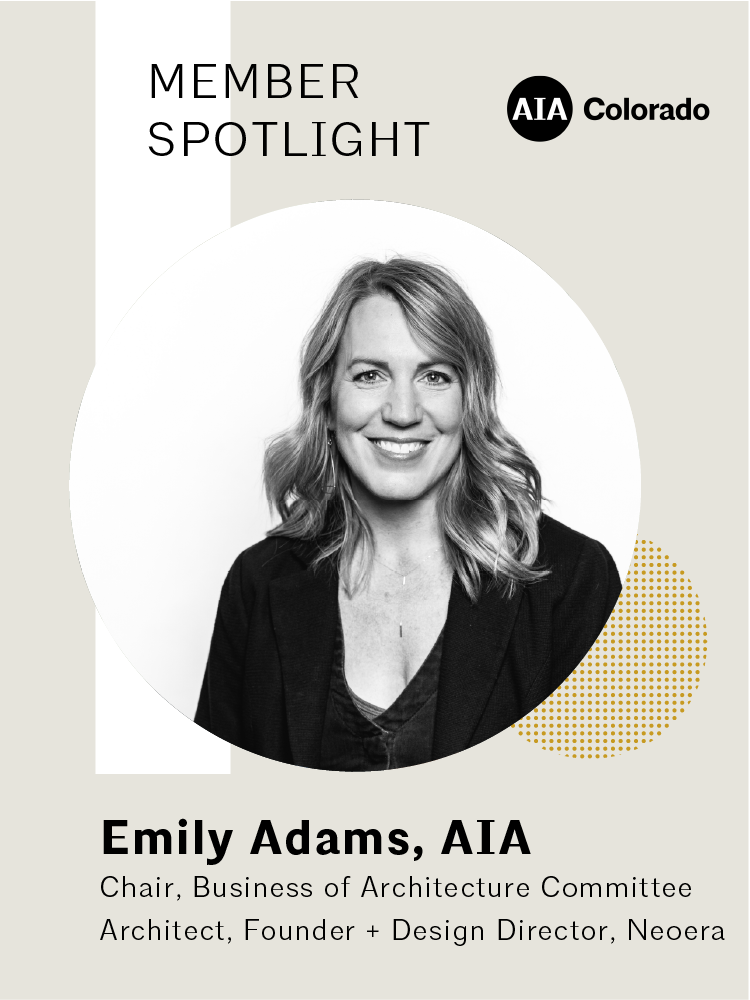
Member Spotlight:
Emily Adams, AIA
Meet Emily Adams, AIA, LEED AP, Founder and Design Director at Neoera. Emily reflects on her unexpected path from journalism to architecture, the importance of curiosity in the design process, the meaningful impact small firms and small projects can have, and why emerging professionals should understand not only design, but the business of architecture.
Read the Member Spotlight here.
COMMUNITY
NEWS
Colorado Green Building Guild 10th Annual Green Home Tour
Saturday, September 19th, from 10am – 7pm, enjoy a self-guided tour of sustainable and high-performance homes across Boulder, Denver, and Fort Collins, paired with the Building Better Expo showcasing the products, practices, and professionals behind sustainable building in Colorado. Attendees can expect to meet some of the homeowners, direct access to the builders and designers who created the homes, and a chance to see green building principles in action. The day wraps with an after party at Relish in Louisville. Hosted by the Colorado Green Building Guild (CGBG), tickets are $15 for a single home tour and $30 for unlimited and available here. All tickets include the expo and after party. AIA Members can use the discount code “AIA” for reduced ticket costs! ($10/$20) If you are interested in volunteering, email jessica@bossarch.com.
CAP’s Fall 2026 Lecture and Exhibition Series
All events are free, open to the public, and will be recorded unless otherwise specified. All lectures, unless specified, will start at 12 p.m. and be held on the Second Floor Gallery of CU Building, 1250 14th St, Denver, CO. View the full Fall schedule here.
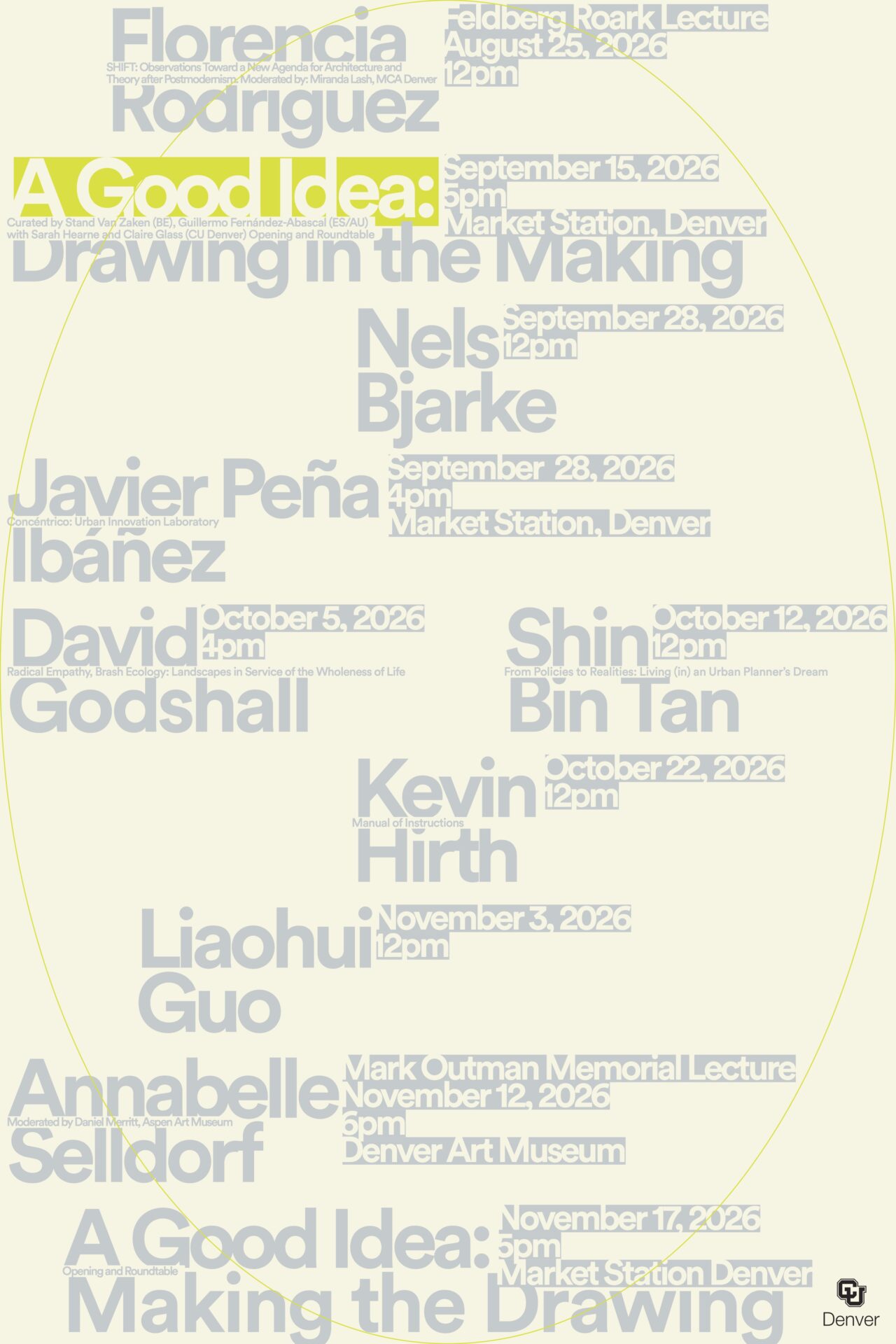
- Tuesday, August 25 • Florencia Rodriguez moderated by Miranda Lash – NESS, Founding Principal
- Monday, September 28 • Nels Bjarke – Western Water Assessment & CIRES, Research Scientist
- Monday, October 5 • David Godshall – Terremoto, Design Director
- Monday, October 12 • Shin Bin Tan – Lee Kuan Yew School of Public Policy, National University of Singapore, Assistant Professor
- Thursday, October 22 • Kevin Hirth – CU Denver CAP, Associate Professor and Director of Undergraduate Studies, KEVIN HIRTH Co., Founder
- Tuesday, November 3 • Liaohui Guo – Atelier Guo, Principal Architect
- Thursday, November 12 • Annabelle Selldorf, FAIA – Selldorf Architects, Founder
CAREER CORNER
JOB BOARD UPDATES
AIA Colorado Job Board
Looking for your next career move? Explore fresh job listings updated daily. Hiring? Showcase your open position for 30 days and connect with top-tier talent.
Featured listings:
NEWA FROM
AIA NATIONAL
Meet AIA Chief Economist Richard Branch
Branch discusses how to leverage economic data, how your firm can prepare for multiple future scenarios at once, and why housing is a “silver bullet for the economy.” Read at AIA.
Leveraging AI for Resilient Design
Discover how AI-powered digital twins and LLMs can help architects assess risk, test scenarios, and translate resilience strategies into actionable, measurable design decisions. Register at AIA.
Women’s Leadership Summit 2026
Women’s Leadership Summit, powered by AIA, brings together the largest network of women in architecture, design, and the allied building industries. This year, the event will take place in Kansas City, MO, from November 1-3. Be part of the WLS community dedicated to advancing women’s leadership and empowerment. Learn more and register at AIA.
AIA COLORADO’S
PREMIER PARTNER SPOTLIGHT
We’re proud to highlight one of AIA Colorado’s Premier Partners, The American Institute of Steel Construction (AISC), and look forward to their ongoing support and involvement serving Colorado’s architecture community.
The American Institute of Steel Construction (AISC), headquartered in Chicago, is a non-partisan, not-for-profit technical institute and trade association established in 1921 to serve the structural steel design community and construction industry in the United States. AISC’s mission is to make structural steel the material of choice by being the leader in structural-steel-related technical and market-building activities, including specification and code development, research, education, technical assistance, quality certification, standardization, market development, and advocacy. AISC has a long tradition of service tothe steel construction industry providing timely and reliable information.
Learn more about The American Institute of Steel Construction (AISC).
AIA COLORADO’S
ALLIED MEMBERS
Find the Right Expertise
Our Allied Members bring depth and diversity to Colorado’s design and construction community. These experienced professionals offer specialized knowledge that complements architectural practice and elevates project outcomes statewide.
Helpful Links:
- Mile High Station, Denver, CO
- Thursday, September 17
- Tickets available here
- Awards sponsorship information
2026 Practice + Design Conference
- Keystone Conference Center, Keystone, CO
- November 11 – 13
- Conference sponsorship information
- Expo Hall registration
AIA Colorado Firm Directory
- Add your firm to the directory here.
Volunteer Opportunities:
Have news to share? If you or your firm have been featured in the media, published in a design outlet, received an award, or announced a major promotion, email AIA Colorado’s Communications Director Jon Bell.
Member Spotlight: Emily Adams, AIA

AIA Colorado Member Spotlight celebrates the architects who are shaping Colorado’s built environment and strengthening our profession. Through conversations about design, leadership, career paths, and the communities they serve, this series offers a personal look at the people behind the projects and the ideas that continue to move architecture forward.
AIA Colorado Member Spotlight
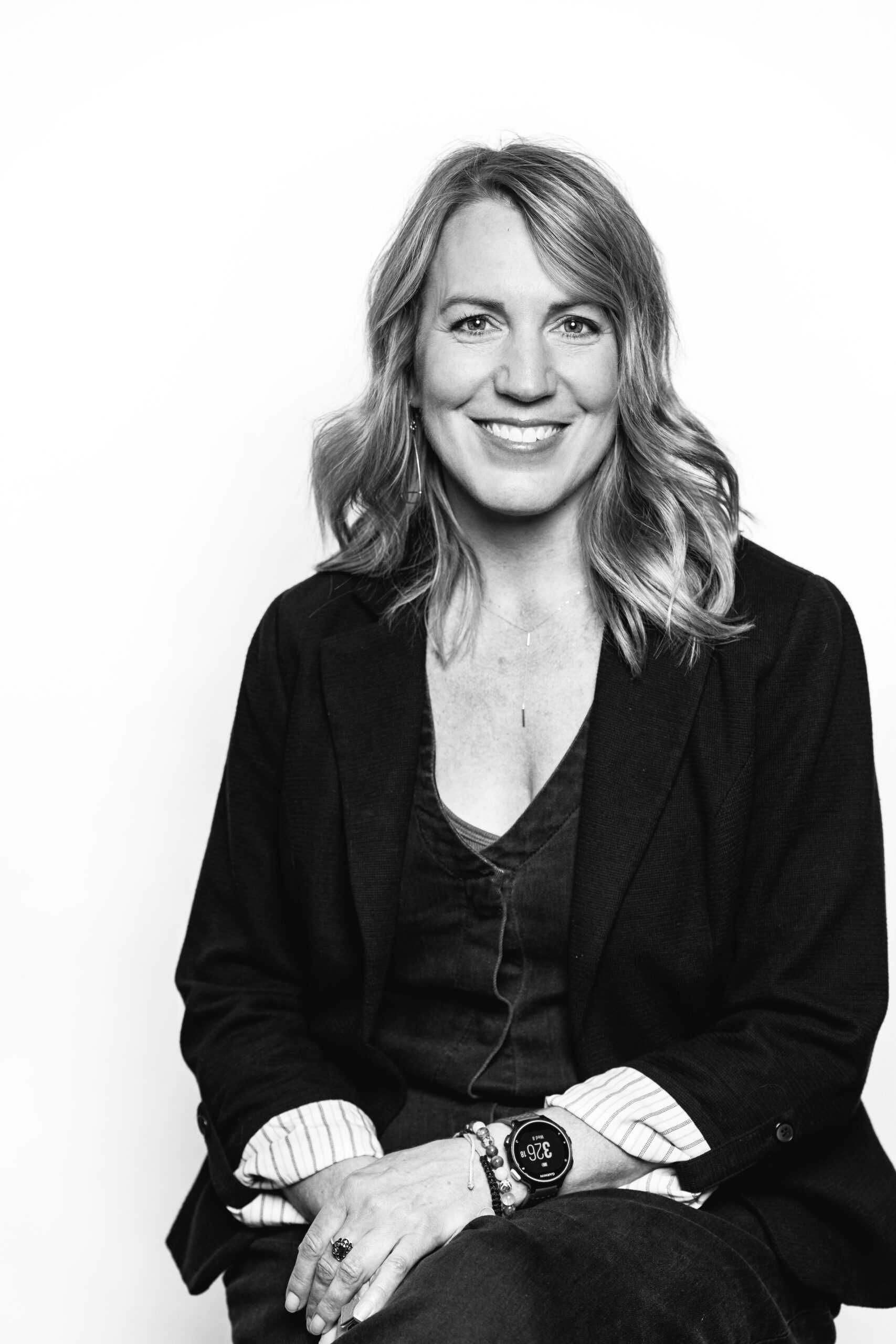
Emily Adams, AIA
Introduction
From journalism and graphic design to architecture and firm ownership, Emily Adams, AIA, LEED AP, has built a career shaped by curiosity, creativity, and an interest in understanding how people experience the spaces around them.
As Founder and Design Director of Neoera, Emily leads a Denver-based practice working across higher education, aviation, workplace, retail, and residential design. Since founding the firm in 2013, she has focused on creating a collaborative and service-oriented design experience while demonstrating the impact small practices can have on projects of every scale.
In this Member Spotlight, Emily reflects on the unexpected path that led her to architecture, designing with curiosity, the value of small firms, what emerging professionals should understand about the business of architecture, and the experiences outside the profession that continue to inspire her.
The Conversation
What drew you to architecture, and when did you know it was the right path for you?
Looking back, there were signs from a very early age. When I was six or seven, I was constantly rearranging my bedroom, which drove my mom absolutely crazy. I was fascinated by how simply changing the organization of a space could completely change the way it felt.
But architecture wasn’t my original career path. In fact, it never occurred to me that it could be a career. I thought I wanted to become a broadcast journalist, so I studied journalism at Iowa State University. While I was there, I worked my way from a computer graphics creator and camera operator to being a “one-man band” at an ABC affiliate news station. I loved uncovering stories, talking with people, and understanding the challenges they faced, but I eventually realized that the relentless pace and daily deadlines of broadcast journalism weren’t for me.
That realization eventually brought me to Denver, where I spent some time working in marketing and graphic design and had the opportunity to work alongside an architect. At first, I thought I would pursue interior design, but the owner of a local architecture firm encouraged me to consider a Master of Architecture degree instead. I began working at the firm while taking a few architecture classes at the University of Colorado Denver, and I fell in love with architecture.
Working alongside talented professionals opened my eyes to what the profession could be, but architecture school confirmed that I had found the right path. It fundamentally changed the way I saw and understood the world around me, and I knew there was no going back.
“It fundamentally changed the way I saw and understood the world around me, and I knew there was no going back.”
How would you describe your design philosophy in a few sentences?
My design philosophy begins with curiosity, listening closely and understanding what a client truly needs, which isn’t always the same as what they initially think they need. I see our role as architects as asking the right questions, simplifying complex challenges, and uncovering opportunities that may not have been obvious at the outset.
Ultimately, good design should be thoughtful, flexible, and responsive to the people who will use the space, while making the greatest possible impact within the realities of the project. And whenever possible, I like to leave room for a little whimsy.
Tell us about a recent project you are proud of. What made it meaningful?
One recent project I’m especially proud of is our work for the College of Media, Design and Information (CMDI) at the University of Colorado Boulder. Early in the project, we worked closely with a large group of stakeholders, using visioning exercises to uncover what they truly needed from the available square footage. That collaboration shaped multiple spaces, including a highly flexible, technology-rich multipurpose space that can support everything from student gatherings and lectures to large faculty meetings.
We also recognized an opportunity to transform previously underused corridors into inviting, occupiable spaces for students and faculty. By creating niches throughout these areas, we were able to extend the project’s impact well beyond its original program.
What makes the project especially meaningful to me is seeing how people use the spaces we design. Because we continue to work in the building, I regularly see students, faculty, and staff occupying the spaces and making them their own. There’s nothing more gratifying than that.
It wasn’t a large project, but it reinforced something I strongly believe: a project doesn’t have to be large to make a meaningful difference in people’s lives. Even small, thoughtful interventions can improve someone’s everyday experience. When we bring that same level of care and intention to every project, regardless of scale, the cumulative impact can be incredibly powerful.
“A project doesn’t have to be large to make a meaningful difference in people’s lives.”
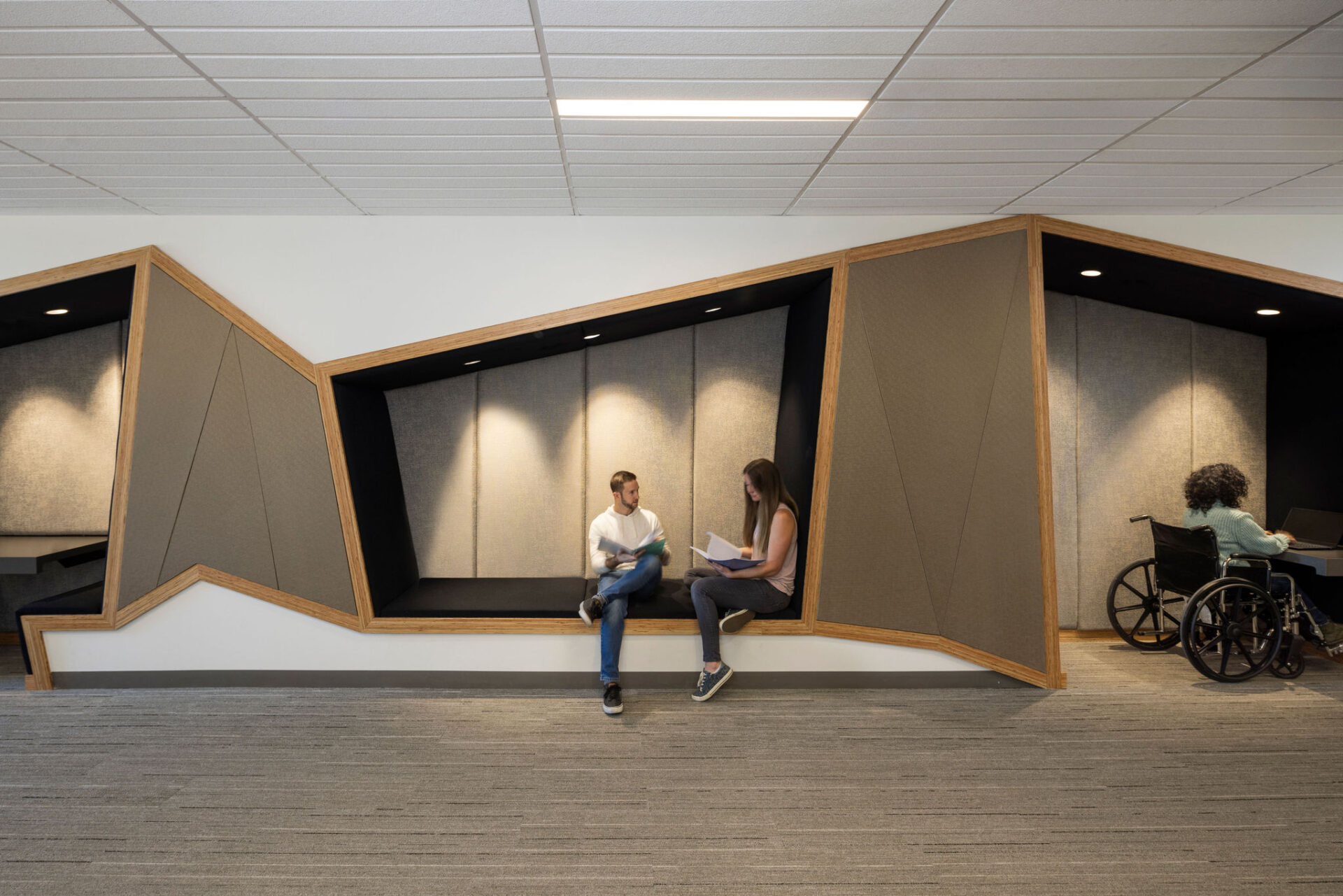
CU Boulder College of Media Design & Information in the CASE Building: Undulating niches transform a previously underutilized corridor into a vibrant, active space for studying and small-group meetings.
Photographer: Jess Blackwell
What is one change you would like to see in the architecture profession?
I would like to see the profession more fully recognize the value that small architecture firms bring to the table. Our size allows us to be agile, to respond quickly, adapt as projects evolve, and make decisions without layers of bureaucracy. Clients also benefit from direct access to firm leadership, greater continuity throughout the process, and a team that is deeply invested in both the project and the relationship.
Small firms are more than capable of taking on complex, large-scale work, yet we often compete with much larger firms operating with fundamentally different resources and fee structures. I’d like to see more clients create meaningful opportunities for small practices and evaluate teams not simply by their size, but by their expertise, creativity, responsiveness, and the overall value they bring to a project.
More broadly, I’d also like to see architects reconsider how we establish our fees. When our value is tied primarily to the number of hours spent on a project, it doesn’t fully account for the experience, insight, and creativity behind the work. I believe our fees should more accurately reflect the value of our ideas and the impact our expertise creates for our clients.
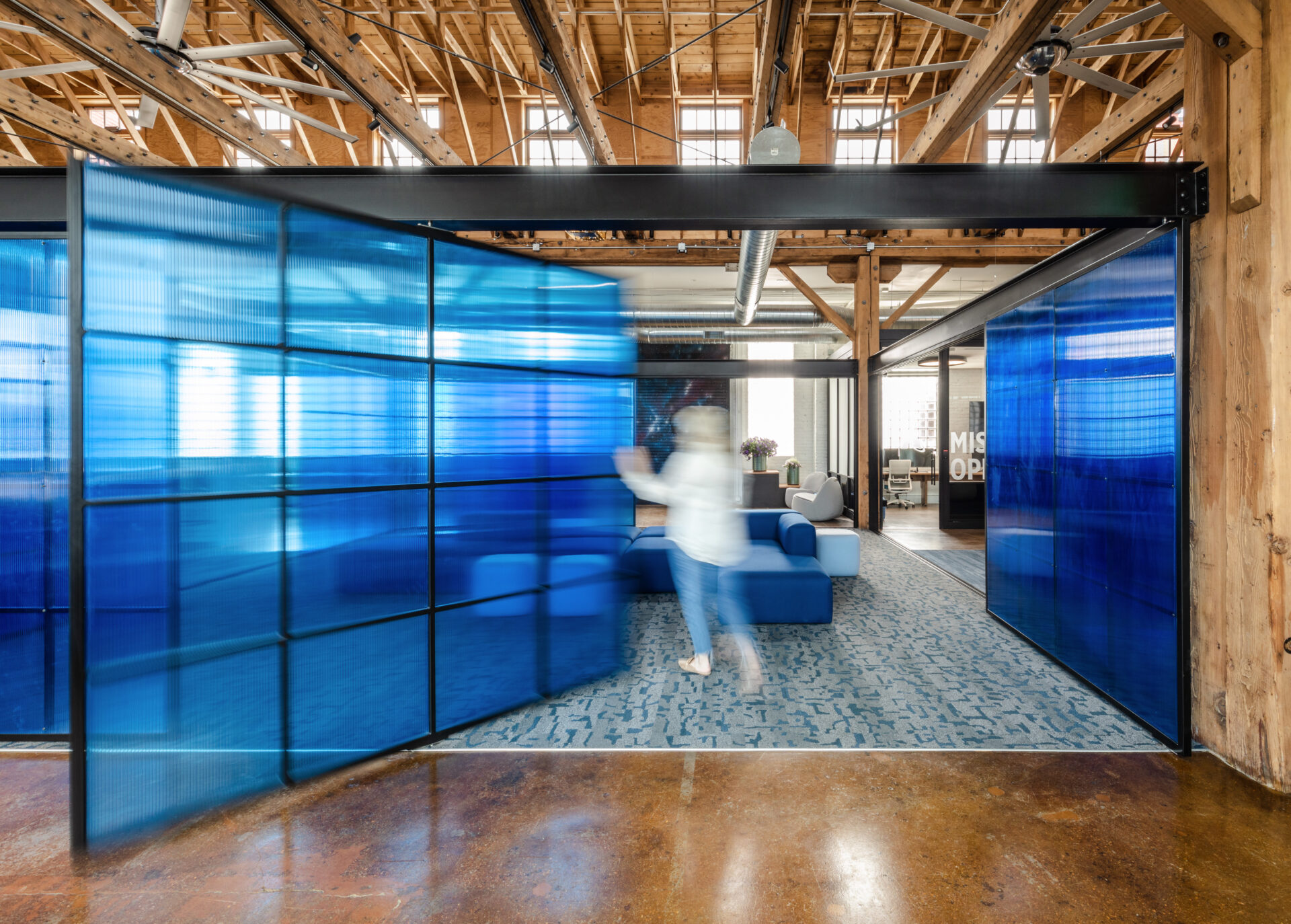
Astroscale U.S. Headquarters: Drawing inspiration from the company’s global headquarters in Japan, the design incorporates Eastern influences, including sliding and pivoting shoji screens.
Photographer: Justin Martin.
What advice would you give to emerging professionals in Colorado?
Be curious and resourceful. Design is an important part of architecture, but it’s only one facet of the profession. Being an architect takes dedication, grit, and perseverance. When you don’t understand something, ask questions, but also take the initiative to find the answer. Curiosity pushes us to keep learning, while resourcefulness helps us become more capable architects and more effective leaders.
I would also encourage emerging professionals to learn about the business of architecture. In school, we’re taught how to design, think differently, and solve problems creatively, but we aren’t necessarily taught how an architecture firm operates. Ask your firm’s leaders about business development, financial strategy, and the thinking behind key decisions. Understanding the bigger picture will make you a better employee, leader, and even a future employer. It will also help you see how your individual contributions support the success of the entire practice.
“Curiosity pushes us to keep learning, while resourcefulness helps us become more capable architects and more effective leaders.”
What inspires you outside of architecture?
I’m inspired by experiences that take me beyond my own perspective. Experiencing different cultures and connecting with people from different places, whether that’s in another part of the United States or across the world, continually challenges the way I see and understand the world. Inevitably, those experiences also shape the way I think about architecture.
Music is another significant source of inspiration for me. I’ve played and performed throughout my life, and I’ve always loved the process of creating something. Whether it’s architecture, art, or music, there’s something incredibly rewarding about beginning with an idea, exploring where it can go, and ultimately bringing something into the world that didn’t exist before.
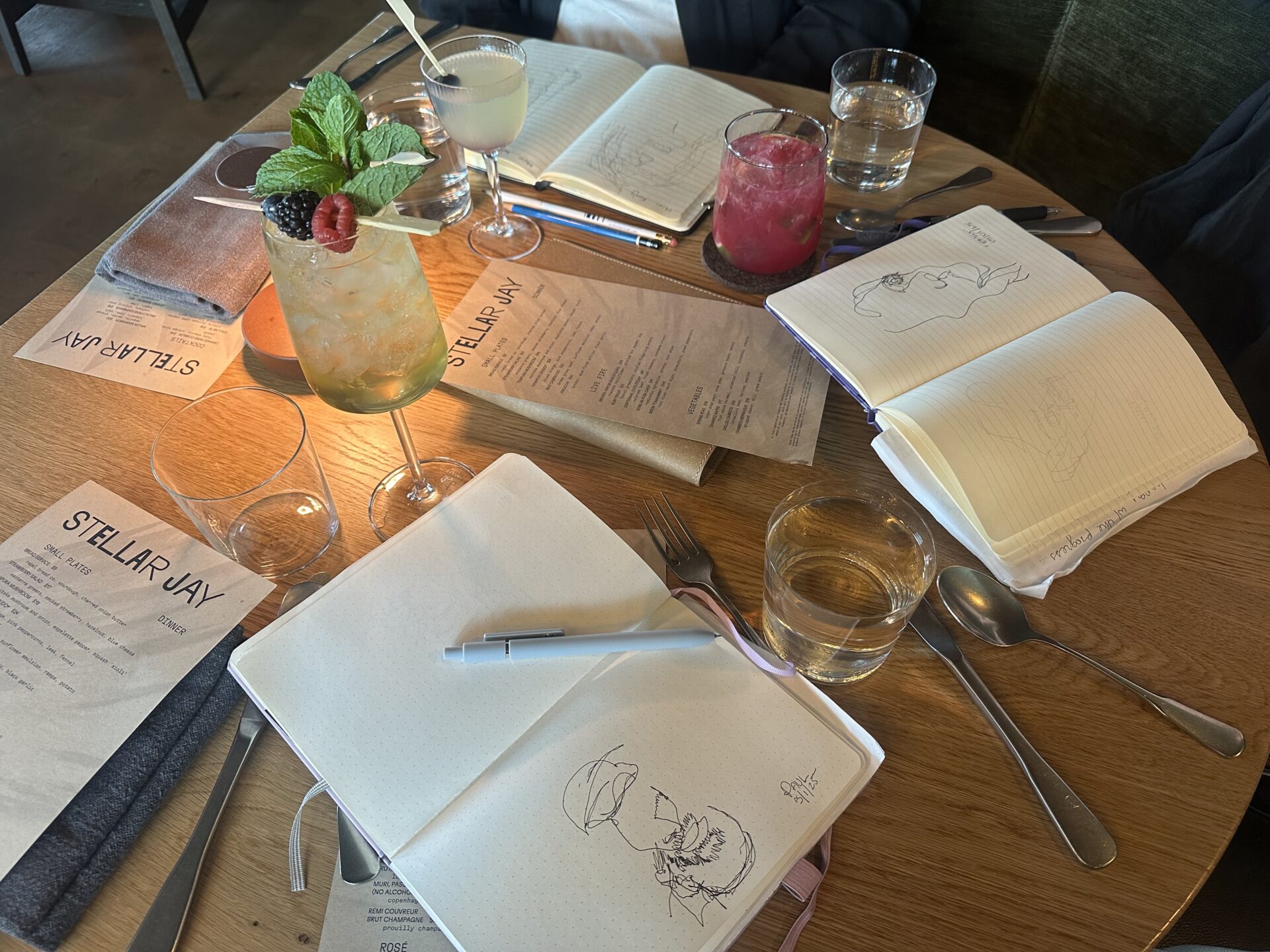
We regularly gather outside the office to laugh, connect, and gain fresh perspective. This photo captures one of our evenings spent blind-contour sketching, an activity that has become a team favorite.
Photography: Emily Adams, AIA
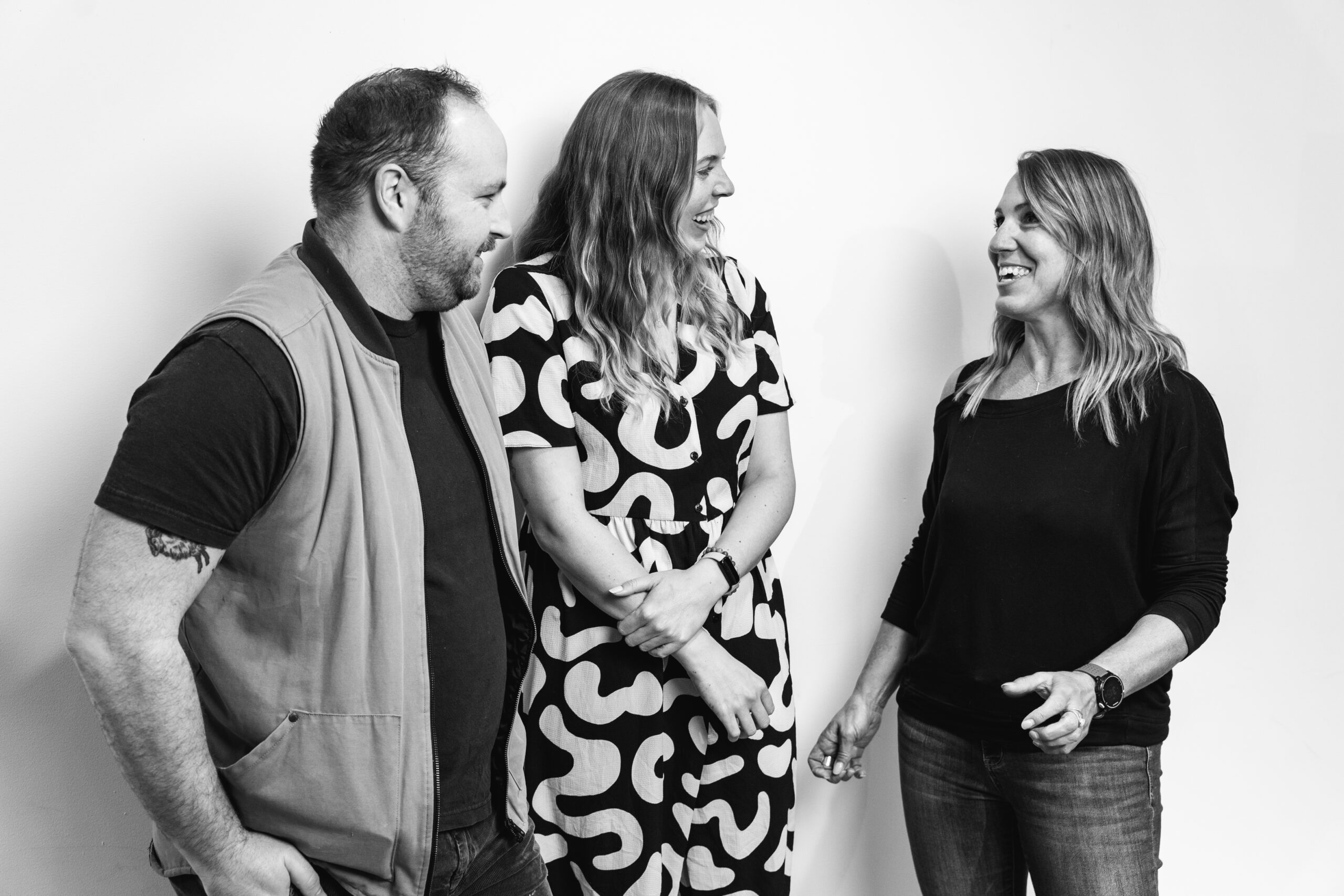
The Neoera team: Paul Hermann, Kelsey Matteson, and Emily Adams, AIA.
Photography: Cody Mann
Thank you to Emily Adams, AIA, for sharing her story, perspective, and insights on the value of curiosity, creativity, and thoughtful design as part of the AIA Colorado Member Spotlight series.
Denver Airport Tour
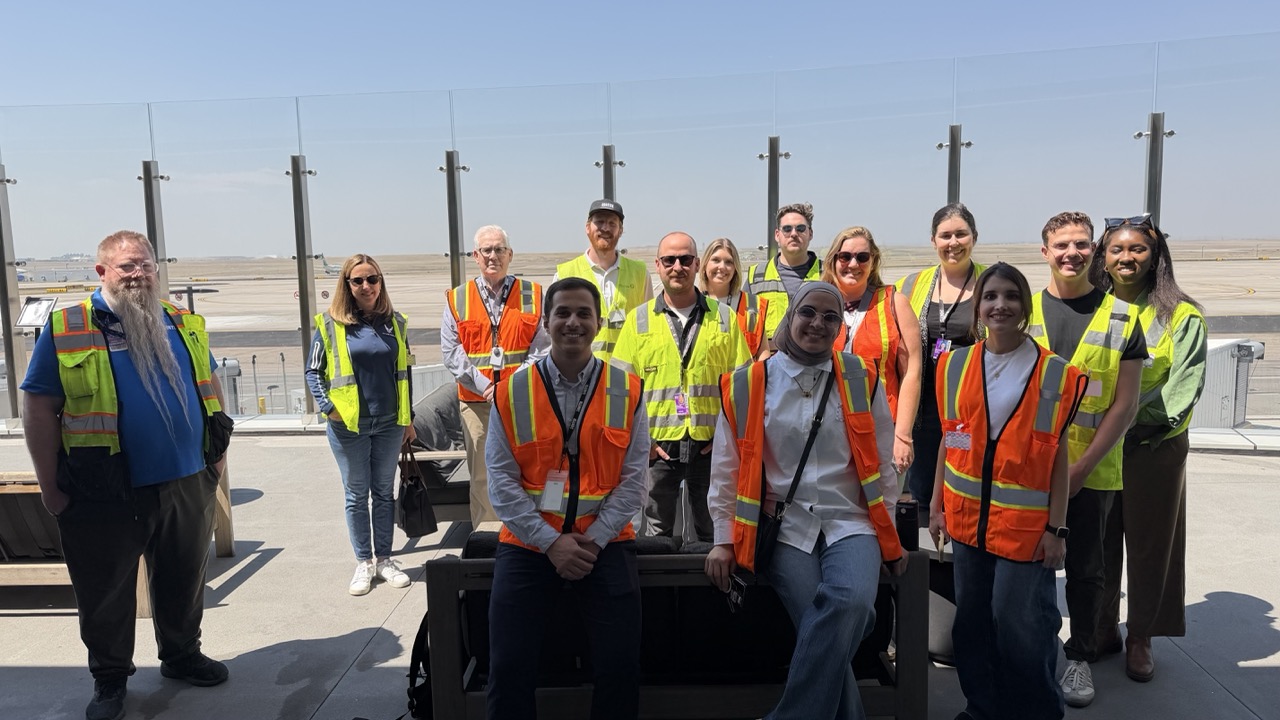
August 6, 2026
Earlier this month, a group of AIA Colorado members had the rare opportunity to go behind the scenes at Denver International Airport (DEN), exploring spaces and systems that most travelers, and even most architects, never get to see.
Led by aviation architects James Childs, AIA, NCARB; Jena Hall, AIA, LEED AP BD+C; and John Lutz, AIA, LEED AP BD+C, of HNTB, the tour offered an in-depth look at the architecture, infrastructure, and coordination required to design and continually evolve one of the country’s busiest airports.
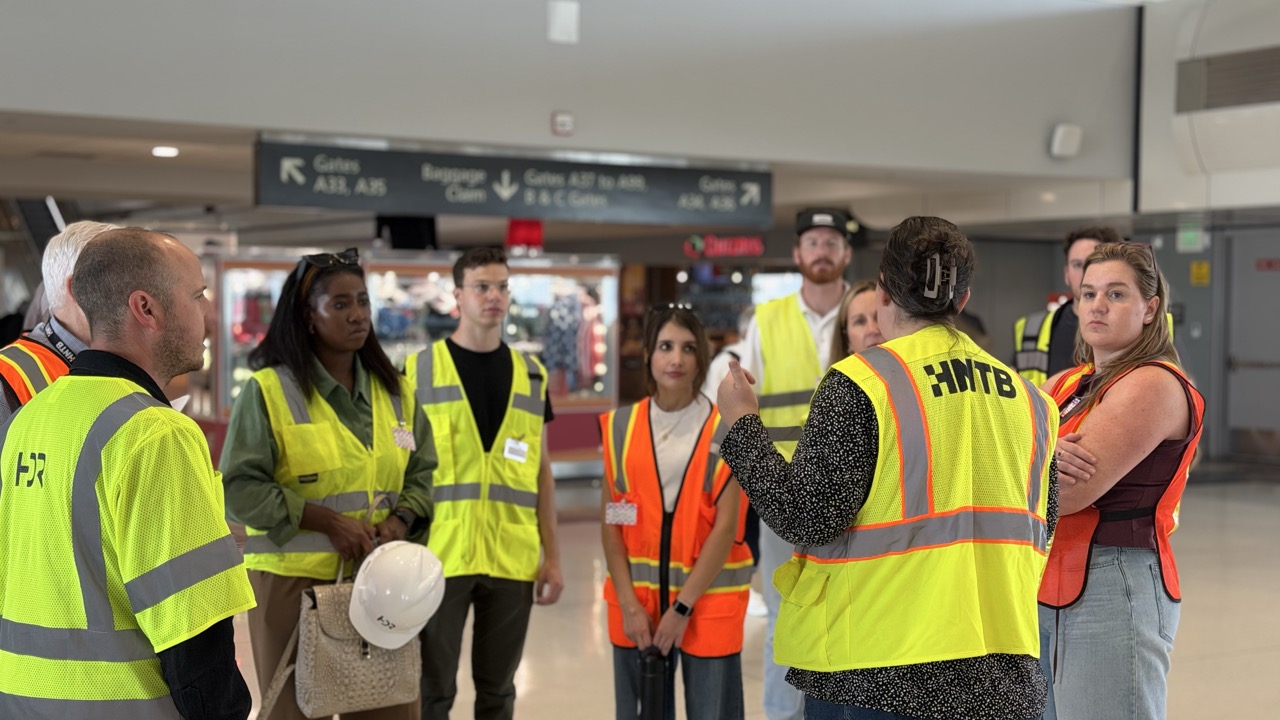
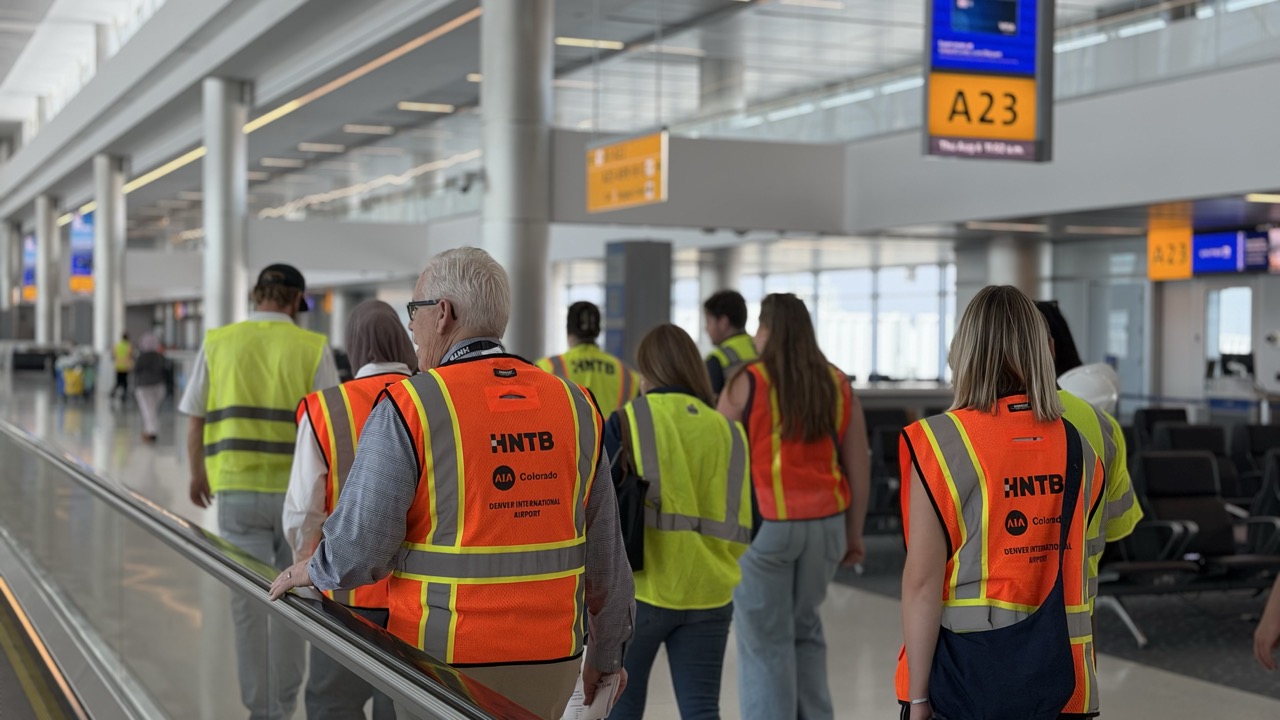
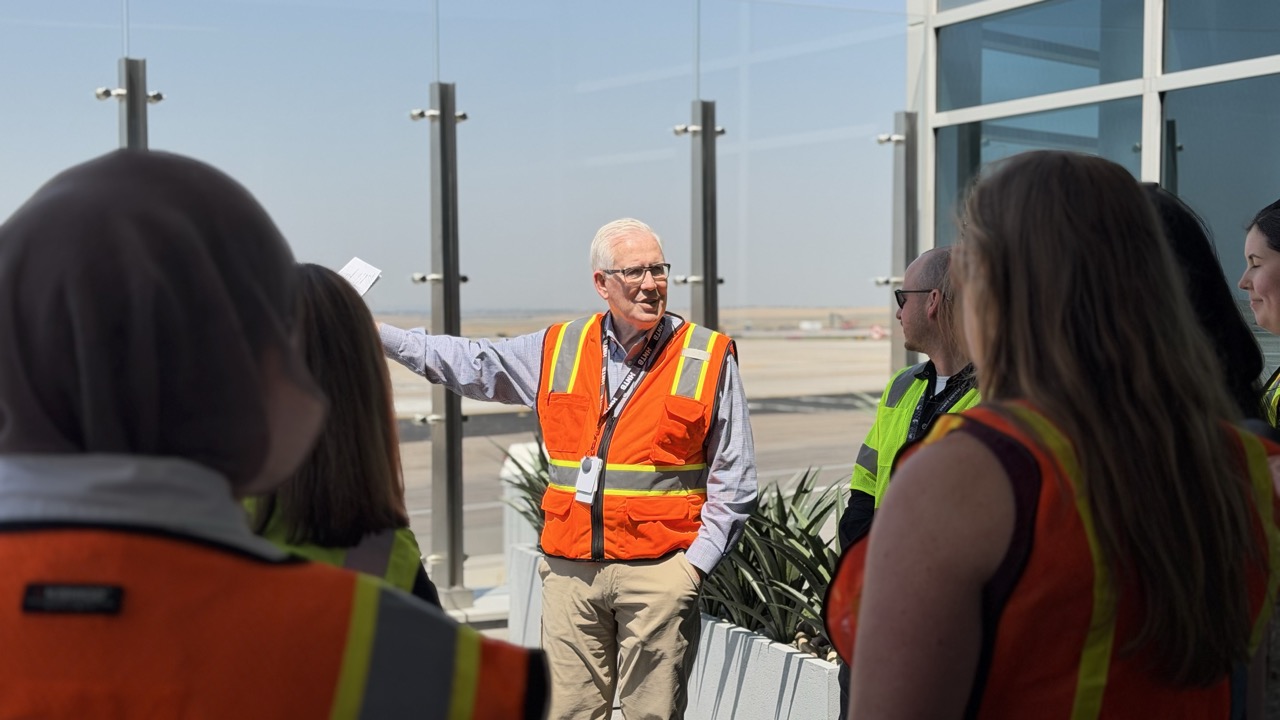
The day began with a closer look at the recent A-West Concourse expansion, where participants heard directly from the architects involved in bringing the project to life. The group learned about the complexities of expanding an active airport, including construction phasing, accessibility and life-safety requirements, and the challenge of maintaining airport operations throughout the process.
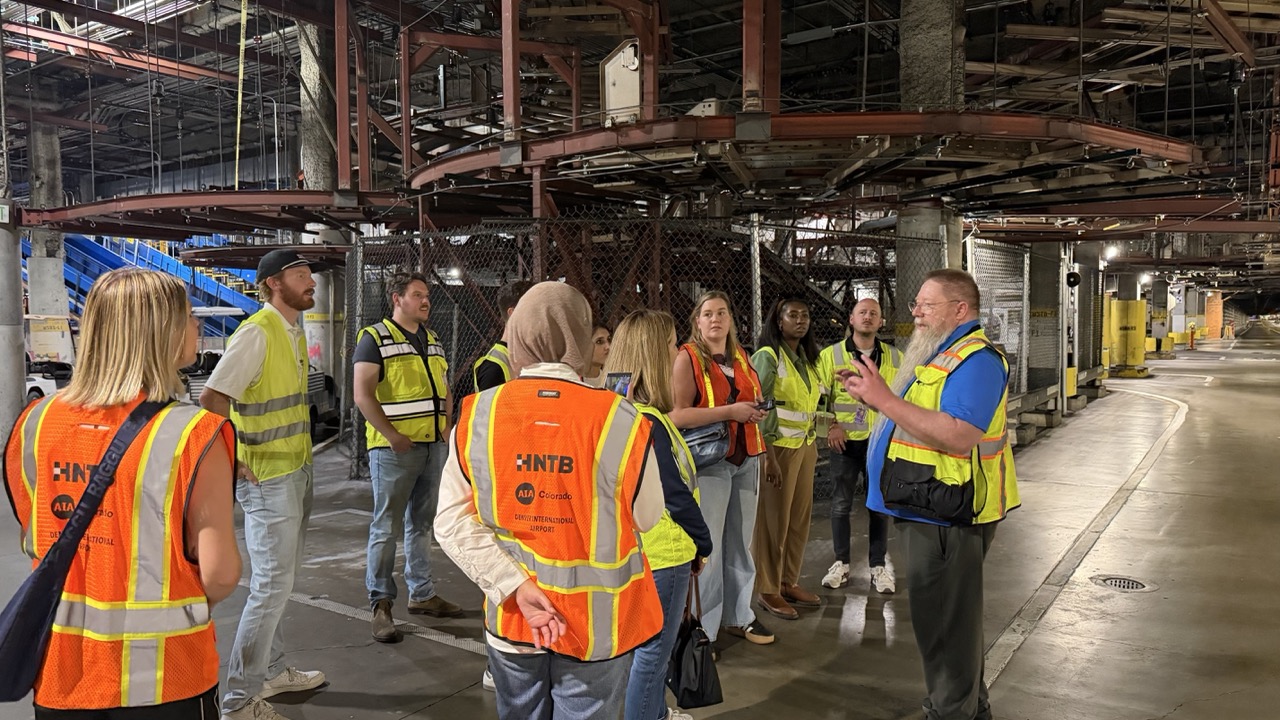
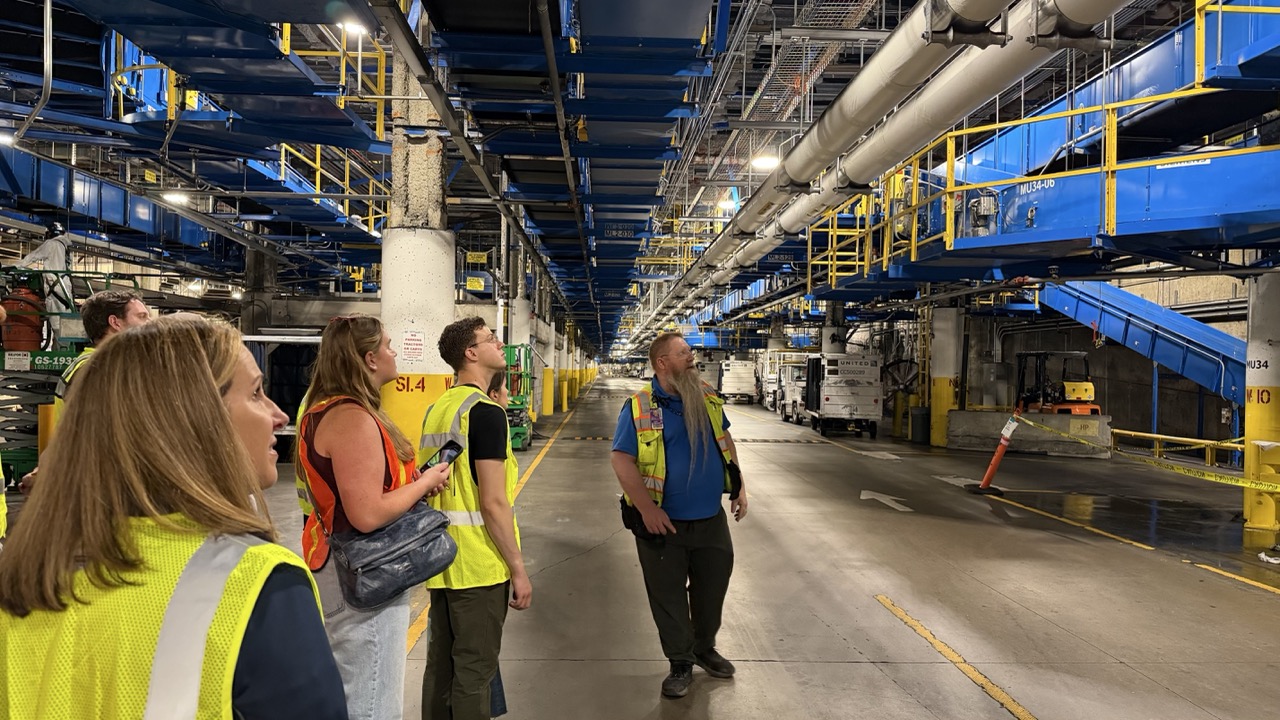
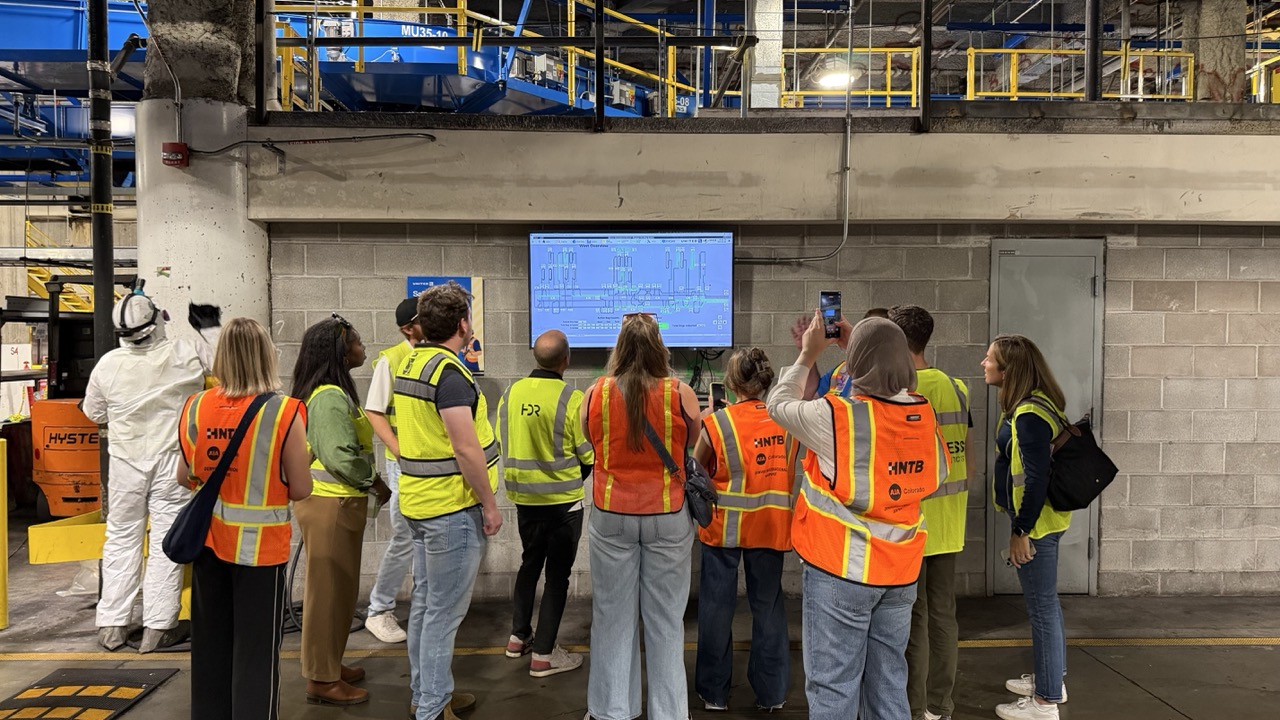
From there, members traveled well beyond the spaces typically experienced by the public. Below the airport, participants explored United Airlines’ baggage handling infrastructure and learned how architecture, mechanical systems, security, and operations must work together to move passengers and baggage efficiently through DEN.
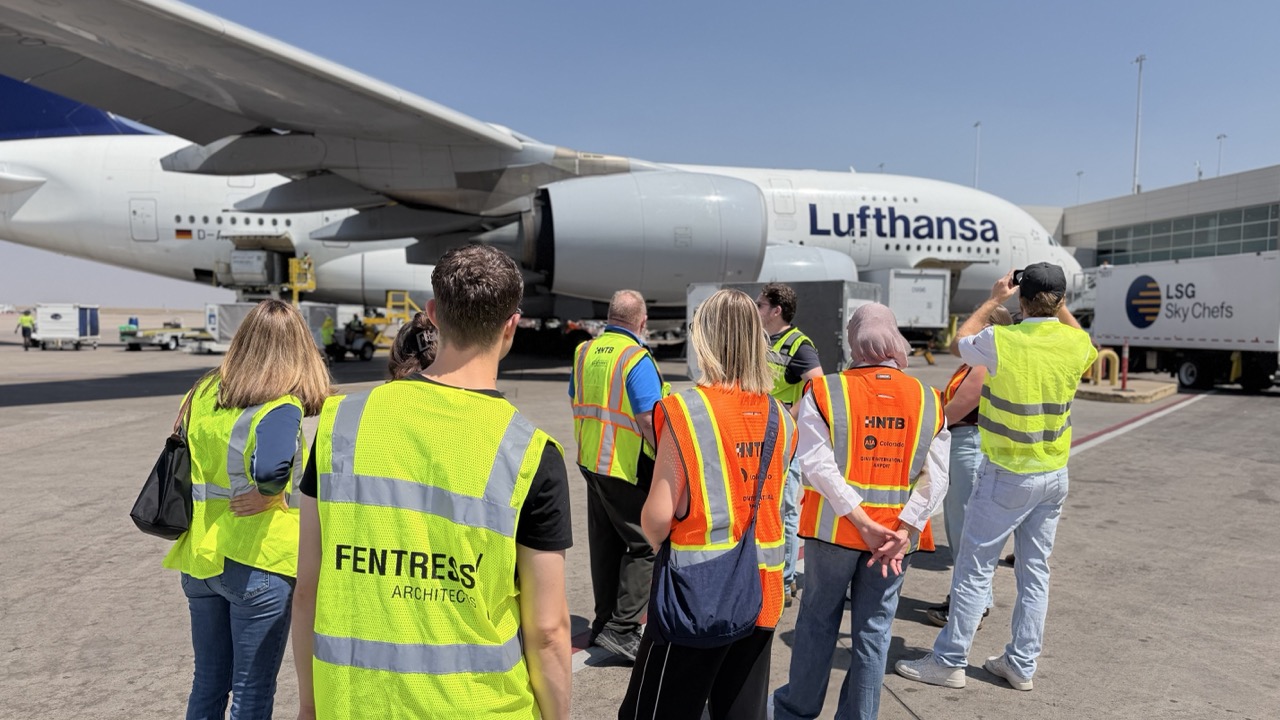
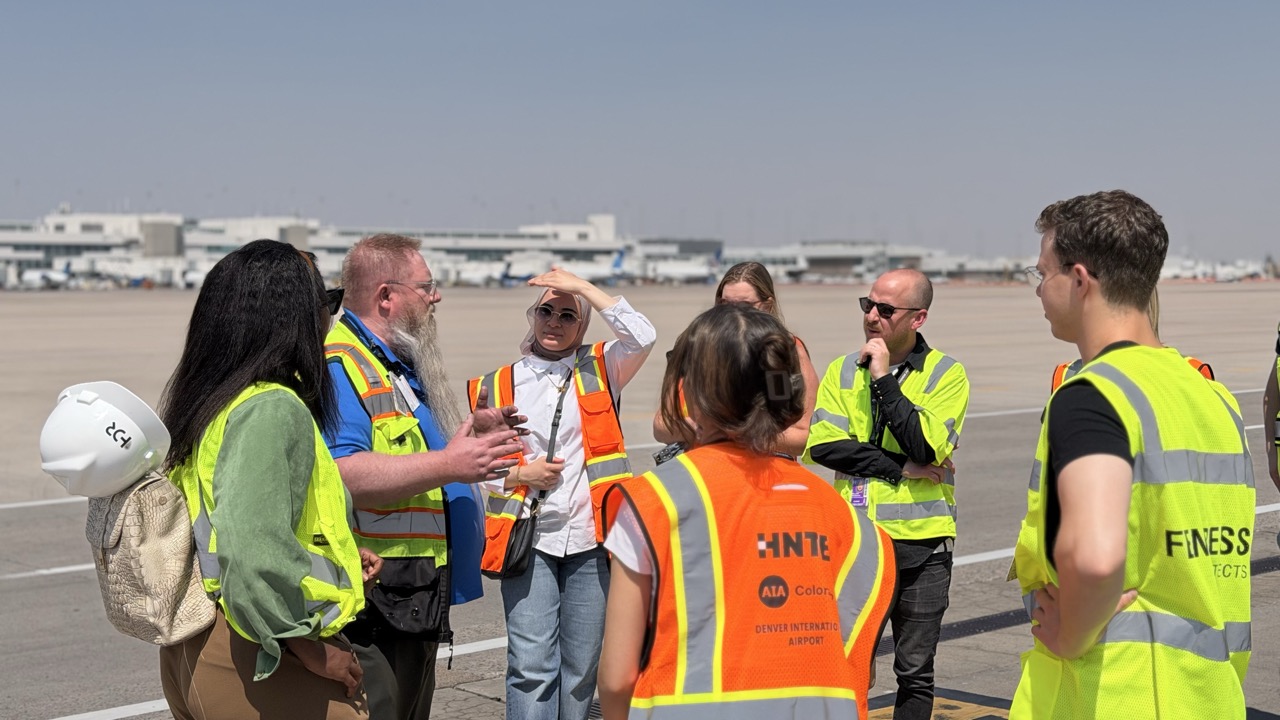
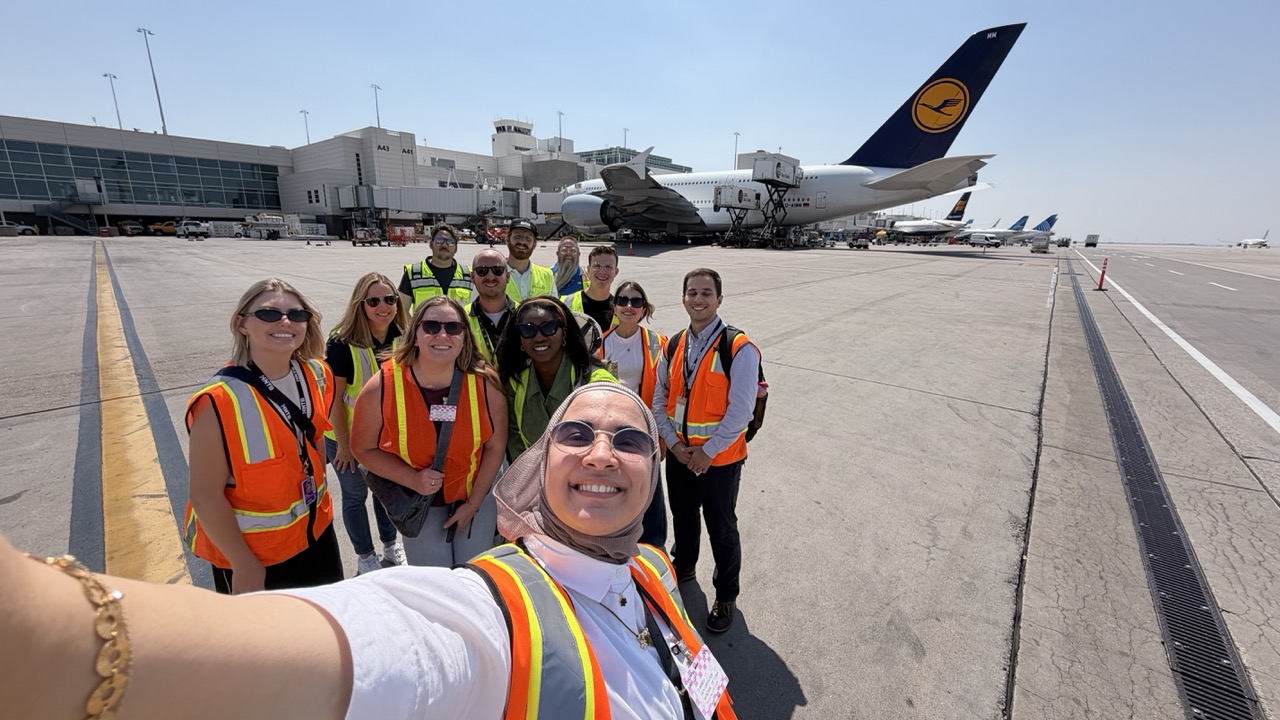
The tour also brought members onto the apron level, offering a dramatically different perspective of the airport and its operations. As a special highlight, the group had the opportunity to see an Airbus A380, the world’s largest passenger aircraft, up close, providing a memorable sense of the scale that airport architecture and infrastructure must accommodate.
Throughout the tour, conversations explored the many layers of aviation design, from phased construction and secure circulation to weather resilience, mechanical systems, accessibility, and the coordination required to keep a high-volume transportation hub operating safely.
The experience offered members a valuable look at the extraordinary complexity behind an environment that millions of passengers move through every year, and an opportunity to learn directly from fellow architects helping shape DEN’s continued evolution.
Special thanks to the HNTB team, James Childs, AIA, Jena Hall, AIA, and John Lutz, AIA for sharing their expertise and providing access to these rarely seen areas of DEN, and to Mo Zaina, Assoc. AIA, NCARB, and Aden Becker for organizing and facilitating this unique learning opportunity for the AIA Colorado community.
Event Recap: Pursuing Net Zero Water in Colorado
Event Recap
Pursuing Net Zero Water in Colorado: Navigating Water Law, Permitting & Infrastructure Constraints
August 5, 2026
What does it actually take to pursue Net Zero Water development in Colorado?
That question guided the second installment of the AIA Colorado’s Committee on the Environment (COTE)’s summer webinar series focused on water and the built environment. Following the first session, Designing Within the Limits: Water Innovation & the Future of Resilient Development in Colorado, this conversation moved from the possibilities of water-conscious design to the practical realities of implementing it.
Hosted by AIA Colorado COTE members Alexis Campion, Assoc. AIA, and Francis Mougne, AIA the discussion brought together professionals working at different points within Colorado’s water system: Damian Higham of Denver Water, Magdiel Garcia, P.E., of Merrick & Company, and Mark Mitisek, P.H., of Spheros Environmental.
Together, the panel explored the water rights, permitting requirements, infrastructure decisions, regulatory frameworks, and long planning horizons that can determine whether an innovative water strategy succeeds.
Start the water conversation earlier
One of the clearest takeaways was the importance of addressing water much earlier in the development process.
Mitisek described his work in water supply planning and water rights as occurring at the very beginning of a project—sometimes before development has taken physical shape. Understanding available water supplies and their legal constraints can influence everything that follows.
Higham shared a similar perspective from the utility side. Denver Water works with developers to determine whether potable water, recycled water, or another source is most appropriate, but those conversations are most productive before infrastructure decisions have already been made.
“There are times where it’s got to be pre-master plan,” Higham said.
For architects, the message is clear: water strategy should not be treated as a technical question to resolve late in design. Early coordination becomes especially important for district-scale recycled water, localized treatment systems, precipitation harvesting, dual plumbing, and other innovative approaches.
Understanding the regulatory landscape
Higham provided an overview of two important components of Colorado’s regulatory framework: Regulation 84, which governs reclaimed water used for approved non-potable applications, and Regulation 86, which addresses graywater treatment and reuse.
These regulations illustrate an important reality: the technical ability to treat water is only one part of the equation. Design teams must understand where water comes from, how it will be treated and used, what happens after use, and which agencies have jurisdiction.
Water reuse can also occur at dramatically different scales. Denver Water operates Colorado’s largest recycled water program, delivering approximately two billion gallons annually, primarily for irrigation and cooling. At a much smaller scale, its administration campus incorporates a localized system treating wastewater generated on site for reuse in toilet flushing and irrigation.
Both demonstrate what is possible while revealing different regulatory, operational, and economic considerations.
Think beyond the property line
Garcia encouraged architects to expand their understanding of Net Zero Water beyond the building or individual site.
“It starts with expanding the way we look at water,” he said.
His work in river restoration, flood-risk management, and watershed infrastructure emphasizes the relationship between development and the larger hydrologic system. Reducing potable water demand is important, but designers should also consider runoff, water quality, flood risk, downstream ecosystems, and existing infrastructure.
“We have to ask whether the project is improving water quality, reducing flood risk downstream, and protecting downstream resources,” Garcia said.
Achieving that broader perspective requires bringing multiple disciplines into the conversation early. Water-resource engineers, civil engineers, architects, environmental specialists, permitting experts, utilities, and regulators each see different parts of the system.
Sterling Ranch demonstrates both possibility and complexity
Mitisek provided an in-depth look at the Regional Precipitation Harvesting Pilot Study at Sterling Ranch, Colorado’s first project of its kind.
Beginning in 2009, the team established a monitoring program to understand the site’s natural hydrology, including rainfall, runoff, and infiltration. That data became foundational to determining how much water could legally be captured while protecting downstream water rights.
The project has explored targeted and regional precipitation capture using stormwater infrastructure rather than focusing primarily on individual residential systems.
“This is not just about a building. This is about the site,” Mitisek said.
The work also demonstrates the importance of collaboration with regulators. The project required sustained coordination with the Colorado Division of Water Resources, Colorado Water Conservation Board, flood-control agencies, water users, and other stakeholders. After more than 15 years of monitoring, planning, technical analysis, and regulatory coordination, the project has progressed into the water court process.
One less-obvious lesson has been the importance of communication. “The hardest thing was explaining really technical aspects of the project in a simple way,” Mitisek said.
Innovative projects require more than good engineering; their success can depend on helping regulators, clients, and communities understand what is being proposed and why.
Permitting is part of design
Garcia reinforced the importance of early regulatory coordination through his work on Reynolds Landing Park along the South Platte River.
Because the corridor had originally been constructed as a U.S. Army Corps of Engineers flood-control project, proposed improvements required a Section 408 permission process in addition to other approvals. That process took approximately three years and involved extensive hydrologic and hydraulic modeling to demonstrate that new improvements would maintain the flood-conveyance function of the existing infrastructure.
The experience illustrated how contemporary goals for ecology, recreation, and resilience can intersect with decades-old infrastructure requirements.
For design teams, permitting should therefore be understood not simply as an approval at the end of design, but as a process that can actively shape the project.
Efficiency comes first
When asked where developers and building owners can achieve the greatest return on investment, Higham cautioned that there is no universal answer. Location, available infrastructure, water sources, building use, and project scale all matter.
Denver Water nevertheless starts from a consistent principle: efficiency first.
“We want to make sure we’re using as little water as possible on the front end before we consider reuse,” Higham said.
Efficient fixtures, thoughtful landscape design, and reduced demand create lasting benefits regardless of what happens to more complicated reuse systems. Treatment equipment can fail, owners can change, and future operators may decide not to maintain an on-site system. Basic efficiency measures continue reducing demand regardless.
Once that foundation is established, reuse and alternative water supplies can build upon it.
Scale matters as well. Household rainwater and graywater systems can be valuable, but centralized or district-scale infrastructure serving large users may offer stronger economics and operational efficiency.
Planning for a future we cannot precisely predict
The conversation inevitably turned toward Colorado’s broader water future, including drought, climate change, declining supplies, and uncertainty surrounding the Colorado River.
Rather than attempting to predict one future, Higham described Denver Water’s use of scenario planning. By testing different possibilities, the utility can identify which strategies perform well across multiple conditions.
Mitisek described the challenge as a “cone of uncertainty”: the farther into the future a team plans, the less certain assumptions about water supply and demand become.
That uncertainty does not eliminate the need for long-term planning. It makes adaptability more important.
Depending on scale and complexity, projects incorporating innovative water systems may require five, seven, ten, or more years of planning. Major infrastructure, water rights proceedings, and river projects can take even longer.
Technology is helping teams navigate some of that uncertainty. Panelists described the growing use of real-time monitoring, hydrologic modeling, optimization tools, scenario analysis, digital twins, forecasting systems, and water-accounting platforms.
Garcia noted that infrastructure has traditionally relied heavily on historical hydrology, but changing conditions make that increasingly difficult.
“Historical data at some point is no longer really applying to what we’re seeing in reality,” he said.
Better data cannot eliminate uncertainty, but it can give communities and design teams better tools for responding to it.
Collaboration may be the most important infrastructure
Across water rights, utilities, watersheds, stormwater, wastewater, architecture, permitting, and public policy, the conversation repeatedly returned to collaboration.
No single profession controls Colorado’s water future.
Architects can reduce building demand and design adaptable infrastructure. Engineers can model hydrologic systems and develop solutions at the watershed scale. Utilities can identify alternative supplies and infrastructure opportunities. Regulators can establish pathways for implementation. Policymakers can adapt laws as conditions change.
AIA Colorado Advocacy Engagement Director Nikolaus Remus, AIA, reinforced the complexity of those relationships during the discussion. Water policy frequently extends far beyond an individual building, affecting municipalities, agricultural users, utilities, ecosystems, developers, and water-right holders. As water challenges increasingly intersect with the built environment, architects will have an important perspective to contribute.
Taken together, the two installments of COTE’s water series offer a useful framework for architects and design teams: start earlier, think beyond the property line, reduce demand first, and bring the right people into the conversation.
Colorado’s water constraints are real. But understanding those constraints—and designing with them rather than around them—can create new opportunities for resilient, water-conscious development.
SPEAKERS:
Magdiel Garcia, Merrick & Company
Magdiel Garcia, P.E. is a Senior Civil Water Project Manager with Merrick & Company and a licensed professional engineer with more than 10 years of experience in water resources engineering. His expertise includes river restoration, recreational whitewater design, hydraulic engineering, flood risk management, ecosystem enhancement, and municipal water infrastructure. He leads multidisciplinary teams through the planning, design, permitting, and construction of complex river and infrastructure projects across the United States. His work focuses on developing resilient, multi-benefit solutions that integrate engineering, environmental stewardship, recreation, public safety, and community needs.
Damian Higham, Denver Water
Damian Higham (pronounced “HI-um”) has his B.S. in Chemical Engineering from Montana State and has 25 years of experience in the water sector. He leads Denver Water’s recycled water program. His duties include strategic and capital planning, regulatory development, permitting, policy development, customer marketing and compliance assurance. He is a past president of WateReuse Colorado and chair of the joint reuse committee of RMSAWWA/RMWEA.
Mark Mitisek, P.H., LRE Water
Mark Mitisek is a water resources professional with more than 20 years of consulting experience specializing in water supply planning, water resources engineering, hydrologic modeling, and the development of advanced decision-support and water accounting systems. He has led a wide range of projects, from real-time flood forecasting and water rights evaluations to comprehensive water supply planning efforts for municipalities,special districts, and private clients. Mark currently manages Colorado’s first Regional Precipitation Harvesting Pilot Study at Sterling Ranch, where he oversees the natural conditions monitoring program supporting the development of a large-scale precipitation harvesting water right and works closely with state agencies to advance the regulatory and operational framework for precipitation harvesting in Colorado. In addition to his technical expertise, Mark leads multidisciplinary water information technology teams that develop innovative modeling tools, data management platforms, and digital solutions that enhance water resource planning, administration, and operational decision-making. Recognized for his collaborative leadership style, he combines engineering, data analytics, and technology to deliver practical, sustainable solutions to complex water management challenges.
Part 1 Recap
Designing Within the Limits: Water Innovation & the Future of Resilient Development in Colorado
The online event featured an interdisciplinary panel including Dr. Sybil Sharvelle of Colorado State University, Lauren McNeill of Group14 Engineering, Russ Slade of Denver Water, and Mike Riggs, AIA, of RTA Architects. Together, the panel explored how architects can respond to Colorado’s finite water resources through innovation, collaboration, and long-term planning.
About the
Committee on the Environment
The Committee on the Environment (COTE®) is a state and national AIA Knowledge Community working for architects, allied professionals, and the public to achieve climate action and climate justice through design. We believe that design excellence is the foundation of a healthy, sustainable, and equitable future. Our work promotes design strategies that empower all AIA members to realize the best social and environmental outcomes with the clients and the communities they serve.
This committee will review AIA’s 2030 Challenge and more to advance AIA Colorado’s imperative of environmental stewardship.
Colorado Architecture News | 08.05.26

News from the Colorado Chapter of The American Institute of Architects
08.05.26
In this Newsletter:
- 2026 Legislative Recap
- Committee on the Environment Water Series: Part 1 recap
- Early Registration open for the Practice + Design Conference
- Colorado ByDESIGN™
- Aug 7 • Coffee meet & greet in Fort Collins
- Aug 19 • Timber Ridge Village tour in Vail
- Aug 20 • Palmer High School construction tour
- Aug 27 • Anythink Nature Library tour
- Premier Partner spotlight: American Institute of Steel Construction (AISC)
AIA COLORADO’S
NEWS
2026 Legislative Recap
Whether you followed the session closely or are just catching up, this recap offers valuable context on where Colorado is headed, and what to watch as lawmakers prepare for 2027. Colorado’s 2026 legislative session may have felt quieter than recent years, but its impact on architecture, housing, resilience, and the future of Colorado’s built environment is anything but. From housing policy and wildfire resilience to building codes, liability, and emerging conversations around AI data centers, AIA Colorado’s annual Legislative Recap breaks down the bills that mattered most to architects and the profession. Read it here.
Event Recap: Designing Within the Limits
As Colorado faces increasing pressure from prolonged drought, rising temperatures, population growth, and changing water availability, AIA Colorado’s Committee on the Environment (COTE) recently launched its two-part summer webinar series with a timely discussion exploring the future of water-conscious design.
Created and moderated by committee members Alexis Campion, Assoc. AIA, and Francis Mougne, AIA, Part 1 in the series, Designing Within the Limits, brought together experts from architecture, engineering, utilities, research, and planning to examine how the design profession can help create more resilient communities.
Read the event recap and watch the session here.
Early Conference Registration now open
Early Registration is now open for the 2026 Practice + Design Conference, The Work of Tomorrow, taking place November 11–13 in Keystone. We’re thrilled to welcome this year’s keynote speakers:
- John Ronan, FAIA
- Stephen Kieran, FAIA
- Robert Ivy, FAIA
- Florian Idenburg, Intl. Assoc. AIA and Jing Liu, AIA
- Angela Brooks, FAIA and Lawrence Scarpa, FAIA
The conference schedule will continue to grow in the coming weeks, so check back often as new sessions are announced.
Planning to attend or exhibit? Conference pricing is now available, Expo Hall booths are open, sponsorship opportunities await your brand, and the conference hotel room block is accepting reservations. We encourage you to book early as the discounted room block has sold out in previous years. Practice + Design Conference info and updates can always be found at aiacolorado.org/conference.
Reserve your conference registration, at Early Registration prices, here.
Colorado ByDESIGN™
With the conclusion of Colorado ByDESIGN™, all five broadcast episodes are now available to watch, offering an inspiring look at the remarkable architecture being designed across our state. A heartfelt thank you to the many AIA Colorado member architects and firms who generously opened their projects and represented Colorado’s architecture community with creativity, excellence, and thoughtfulness.
If you’ve designed a project you’re especially proud of and believe it would make a compelling feature in a future episode, the ByDESIGN team would love to hear from you and begin the conversation about bringing your work to the screen!
Watch all five episodes and learn more about featuring your project on the show here.
AIA COLORADO’S
EVENTS
Aug 7 • Coffee meet & greet in Fort Collins
Friday, August 7th, at 8am, join AIA Colorado North members for your morning beverage and conversation at The Caldwell, one of Fort Collins’ newest establishments. RSVP here.
Aug 19 • Timber Ridge Village tour in Vail
Wednesday, August 19th, at 2pm, join members in the West for a tour of of Timber Ridge Village in Vail, one of the most ambitious workforce housing developments undertaken in Colorado’s mountain communities. As the Town of Vail’s largest capital project to date, this $165 million redevelopment transforms a long-standing employee housing site into a modern, transit-oriented neighborhood featuring more than 300 deed-restricted homes for the local workforce. Designed by Pure Design in collaboration with Triumph Development West and the Town of Vail, the project demonstrates how architecture, planning, public policy, and innovative construction methods can address the growing housing challenges facing resort communities. Tour approved for 2 LU|HSW. More info and RSVP here.
Aug 20 • Palmer High School construction tour
Thursday, August 20th, at 4pm, join South members for a tour of the new Palmer High School, an ongoing Palmer High School project by RTA Architects and Perkins Eastman. This guided jobsite tour of Palmer High School offers participants first-hand exposure to active building construction within an occupied educational campus, with an emphasis on installation of precast concrete wall panels, construction means and methods, sequencing, and coordination across multiple trades. The tour will review how work is planned, staged, and executed on a constrained, occupied school campus, including temporary protection, access control, and safety measures. Tour approved for 1.5 LU|HSW. More info and RSVP here.
Aug 27 • Anythink Nature Library tour
Thursday, August 27th, at 4pm, join members for a guided tour of the Anythink Nature Library, designed by Davis Partnership Architects. Situated on a 15-acre hillside adjacent to the Aylor Open Space trail network, the project explores how architecture can foster meaningful connections between people, learning, and the natural environment. Attendees will experience the building’s curvilinear design, daylight-filled interiors, and integrated indoor/outdoor programming spaces, including gardens, nature-focused learning environments, and community gathering areas. The tour will highlight strategies related to site integration, biophilic design, experiential learning, and the creation of healthy, restorative public spaces. Participants will gain insight into the collaborative design process and the architectural decisions that support the library’s mission to help visitors “find their place in nature.” Tour approved for 1 LU|HSW. More info and RSVP here.
Sept 17 • Design + Honor Awards Celebration
More than an awards ceremony, this is a celebration of Colorado’s architecture community and the people, ideas, and partnerships that continue to shape the built environment across our state.
Thursday, September 17, starting at 5:30pm, join colleagues, clients, collaborators, emerging professionals, and industry partners for an unforgettable evening at Mile High Station as we recognize the recipients of the 2026 Design + Honor Awards while celebrating the collective creativity, leadership, and impact of the architectural profession.
Enjoy craft curated cocktails, an exceptional culinary experience, and a live performance by Extreme Strings, creating an energetic backdrop for reconnecting with old friends, making new connections, and celebrating together. Tickets include catered cuisine and your first two craft beverages. We look forward to celebrating with you!
Grow your impact by sponsoring the event. More info available here.
Buy your tickets here.
MEMBER
NEWS
Introducing AIA Colorado Member Spotlight
AIA Colorado is made up of architects with different backgrounds, experiences, areas of practice, and perspectives, each contributing to the profession and the communities we serve. Our new Member Spotlight series will introduce you to members from across the state, sharing their career paths, ideas about architecture, work they are proud of, and a little about who they are beyond the profession.
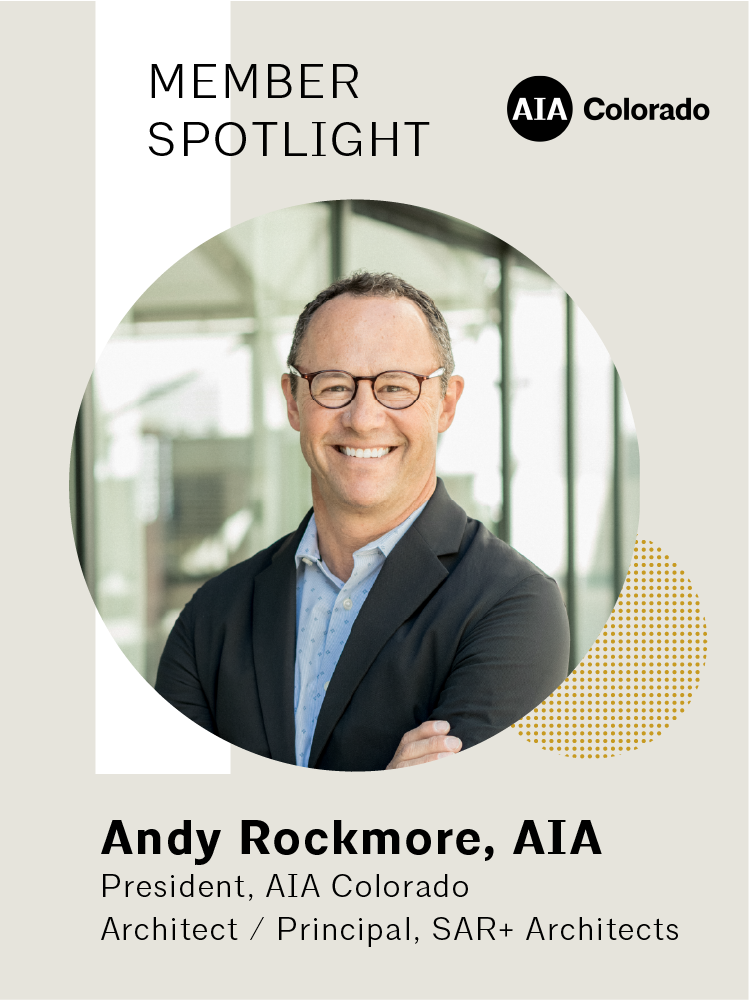
Member Spotlight:
Andy Rockmore, AIA
We’re kicking off the series with 2026 AIA Colorado President Andy Rockmore, AIA, architect and Principal at SAR+ Architects. Andy reflects on discovering architecture as a teenager, finding creativity within constraints, the role architects can play in shaping Colorado’s communities, and why he believes human judgment, empathy, and problem-solving will become even more valuable as the profession evolves. Read the Member Spotlight here.
Boulder Associates becomes BA, unifying nine offices under one national brand. Learn more about the firm’s recent re-branding efforts here.
COMMUNITY
NEWS
2026 Jason Pettigrew Leadership Scholarship: Call for Entries
The Jason Pettigrew Leadership Scholarship honors the legacy of Jason Pettigrew, Assoc. AIA, whose passion, leadership, and commitment to emerging professionals left a lasting impact on the Western Mountain Region. Established in 2004 following his passing, the scholarship supports Associate AIA members who demonstrate leadership potential and a commitment to service within the profession. Recipients receive funding to attend both the AIA Leadership Summit in Washington, D.C., and the AIA College of Fellows Western Mountain Region Conference, providing valuable opportunities for leadership development, networking, and engagement with the Institute. Applications are open to Associate AIA members in the Western Mountain Region states, with submissions evaluated on demonstrated leadership, AIA involvement, and future commitment to the profession. More information can be found here and applications can be started here. Application deadline is Monday, August 10th.
Colorado Green Building Guild 10th Annual Green Home Tour
Saturday, September 19th, from 10am – 7pm, enjoy a self-guided tour of sustainable and high-performance homes across Boulder, Denver, and Fort Collins, paired with the Building Better Expo showcasing the products, practices, and professionals behind sustainable building in Colorado. Attendees can expect to meet some of the homeowners, direct access to the builders and designers who created the homes, and a chance to see green building principles in action. The day wraps with an after party at Relish in Louisville. Hosted by the Colorado Green Building Guild (CGBG), tickets are $15 for a single home tour and $30 for unlimited and available here. All tickets include the expo and after party. AIA Members can use the discount code “AIA” for reduced ticket costs! ($10/$20) If you are interested in volunteering, email jessica@bossarch.com.
CAREER CORNER
JOB BOARD UPDATES
AIA Colorado Job Board
Looking for your next career move? Explore fresh job listings updated daily. Hiring? Showcase your open position for 30 days and connect with top-tier talent.
Featured listings:
NEWA FROM
AIA NATIONAL
Next to Lead
Next to Lead is a leadership development training program for racially and ethnically underrepresented women in architecture. The 2026 Next to Lead program will kick-off in September 2026 and conclude in June 2027. Applications are due by August 7, 2026. Learn more and apply at AIA.
Young Architects Forum (YAF) Now Ya Know – July edition
A newsletter from the AIA Young Architects Forum (YAF). Look out for important news, AIA updates, and ways to engage, no biggie. Read it here.
ABI June 2026: Billings remain weak at architecture firms
The AIA/Deltek Architecture Billings Index ® (ABI) score for the month was 47.3. While this score is nearly three points higher than the May score, it still indicates that a majority of firms reported a decline in billings this month, although fewer firms reported a decline than last month. Read at AIA.
Beyond Renewal Season: Understanding Your Relationship with an Insurance Broker
Most organizations and firms think about their insurance broker once a year—when it’s time to renew coverage. But the best broker relationships don’t begin and end at renewal. From navigating claims and emerging risks to evaluating coverage as your organization evolves, your broker can be a valuable year?round resource. Discover how making the most of that relationship can help your organization stay protected long after the renewal paperwork is signed. Read more at AIA Trust.
AIA COLORADO’S
PREMIER PARTNER SPOTLIGHT
We’re proud to highlight one of AIA Colorado’s Premier Partners, The American Institute of Steel Construction (AISC), and look forward to their ongoing support and involvement serving Colorado’s architecture community.
The American Institute of Steel Construction (AISC), headquartered in Chicago, is a non-partisan, not-for-profit technical institute and trade association established in 1921 to serve the structural steel design community and construction industry in the United States. AISC’s mission is to make structural steel the material of choice by being the leader in structural-steel-related technical and market-building activities, including specification and code development, research, education, technical assistance, quality certification, standardization, market development, and advocacy. AISC has a long tradition of service tothe steel construction industry providing timely and reliable information.
Learn more about The American Institute of Steel Construction (AISC).
AIA COLORADO’S
ALLIED MEMBERS
Find the Right Expertise
Our Allied Members bring depth and diversity to Colorado’s design and construction community. These experienced professionals offer specialized knowledge that complements architectural practice and elevates project outcomes statewide.
Helpful Links:
- Mile High Station, Denver, CO
- Thursday, September 17
- Tickets available here
- Awards sponsorship information
2026 Practice + Design Conference
- Keystone Conference Center, Keystone, CO
- November 11 – 13
- Conference sponsorship information
- Expo Hall registration
AIA Colorado Firm Directory
- Add your firm to the directory here.
Volunteer Opportunities:
Have news to share? If you or your firm have been featured in the media, published in a design outlet, received an award, or announced a major promotion, email AIA Colorado’s Communications Director Jon Bell.
Fall 2026 • Signature Updates

Early registration is now open for AIA Colorado’s 2026 Practice + Design Conference, and tickets are available for the Design + Honor Awards Celebration.
2026
Practice + Design Conference
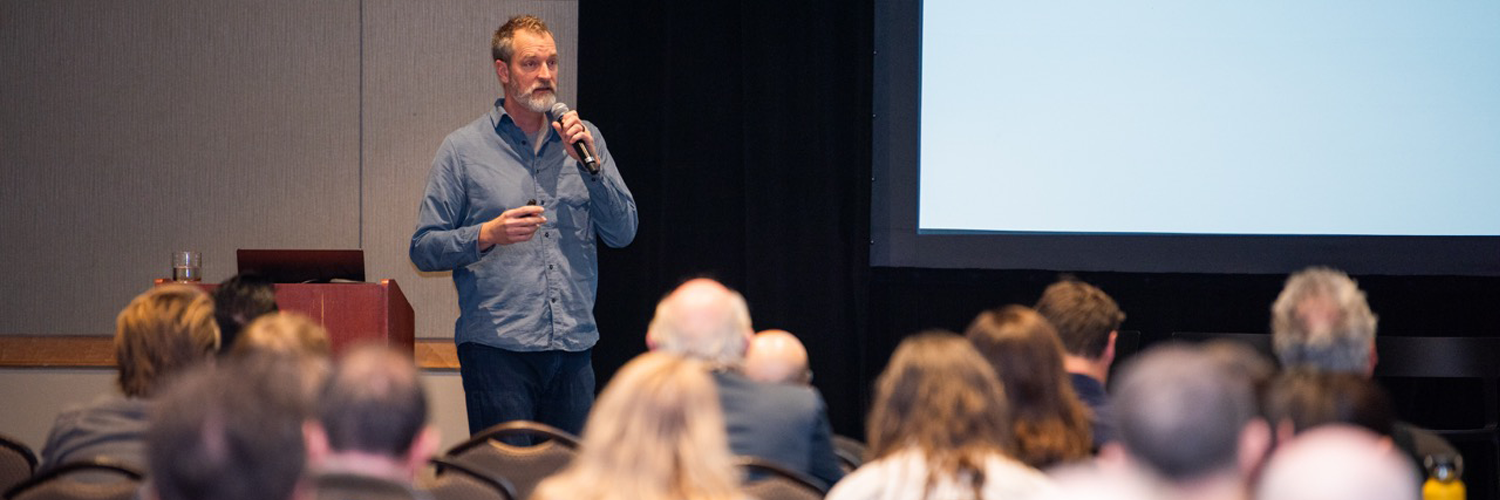
Share Your Expertise
The 2026 Practice + Design Conference Call for Presentations submission window closes this Friday!
This year’s theme, The Work of Tomorrow, explores how architects embrace uncertainty with optimism, shaping the future through innovative ideas, evolving practices, and forward-thinking design.
Share your expertise and shape the profession. Presenting at the Practice + Design Conference is an opportunity to share the lessons, ideas, and innovations you’ve gained through practice while helping fellow architects navigate the challenges and opportunities ahead. Selected presenters will also receive a featured recap article shared with AIA Colorado’s membership and imagery for future use, extending the impact of your session well beyond the conference.
Submit your presentation by Friday, July 31, 2026, at Noon, here.
Early Conference Registration Now Open
Early Registration is now open for the 2026 Practice + Design Conference, The Work of Tomorrow, taking place November 11–13 in Keystone.
We’re thrilled to welcome this year’s keynote speakers:
- John Ronan, FAIA
- Stephen Kieran, FAIA
- Robert Ivy, FAIA
- Florian Idenburg, Intl. Assoc. AIA and Jing Liu, AIA
- Angela Brooks, FAIA and Larry Scarpa, FAIA
The conference schedule will continue to grow in the coming weeks, so check back often as new sessions are announced.
Planning to attend or exhibit? Conference pricing is now available, Expo Hall booths are open, sponsorship opportunities await your brand, and the conference hotel room block is accepting reservations. We encourage you to book early as the discounted room block has sold out in previous years.
Practice + Design Conference info and updates can always be found at aiacolorado.org/conference. Reserve your conference registration, at Early Registration prices, here.
Wednesday’s session
New this year is The State of the State of Colorado, a Wednesday kickoff session included with conference registration, starting at 3pm and followed by a happy hour.
Featuring experts in economics, demographics, resilience, and public policy, this timely program offers a data-driven look at the trends influencing Colorado’s built environment and the future of architectural practice.
Learn more about this session and the presenters here.
AIA Colorado Design + Honor Awards Celebration
More than an awards ceremony, this is a celebration of Colorado’s architecture community and the people, ideas, and partnerships that continue to shape the built environment across our state.
Thursday, September 17, starting at 5:30pm, join colleagues, clients, collaborators, emerging professionals, and industry partners for an unforgettable evening at Mile High Station as we recognize the recipients of the 2026 Design + Honor Awards while celebrating the collective creativity, leadership, and impact of the architectural profession.
Enjoy craft curated cocktails, an exceptional culinary experience, and a live performance by Extreme Strings, creating an energetic backdrop for reconnecting with old friends, making new connections, and celebrating together.
Grow your impact by sponsoring the event. More info available here.
Tickets include catered cuisine and your first two craft beverages. We look forward to celebrating with you!
2026 Legislative Recap

2026 Legislative Recap
Introduction
The 2026 legislative session felt quieter than in recent years for AIA Colorado due to legislators focusing on a $1.5 billion budget deficit. This played out in two ways. First was simply that legislators had to make some tough decisions about what to cut and that took up a significant portion of their time in the 120-day session. The other impact was that legislators had to think carefully before introducing new bills with any cost to the state. This resulted in fewer bills overall and tougher battles to get through the Appropriations committees where fiscal impacts were scrutinized.
Affordability in general has also been a common complaint among constituents and business groups, resulting in a break from new regulatory bills on a variety of subjects of interest to architects such as environmental protection and liability changes for construction professionals.
Top AIA Colorado Housing Bills
Meeting our housing needs remains a challenge in Colorado. While the state is not in a financial position to subsidize affordable housing, we are still seeing successful attempts to clear local regulation logjams that are seen as barriers to affordability instead of as necessary regulations to preserve local character and align with master plans. However, we began to see the limits of this heavy-handed approach by the state as multiple key housing bills failed to advance in the senate after passing in the house. Other failed housing bills simply couldn’t justify their cost to the state with the legislature having to address a record budget deficit.
HB26-1001: Housing Developments on Qualifying Properties
Bill status: Signed into law
AIA Colorado Position: Support
Summary:
The Housing Opportunities Made Easier (HOME) Act will promote new residential development on qualifying properties owned by certain entities such as mission-driven non-profit developers, school districts, universities, and transit authorities. Other non-profit property owners may partner with qualifying entities. The bill’s emphasis is on delivering more affordable housing, though it chose to focus on developer qualifications over strict definitions of unit affordability. A qualifying property is defined as being five acres or smaller and typically within a municipality, though certain established areas of unincorporated county land may also qualify.
Beginning in 2028, local jurisdictions must allow the use of an administrative approval process if the property, developer, and the project itself meet the qualifications in the bill. This means that such projects must be approved regardless of local zoning for the properties. Local infrastructure and utility access have to be available to meet the project needs though. Local governments are not obligated to shoulder the burden of new infrastructure costs or to approve projects where resources (water, roads, sewer, electricity, etc.) simply aren’t available. Softer types of infrastructure such as municipal service capacity cannot be used to deny a project.
The key qualifications for developers are that they be registered 501(c)(3) non-profits and have five years of demonstrated history providing affordable housing. Given the variety of definitions and financing restrictions around “affordable” housing, this bill will not dictate that the projects themselves be affordable. This should be seen as promoting flexibility in providing different housing types that are viable to develop given the site and other local circumstances (teacher housing on school district land, for example).
Buildings will typically be allowed to reach three stories regardless of zoning height limits (with certain exemptions). This is a commonly cited density for affordable multi-family residential projects to pencil out from a financing standpoint. The total building size and number of units will otherwise be as allowed by building codes. The state is stepping in to override local control but AIA Colorado supported this bill due to appropriate guardrails and qualifications that will create new opportunities for residential units we desperately need across the state.
Impact
If your firm does affordable or market-rate multifamily residential work, there may be new opportunities for projects on properties not previously developable, especially where existing land ownership can reduce development costs enough to make more projects pencil out. Private developers that are not non-profits won’t be able to take advantage of this bill on their own though.
HB26-1065: Transit and Housing Investment Zones
Bill status: Signed into law
AIA Colorado Position: Support
Summary:
Colorado has multiple regional mass transportation projects in the works, most notably the Colorado Connector Rail along the Front Range and the Mountain Rail connecting Denver to northwest Colorado. Local communities where stops/stations will be located would benefit from new transit-oriented development but need to invest in infrastructure improvements that were not previously planned.
To jump-start new development, this bill creates a tax increment revenue program that can fund improvements in designated transit investment areas. For up to 6 projects that get approved, this program will provide loans that can be repaid with future local tax revenue. Approved projects also qualify for a tax credit for affordable housing within the designated areas.
AIA Colorado supported this bill to help ensure that communities with upcoming mass transit access can start planning for local development and housing that will make the most sense given these new opportunities.
Impact
For firms that do work in communities along new regional mass transit routes, there may be new planning and project opportunities, as well as favorable zoning changes, especially if a municipality qualifies for this new program so they can start this work sooner.
HB26-1066: Tax Exemptions Low Income Rental Property Development
Bill status: Failed to advance out of House Appropriations
AIA Colorado Position: Support
Summary:
Under current law, property taxes are not required to be paid during the development process for qualifying for-sale affordable housing projects. Given unpredictable timelines and challenges to get financing in place, the property taxes charged on vacant lots can be a significant hurdle to making these projects viable. If the project falls through at any point before completion, back taxes are owed.
This bill would have extended the same property tax considerations to rental affordable housing projects. This could have saved considerable amounts of money for multifamily rental housing projects that are less susceptible to construction defect lawsuits. AIA Colorado recognizes the need for more affordable housing units of all types across the state and our members see firsthand how challenging it is to qualify for financing necessary to get these units on the market. We supported this bill to ease some of these challenges during development timelines we can’t control.
Unfortunately, the massive state budget deficit resulted in legislators being very hesitant to eliminate any tax revenue. They were also swayed by many local governments arguing that they have similar budget issues. This is a bill that we expect to see again in the future when the state budget situation isn’t as dire.
Impact
While we don’t know if this bill will return in the future, it has still brought attention to the high cost of property taxes paid during prolonged development timelines for affordable housing projects.
HB26-1206: Improved Funding to Support Development
Bill status: Failed to reconcile differences between House and Senate versions
AIA Colorado Position: Support
Summary:
Local governments can refer ballot measures to residents to raise taxes and citizens can initiate ballot measures to raise taxes. Local housing authorities, however, cannot. This bill would have given them the ability to put ballot measures forward to raise taxes (up to a 1% increase) specifically to fund new housing projects in their jurisdiction.
AIA Colorado supported this bill as there are situations where elected city council members or county commissioners are opposed to considering any tax increase despite a housing shortage in their jurisdiction. This bill would have given voters the ability to approve (or decide against) funding for local affordable housing directly.
Impact
This bill highlights the challenges that housing authorities face in delivering affordable housing when local governments have different taxation philosophies.
Other Housing Bills of Interest
HB26-1114: Allowed Minimum Lot Size for Subject Jurisdictions
Bill status: Failed in Senate committee after passing in House
AIA Colorado Position: Monitor
Summary:
This bill would have prevented local governments from requiring single-family residential zoned lots be greater than 2,000 square feet. It also included language to ensure that other zoning regulations didn’t make development on these smaller lots effectively impossible. The intent was to promote smaller residential lot sizes and therefore smaller, more affordable homes.
It would not have prevented developers from subdividing land into larger lot sizes up to any maximums allowed by local regulation. They simply couldn’t be forced into lot sizes above 2,000sf. Existing parcels would not have been affected. Properties zone for 2+ residential units would not be subject to this bill’s requirements.
Despite the bill sponsors’ decision to limit this bill’s scope to Colorado’s metropolitan areas only, AIA Colorado was concerned that without additional clarity or restrictions, the bill could have had a negative impact on local planning efforts from both growth projection and infrastructure planning perspectives. We look forward to working with other stakeholders on the anticipated effort to reintroduce this bill in 2027.
HB26-1308: Lot Splitting Approval by Subject Jurisdictions
Bill status: Failed in Senate committee after passing in House
AIA Colorado Position: Monitor
Summary:
This bill would have allowed the owners of qualifying single-family residential lots to legally split their property though a simple administrative process. That application could not be denied subject to meeting the required criteria. The criteria were focused on ensuring that both new lots could reasonably be built upon and that right-of-way access and utility sharing (as necessary) was handled appropriately. This bill would have applied to properties in Colorado metropolitan areas where accessory dwelling units (ADUs) are already allowed by state law. The split could occur on an empty lot, a lot with a single primary structure, or a lot that already contained an ADU, effectively promoting that to a primary residence on its own new lot.
AIA Colorado identified numerous potential unintended consequences on the viability of newly split lots. While bill amendments attempted to address many of these, there was still significant opposition from local governments. The bill sponsors have already signaled their intent to reintroduce an updated version of the bill in 2027 after more comprehensive stakeholder outreach.
Top AIA Colorado Sustainability/Resiliency Bills
Disaster mitigation and resiliency remain important topics as the state grappled with historic drought conditions and the prospect of elevated wildfire risks.
Large load (AI) data centers were a hot topic during the 2026 legislative session with two competing regulation bills introduced in the House (HB26-1030) and Senate (SB26-102). The house bill favored an incentive approach, giving long-term tax breaks to facilities that met voluntary criteria to reduce utility burdens and be a good neighbor. The senate bill was much stricter, setting various requirements, limits, and disclosures for these facilities. Governor Polis signaled that he wanted the bill sponsors to work together on a compromise, but nothing came of this effort amidst a lot of bad press from other states where AI data centers have proven to be bad neighbors. We expect SB26-102 in particular to come back in some form in 2027.
HB26-1030: Data Center & Utility Modernization
Bill status: Failed to advance out of House committee
AIA Colorado Position: Monitor
Summary:
This bill would have created a data center and incentive program that data centers could opt into for a 100% state sales and use tax exemption for 20 years after project completion. The requirements for the program included a preliminary consultation with the electric utility that would serve the site, commitments for future investment and the creation of full-time jobs in Colorado, using prevailing wages and meet labor requirements, and resource efficiency certification.
We were worried about the viability of an optional program and that long term tax breaks wouldn’t result in enough community and grid investment to offset the loss in state tax revenue. This bill spent nearly the entire session in negations with various parties to find a path to success and AIA Colorado opted to remain in a monitor position while we awaited more detail to evaluate if the proposed program would work as intended. The bill sponsors were unable to find a path forward this year.
Impact
AI Data centers can have a positive economic impact but cause massive community end environmental upheaval along the way. State and local governments will continue to explore how to properly regulate this emerging building type that’s unlike other energy-intensive industrial sites.
HB26-1334: Modify Standards of Wildfire Resiliency Code Board
Bill status: Failed in House committee
AIA Colorado Position: Amend
Summary:
Colorado has a new Wildfire Resiliency Code and map that went into full effect earlier this year. There have been ongoing complaints from smaller local jurisdictions that enforcing the code and performing inspections would be overly burdensome on their available building department staff. Lawmakers have also heard from product manufacturers that they want more time to test their products in accordance with the code requirements. This bill would have pushed the implementation date back another year, as well as make it easier for residents to initiate variance requests.
AIA Colorado took an amend position specifically to request that the variance change be removed from the bill. There is an existing process for local governments to work with the state’s code board on variances and the board does not have the capacity to consider individual project-related requests. This language was removed and AIA Colorado shifted to a monitor position, even though we had reservations about the implementation delay. Committee members at the bill’s first hearing had similar concerns and voted against advancing the bill, allowing the code to go into effect as scheduled.
Impact
Architects who do work in wildland/urban interface zones (in the western half of the state in particular) need to ensure that they’re working with clients, contractors, and local governments to meet the state’s new wildfire resiliency code.
SB26-049: Homeowner Natural Disaster Mitigation
Bill status: Failed in Senate Appropriations
AIA Colorado Position: Support
Summary:
This bill was a creative effort to help homeowners fund the hardening of their homes against disasters and make it easier to pay insurance deductibles for repairs after a disaster. There were two components originally. The first was opening up an existing natural disaster mitigation enterprise fund for local governments to also allow individuals and HOAs to apply for financial assistance. Local governments successfully lobbied against this provision, arguing that their needs were already greater than what the fund could provide.
The second component was the creation of catastrophe savings accounts (CSAs) that would be tax-deductible and work similarly to health savings accounts offered by many health insurance plans. These would have helped some homeowners who have sufficient income to set aside money for insurance deductibles. However, these folks are already in the best financial position to rebuild post-disaster. There were questions about how Colorado would administer these accounts and it was too big of an ask to create a program that would reduce tax revenue given the state’s budget deficit. The bill failed to pass out of the Appropriations Committee that reviews how much bills will cost the state if passed into law.
Impact
Even though this bill didn’t pass, legislators will continue to look for creative and cost-effective ways to help homeowners protect their existing homes in wildfire and hail-prone areas of the state.
SB26-102: Large-Load Data Centers
Bill status: Failed to advance out of Senate committee
AIA Colorado Position: Amend
Summary:
The philosophy behind this bill was that large load (AI) data centers (defined here as 30MW and larger facilities) shouldn’t put any new strain on the electric grid, water availability, and the community where they are located. The first requirement was that the facility’s electricity only be generated from renewable sources, whether on the grid or on-site (in any combination). This was intended to be as restrictive as it sounds and proved very contentious. AIA Colorado took an amend position on this bill as we felt this requirement was ultimately too strict and would effectively ban larger data centers.
AIA Colorado supported the remaining provisions in the bill as measures that would protect the environment, limit utility rate spikes, and ensure that data center operators do community outreach prior to getting approval. The facility would have been required to pay for utility infrastructure needed only by the facility itself (substations, transmission lines, easements, etc.). Water used for cooling equipment was required to utilize water-efficient technologies but the bill deferred to local governments to make this determination. Backup generators powered with fossil fuels had strict usage requirements. There were substantial facility reporting requirements to help confirm they weren’t using excessive electricity and water.
Ultimately, the heavy regulations this bill proposed, however well-intentioned, were perceived as being too strict and would effectively ban larger data centers. Even after months of negotiations, parties couldn’t come to an agreeable set of changes.
Impact
As also noted above for HB26-1030, AI Data centers can have a positive economic impact but cause massive community and environmental upheaval along the way. State and local governments will continue to explore how to properly regulate this emerging building type that’s unlike other energy-intensive industrial sites.
Other Sustainability/Resiliency Bills of Interest
HB26-1007: Improve Customer Use Distributed Energy Resources
Bill status: Signed into law
AIA Colorado Position: Monitor
Summary:
As solar panel manufacturing costs continue to drop, new products are hitting the market such as plug-in solar generation devices. These panels can be placed in one’s yard or attached to a railing and plugged into a standard wall socket. They would credit the property owner for electricity generated just like rooftop solar. Starting in 2027, electric utilities must allow the use of these portable solar panels, including the installation of a meter collar as needed to achieve intended safety and usage tracking requirements. Of note, common interest communities (HOAs) may not prohibit the use of these plug-in panels provided they are installed and secured properly.
HB26-1268: Renewable Energy Development on Disturbed Lands
Bill status: Signed into law
AIA Colorado Position: Monitor
Summary:
This bill allows a local government to designate a “renewable energy reinvestment area” where renewable energy generation and energy storage systems may be installed. For qualifying sites, this designation allows an urban renewal authority or county revitalization authority to distribute tax increment revenue to finance or reimburse costs for qualifying projects.
HB26-1326: Sunset Public Utilities Commission
Bill status: Signed into law
AIA Colorado Position: Monitor
Summary:
Colorado’s Public Utilities Commission is subject to the state’s periodic sunset review process to determine if it remains necessary and is accomplishing its mission in its current form (similar to how architects and other licensed professionals go through state review every 8-15 years). There was no doubt that the commission should continue to regulate public utilities, but this bill was an opportunity to address criticisms and logistical/bureaucratic challenges in how it operates.
The change most relevant to our membership is the acknowledgement that a three-person commission, subject to open meeting laws, has been slow to respond to issues related to the state’s electrical grid capacity and various utility requests to raise their rates. There was a push to expand the commission size and require geographic diversity amongst its members, but the final bill only included the requirement that a study be conducted on how to identify efficiency improvements. Still, this could result in a future commission that better understands the differences between utilities across the state and how to better facilitate long-term efforts to fully electrify more of the built environment.
HB26-1395: Repeal Wildfire Resilient Homes Grant Program
Bill status: Signed into law
AIA Colorado Position: Monitor
Summary:
This year saw numerous state-funded programs cancelled to address the state’s budget deficit. One casualty of these cuts is the Wildfire Resilient Homes Grant Program created in 2023. This program had allowed homeowners to apply for grants to retrofit or improve structures on their property to be more wildfire resilient. Only about $50,000 in grants were paid out since the program’s inception.
SB26-155: Increase Access Homeowner’s Insurance Enterprise
Bill status: Signed into law
AIA Colorado Position: Monitor
Summary:
Hail damage to residential roofs in Colorado is a significant driver of increases in homeowners insurance premiums in recent years. This bill creates a government enterprise that will collect an annual fee from insurance companies and provide services and grants back to those insurers. This will allow the state to better understand issues and set consistent standards across the entire insurance industry. The effort is intended to result in better minimum roof installation quality and reduce policy rates in the long term. The fees that insurers pay cannot be passed on to policyholders, though the state cannot prevent insurers from raising rates in general that may end up having the effect of absorbing the fee.
Top Liability, Code, And Other Bills
This year saw fewer bills on the subjects of architect liability and building codes.
HB26-1236: Arbitration Reform
Bill status: Vetoed by Governor
AIA Colorado Position: Amend
Summary:
This bill was intended to strengthen consumer and employee protections in arbitration agreements that often cannot be negotiated to ensure the process is fair to all parties. AIA Colorado identified unclear language and potential contradictions in the original version of the bill and worked with its sponsors on amendments that addressed our concerns. We shifted to a monitor position after these amendments were adopted as the bill was no longer harmful to the architecture profession.
Other construction industry groups, as well as the business community in general, were opposed to this bill on principle. There was a fear that arbitration provisions in home sales agreements would be restricted to the point that it would harm for-sale residential development that already lags behind demand. These arguments persuaded Governor Polis to veto the bill. It’s unclear if sponsors will reintroduce the bill in 2027 with a new governor.
Impact
AIA Colorado looks very closely at any liability-related bills that affect architects, developers, and other construction professionals. This bill was a good example of working with a legislator who listened to our concerns and amended their bill to address them. Employee and consumer protections are subjects that will certainly see additional bills in the future.
SB26-109: Building Code Accessibility
Bill status: Signed into law
AIA Colorado Position: Support
Summary:
Colorado statute in CRS 9-5-101 through 9-5-106 contains housing accessibility-related definitions, provisions, and clarifications that are intended to complement the IBC and ICC A117.1 building codes. This statute also contains an existing (unchanged) methodology that supersedes code to determine how many of each accessible dwelling unit type are required depending on project size.
Statute did not previously indicate the applicable version of A117.1 but existing language had been using terms and definitions found in the 2009 version that are no longer in use. This bill makes conforming changes so that statute now refers to and aligns with terminology in the 2017 version of A117.1.
AIA Colorado supported this effort as it reduces confusion and was not intended to make substantive changes to accessibility requirements compared to A117.1 (2017).
Impact
These changes should reduce potential confusion when comparing statute language to the accessibility codes that statute requires to be used for residential projects. Unfortunately, the US Department of Housing and Urban Development (HUD) still has not recognized the latest versions of A117.1 or the IBC as being an FHA safe harbor, but this bill does not change how architects have had to navigate that disconnect.
Other Liability, Code, And Miscellaneous Bills of Interest
HB26-1430: Transportation Funding Adjustments
Bill status: Signed into law
AIA Colorado Position: Monitor
Summary:
The Colorado Contractors Association (disclosure: CCA and AIA Colorado are both members of the Building Jobs 4 Colorado coalition) has led an effort to put forth a constitutional amendment ballot initiative to guarantee minimum annual transportation funding levels. The intent of this amendment is for the state to catch up in road and bridge maintenance and fund future road expansion needs. This money would not be allowed to be used for public transit investment purposes though.
This bill would change gas tax rates and make related changes to effectively cancel out any transportation funding increases that the ballot initiative would enable. The state legislature already faces significant restrictions on how it can spend state tax revenue to meet our annual balanced budget requirement. In tight budget years (often triggered by TABOR restrictions more so than revenue shortfalls), legislators don’t want their hands tied even further than they already are.
SB26-150: Modernizing Regional Transportation District
Bill status: Signed into law
AIA Colorado Position: Monitor
Summary:
The Regional Transportation District (RTD) board of directors has long been criticized for its ineffectiveness as both a board and the level of engagement demonstrated by individual board members were in their responsibilities. This bill is the second recent attempt to overhaul and simplify the board composition. It reduces the board composition from 15 elected members down to 5 elected and 4 appointed members. It also modernizes other board-related efforts including accessibility assessments, reporting requirements, and subregional service coordination.
A notable downside to the new system is that the consolidated districts will be significantly larger and more difficult to campaign effectively within, as there is no direct overlap with other political district boundaries. Candidates have already struggled to raise money for effective campaign outreach to voters and reduce representation for the people who live in and use RTD services. Evaluating the effectiveness of this change will take time as the consolidation has to be phased in over multiple election cycles based on when different board seats are up for election.
SB26-172: Front Range Passenger Rail District
Bill status: Signed into law
AIA Colorado Position: Monitor
Summary:
The ongoing effort to create a passenger rail line across the entire Front Range of Colorado took a significant step forward this year with this bill’s creation of a new rail district entity. It will be tasked with managing and coordinate with all the local municipalities and metropolitan districts along the proposed route. This will include regulating any local actions to establish/increase a tax or create debt to fund local investment in the rail line.
Event Recap: Designing Within the Limits
Event Recap
Designing Within the Limits: Water Innovation & the Future of Resilient Development in Colorado
July 22, 2026
As Colorado faces increasing pressure from prolonged drought, rising temperatures, population growth, and changing water availability, AIA Colorado’s Committee on the Environment (COTE) launched its two-part summer webinar series with a timely discussion exploring the future of water-conscious design.
Created and moderated by committee members Alexis Campion, Assoc. AIA, and Francis Mougne, AIA, the series brings together experts from architecture, engineering, utilities, research, and planning to examine how the design profession can help create more resilient communities.
The online event featured an interdisciplinary panel including Dr. Sybil Sharvelle of Colorado State University, Lauren McNeill of Group14 Engineering, Russ Slade of Denver Water, and Mike Riggs, AIA, of RTA Architects. Together, the panel explored how architects can respond to Colorado’s finite water resources through innovation, collaboration, and long-term planning.
A recurring theme throughout the discussion was that while Colorado’s water challenges are significant, many opportunities already exist within today’s regulatory framework. Panelists emphasized that graywater reuse, rainwater harvesting, on-site treatment systems, and fit-for-purpose water strategies are no longer theoretical concepts, they are practical solutions that can be implemented today on many projects. Several speakers noted that one of the greatest barriers is not policy itself, but a lack of awareness and early coordination among project teams, owners, and local jurisdictions.
The conversation also highlighted the importance of viewing water as a design resource rather than an assumed utility. Panelists encouraged architects to begin conversations about water reuse early in the design process, evaluate building water intensity alongside energy performance, and consider future-proofing projects through strategies such as dual-plumbing systems and infrastructure that can accommodate future water reuse technologies.
Drawing from projects including the National Western Center Hydro Building, the Pikes Peak Summit Complex, and several Living Building Challenge projects across Colorado, speakers shared lessons learned about navigating permitting, water rights, and innovative building systems. While challenges remain, particularly around Colorado’s complex water laws, panelists agreed that demonstration projects are helping build momentum toward broader adoption and future policy improvements.
Russ Slade of Denver Water offered a sobering overview of Colorado’s current drought conditions and the long-term realities of water supply planning. He discussed how climate change, wildfire, declining snowpack, and increasing demand are reshaping water management across the Front Range, emphasizing that conservation, watershed stewardship, and non-potable reuse will become increasingly important components of resilient communities. Denver Water’s investments in forest restoration, recycled water infrastructure, and advanced forecasting technologies illustrate the scale of planning required to secure reliable water supplies decades into the future.
The discussion also explored emerging challenges such as AI data centers, agricultural water use, and the economics of water reuse. Rather than viewing these as isolated issues, panelists encouraged participants to think holistically about circular water systems, watershed health, and designing buildings that can adapt as water becomes an increasingly valuable resource.
Despite the complexity of the challenges ahead, the webinar concluded on an optimistic note. Panelists pointed to Colorado’s culture of innovation, collaborative problem-solving, and growing awareness of water issues as reasons for confidence. As more successful projects demonstrate what is possible, the design community is well positioned to help shape policies, technologies, and buildings that support a more resilient water future.
SPEAKERS:
Sybil Sharvelle One Water & CSU Hydro Building
Dr. Sybil Sharvelle is a Professor in the Department of Civil and Environmental Engineering and is a member of the Environmental Engineering focus area. Her research interests include water reuse (graywater and reclaimed water), integrated urban water management, and waste conversion to energy. Her doctoral work included development of a system for treatment of graywater for potable reuse during space missions. This project led to her current interest in fit-for-purpose water systems, in which she has led projects funded by the Water Research Foundation, USEPA and National Science Foundation. Dr. Sharvelle was a member of the National Research Council Committee for Beneficial Use of Graywater and Stormwater and chaired the NWRI panel for Decentralized Non-Potable Water Systems.
Lauren McNeill Group 14
Lauren McNeill is an Associate Principal with Group14 Engineering – a woman-owned sustainability & energy efficiency consulting firm based in Denver, Colorado. In her 16 years of experience at Group14, Lauren has led over 100 projects in meeting their sustainability goals, including several projects that incorporated creative water reuse: Aspen Distillery, Northglenn City Hall, Yannell Conservation Habitat, and the Hydro Building at National Western Center.
Russel Slade Denver Water
Russ Slade is a Senior Planner at Denver Water with 19 years of experience supporting the utility’s water resources and operations. He spent a decade in the Water Rights group, where he played a key role in adjudicating and defending Denver Water’s water rights. For the past nine years, Russell has been part of the Raw Water Supply team, focusing on the operation and accounting of water rights across Denver Water’s collection system. His work bridges legal, operational, and planning perspectives to help ensure reliable and sustainable water supply management.
Mike Riggs Pikes Peak RTA
Mike Riggs, AIA, LEED BD+C, Principal, has over twenty years’ experience at RTA. Mike has a diverse background while working on a number of K-12, retail, office, and healthcare projects. Mike served as the Project Architect on the Pikes Peak Summit Complex, and he was responsible for the technical execution of the design and construction documents. Mike’s role continued through construction as the lead representative for the design team and he continues in that role through the LEED Certification and Living Building Certification processes, which are still ongoing.
Part 2
Pursuing Net Zero Water in Colorado: Navigating Water Law, Permitting & Infrastructure Constraints
Following a first conversation exploring the future of water-conscious design in Colorado, AIA Colorado’s Committee on the Environment (COTE) continued its two-part summer webinar series by turning to the practical realities of putting those ideas into action.
Created and moderated by committee members Alexis Campion, Assoc. AIA, and Francis Mougne, AIA, Part 2 in the series, Pursuing Net Zero Water in Colorado, brought together experts in water resources, utilities, infrastructure, and engineering to explore how water rights, permitting requirements, infrastructure constraints, and long-term planning shape what is possible—and why architects should begin thinking about water early in the design process.
About the
Committee on the Environment
The Committee on the Environment (COTE®) is a state and national AIA Knowledge Community working for architects, allied professionals, and the public to achieve climate action and climate justice through design. We believe that design excellence is the foundation of a healthy, sustainable, and equitable future. Our work promotes design strategies that empower all AIA members to realize the best social and environmental outcomes with the clients and the communities they serve.
This committee will review AIA’s 2030 Challenge and more to advance AIA Colorado’s imperative of environmental stewardship.
Member Spotlight: Andy Rockmore, AIA

AIA Colorado Member Spotlight celebrates the architects who are shaping Colorado’s built environment and strengthening our profession. Through conversations about design, leadership, career paths, and the communities they serve, this series offers a personal look at the people behind the projects and the ideas that continue to move architecture forward.
AIA Colorado Member Spotlight
Andy Rockmore, AIA
Title: Architect / Principal
Firm: SAR+ Architects
Location: Denver, CO
Years in practice: 22
Credentials: AIA
Introduction
From helping shape Denver’s urban renaissance to leading one of Colorado’s most respected design firms, Andy Rockmore, AIA, has spent more than two decades creating places that strengthen communities and enrich the public realm.
As a Principal at SAR+ Architects and the 2026 President of AIA Colorado, he believes architects have a responsibility that extends well beyond buildings, serving as problem solvers, civic leaders, and advocates for resilient, vibrant communities.
In this Member Spotlight, Andy reflects on discovering architecture as a teenager, finding creativity within constraints, the future of artificial intelligence in practice, and why connecting with fellow architects remains one of the profession’s greatest rewards.
The Conversation
What drew you to architecture, and when did you know it was the right path for you?
As a child, I was always drawing, everywhere! My parents once found an entire mural on the wall under my bed, 1 foot tall, 6 feet long. My father also loved to build additions to our house, furniture, and anything else the family needed. I loved being his helper.
In 10th grade, my mother took me to see the architecture studio at RPI, where I eventually went to college. I’ll never ever forget that moment, walking into a room full of drawings and models and people making amazing structures. It was a whole new world I didn’t know existed! I still feel similarly when I walk into our office every day.
“I still feel the same excitement walking into our office today as I did walking into my first architecture studio.”
How do you approach the balance between creativity and constraints such as budget, code, and client needs?
Balance is the perfect word to describe what architects try to achieve between all those forces and many more. The most important approach is accepting the possibilities AND the constraints! We are professional service providers, working in the interest of others first. Too often architects prioritize creativity and ignore constraints, leaving a client unable to implement what they need. Responsible architects know all too well, creativity is found within the constraints, not in avoiding them.
“Responsible architects know all too well that creativity is found within the constraints, not in avoiding them.”
What is one tool, habit, or process you rely on that others might not expect?
I still take notes by hand, because I remember what I write/draw. I find it easier to focus, listen intently, and remember what I’ve documented immeasurably better than typing.
In your view, what role should architects play in shaping Colorado’s communities?
As architects, we need to be using our diverse problem-solving skills to play in many roles. Colorado is a relatively young state with a national identity tied to its mountain towns, our front range cities, and outdoor culture. Colorado architects should ensure new development reinforces our state’s unique character, rather than superimposing ideas from other places.
Colorado architects should be leaders in climate resilience, focusing on wildfire risk, water scarcity, and increasing energy demands.
Our profession needs to keep expanding our traditional role by serving the public, not simply private clients. Architects should get involved in local government to help influence affordability initiatives, school planning, community development, and civic infrastructure. Our communities need us!
Our communities need us!
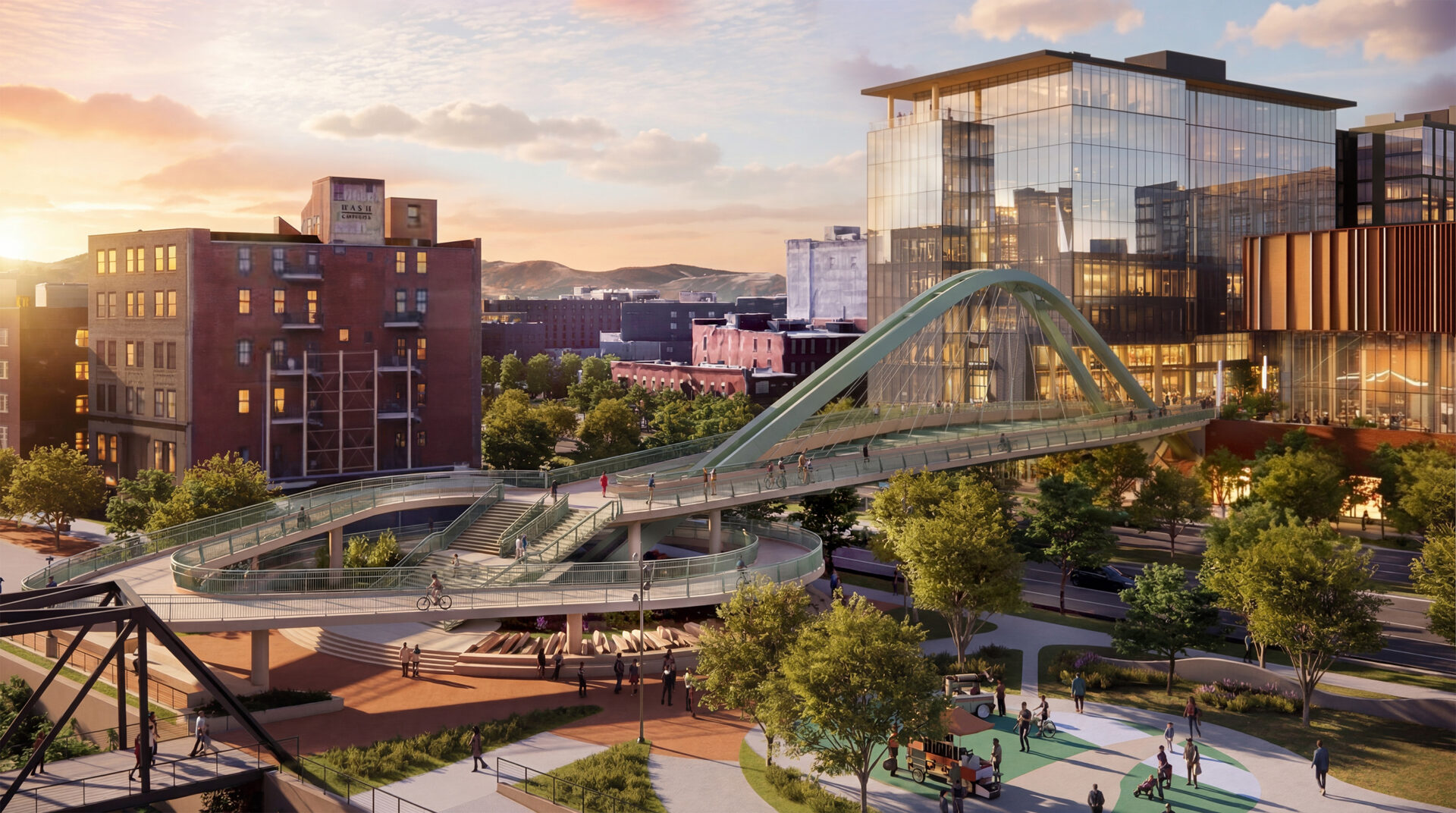
As part of the first phase of the KSE Ball Arena Redevelopment, Wynkoop Crossing will connect Denver’s historic Lower Downtown district to the emerging mixed-use neighborhood surrounding Ball Arena, helping transform a formerly disconnected edge of downtown into a vibrant, accessible urban corridor.
Rendering provided by SAR+ Architects
Where do you see the future of architecture heading in the next 5 to 10 years?
I believe that AI will continue to impact our profession in very significant ways. However, unlike some of the doomsayers, I’m confident there will be even more value placed on an architect’s judgement, reason, empathy, and ability to solve problems that create healthy places, meaningful connections, and a sense of ease to help people thrive in our complex world.
How has AIA Colorado supported your career or practice?
I’m continually grateful for the ways AIA supports our firm by providing resources that help us run our business and stay ahead of our evolving profession. Whether it’s the Compensation Report, the latest AI Toolkit, or leadership and mentoring opportunities like AIA Colorado’s Ascend and the Christopher Kelley Leadership Development Program, our firm has benefited tremendously from AIA’s support.
On a personal level, my involvement with AIA has connected me to the profession in meaningful ways. I’ve had the opportunity to build friendships with architects from across the country, and I’m continually struck by, and comforted by, how much we all have in common. Despite practicing in different places and facing different challenges, we share a common passion for improving our communities through design.
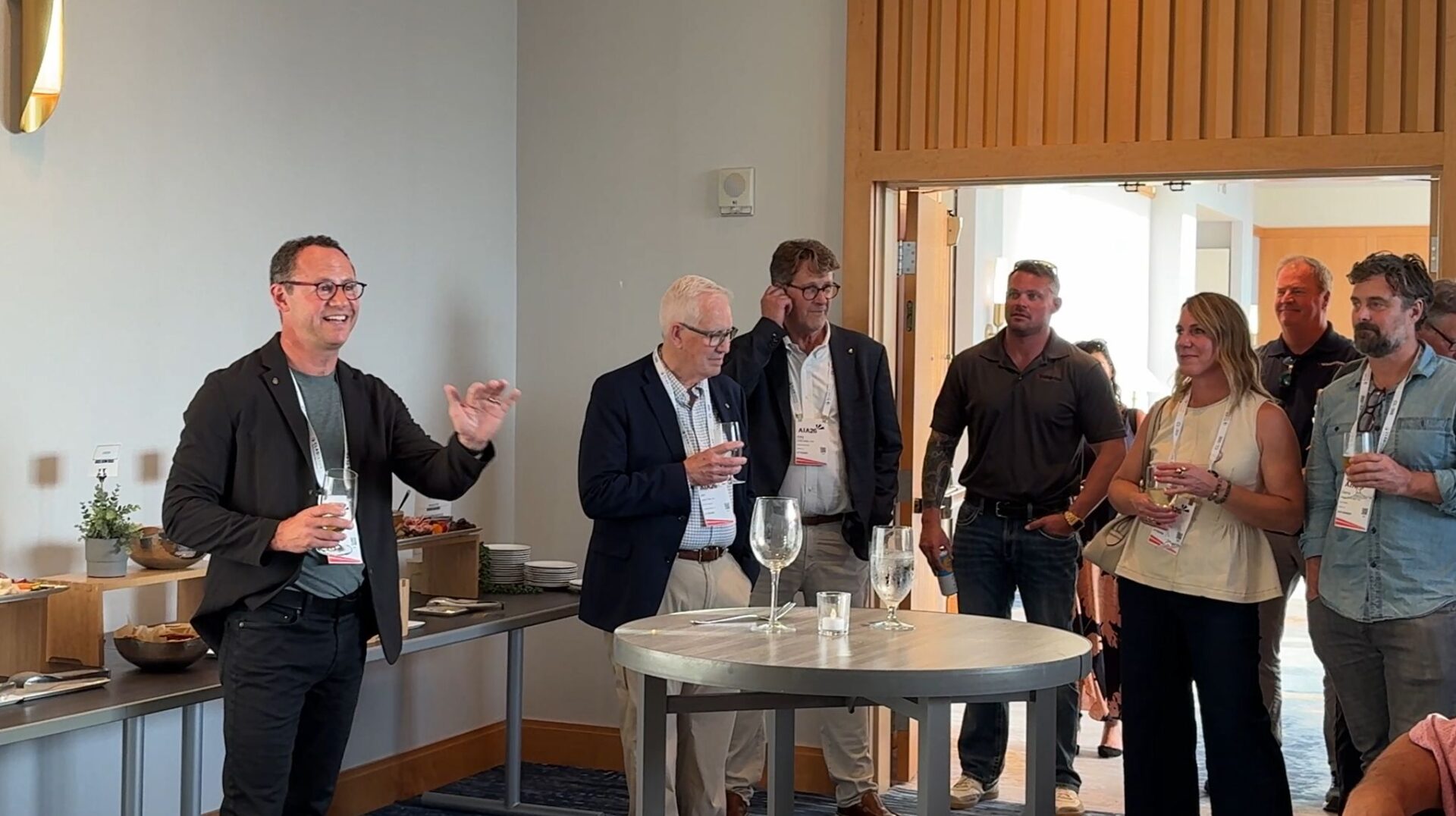
I’ve really enjoyed getting to know and connect with AIA Colorado members from across the state, and this year’s AIA Conference in San Diego was a great opportunity to spend time together.
If you were not an architect, what would you be doing?
If I couldn’t practice architecture, I’d be a therapist. I find people and their stories far more interesting, complex, and wonderful than any building or place.
Thank you to Andy Rockmore, AIA, for sharing his story to kickoff the AIA Colorado Member Spotlight series!
Colorado Architecture News | 07.15.26
News from the Colorado Chapter of The American Institute of Architects
07.15.26
In this Newsletter:
- Practice + Design Conference Call for Presentations
- Academy of Architecture for Health National Update
- Colorado ByDESIGN™
- July 22 • Committee on the Environment Water Series: Part 1
- July 29 • Highlands Ranch Senior Center tour
- Aug 5 • Committee on the Environment Water Series: Part 2
- Aug 7 • Coffee meet & greet in Fort Collins
- Aug 19 • Timber Ridge Village tour in Vail
- Aug 20 • Palmer High School construction tour
- Aug 27 • Anythink Nature Library tour
- Premier Partner spotlight: KL&A Engineers & Builders
AIA COLORADO’S
NEWS
Share Your Expertise
The 2026 Practice + Design Conference Call for Presentations submission window closes July 31st!
This year’s theme, The Work of Tomorrow, explores how architects embrace uncertainty with optimism, shaping the future through innovative ideas, evolving practices, and forward-thinking design.
Share your expertise with your peers by leading a session in Keystone this fall. Submit your presentation by Friday, July 31, 2026, at Noon.
Academy of Architecture for Health National Update
What priorities are shaping the future of healthcare design? During AAH Colorado’s recent National Update, 2026 AAH National President Pierce McVey, AIA, LEED AP, shared the Academy’s strategic initiatives, upcoming programs, mentorship opportunities, and the 2026 theme of Resilience, while Colorado Chair Tim Neely, AIA, highlighted the chapter’s volunteer efforts, community health initiatives, and upcoming programming. Read the full recap, explore opportunities to get involved, and watch the complete recording of the session here.
Colorado ByDESIGN™
With the conclusion of Colorado ByDESIGN™, all five broadcast episodes are now available to watch, offering an inspiring look at the remarkable architecture being designed across our state. A heartfelt thank you to the many AIA Colorado member architects and firms who generously opened their projects and represented Colorado’s architecture community with creativity, excellence, and thoughtfulness.
If you’ve designed a project you’re especially proud of and believe it would make a compelling feature in a future episode, the ByDESIGN team would love to hear from you and begin the conversation about bringing your work to the screen!
Watch all five episodes and learn more about featuring your project on the show here.
AIA Group Enrollment
Group Enrollment provides firms employing 10+ members with a single, consolidated invoice for their teams. Support your team with AIA membership! Firms can enroll anytime at by visiting the dedicated landing page here, or email membership@aiacolorado.org to let us know you are interested and we will help connect you with the national team to onboard your firm.
AIA COLORADO’S
EVENTS
July 22 • Designing Within the Limits: Water Innovation & the Future of Resilient Development in Colorado
Wednesday, July 22nd, at Noon, join AIA Colorado’s Committee on the Environment (COTE) on examining how water scarcity is shaping the future of development in Colorado and explores strategies for creating more resilient, water-conscious communities. Participants will learn about innovative water management approaches, emerging technologies, and integrated planning solutions that support public health, safety, and welfare through sustainable resource stewardship and resilient infrastructure design. Session to be submitted for 1 LU|HSW. More info and RSVP here.
July 29 • Where Community Happens: A Tour of Highlands Ranch Senior Center
Wednesday, July 29th, at 5pm, join members for a tour of Highlands Senior Center, a vibrant community hub designed to support wellness, accessibility, and social connection for aging adults. Tour will be led by architects from OZ Architecture and will examine how flexible programming, intuitive circulation, natural light, and community-driven aesthetics contribute to environments that enhance health, safety, and welfare for older adults. Tour has been submitted for 1 LU|HSW. More info and RSVP here.
Aug 5 • Pursuing Net Zero Water in Colorado: Navigating Water Law, Permitting & Infrastructure Constraints
Wednesday, August 5th, at Noon, join AIA Colorado’s Committee on the Environment (COTE) on exploring the challenges and opportunities of pursuing Net Zero Water development in Colorado through a discussion of water rights, permitting requirements, and infrastructure constraints. Participants will gain insights from industry experts on lessons learned and practical strategies for advancing resilient, water-conscious projects that support public health, safety, and welfare. Session approved for 1 LU|HSW. More info and RSVP here.
Aug 7 • Coffee meet & greet in Fort Collins
Friday, August 7th, at 8am, join AIA Colorado North members for your morning beverage and conversation at The Caldwell, one of Fort Collins’ newest establishments. RSVP here.
Aug 19 • Timber Ridge Village tour in Vail
Wednesday, August 19th, at 2pm, join members in the West for a tour of of Timber Ridge Village in Vail, one of the most ambitious workforce housing developments undertaken in Colorado’s mountain communities. As the Town of Vail’s largest capital project to date, this $165 million redevelopment transforms a long-standing employee housing site into a modern, transit-oriented neighborhood featuring more than 300 deed-restricted homes for the local workforce. Designed by Pure Design in collaboration with Triumph Development West and the Town of Vail, the project demonstrates how architecture, planning, public policy, and innovative construction methods can address the growing housing challenges facing resort communities. Tour approved for 2 LU|HSW. More info and RSVP here.
Aug 20 • Palmer High School construction tour
Thursday, August 20th, at 4pm, join South members for a tour of the new Palmer High School, an ongoing Palmer High School project by RTA Architects and Perkins Eastman. This guided jobsite tour of Palmer High School offers participants first-hand exposure to active building construction within an occupied educational campus, with an emphasis on installation of precast concrete wall panels, construction means and methods, sequencing, and coordination across multiple trades. The tour will review how work is planned, staged, and executed on a constrained, occupied school campus, including temporary protection, access control, and safety measures. Tour approved for 1.5 LU|HSW. More info and RSVP here.
Aug 27 • Anythink Nature Library tour
Thursday, August 27th, at 4pm, join members for a guided tour of the Anythink Nature Library, designed by Davis Partnership Architects. Situated on a 15-acre hillside adjacent to the Aylor Open Space trail network, the project explores how architecture can foster meaningful connections between people, learning, and the natural environment. Attendees will experience the building’s curvilinear design, daylight-filled interiors, and integrated indoor/outdoor programming spaces, including gardens, nature-focused learning environments, and community gathering areas. The tour will highlight strategies related to site integration, biophilic design, experiential learning, and the creation of healthy, restorative public spaces. Participants will gain insight into the collaborative design process and the architectural decisions that support the library’s mission to help visitors “find their place in nature.” Tour approved for 1 LU|HSW. More info and RSVP here.
Thursday, September 17, 2026, 5:30 – 9pm, at Mile High Station, Denver.
Learn more about the event and buy your tickets here.
COMMUNITY
NEWS
City of Colorado Springs seeking architect to serve on the Fire Board of Appeals
The Fire Board of Appeals is established to hear and decide appeals of orders, decisions or determinations made by the fire code official or his/her designee relative to the application and interpretation of the currently adopted International Fire Code. Meeting time is the 2nd Friday of every month at 8:30am. Interested applicants are encouraged to review the Downtown Form-Based Zone Boundaries prior to applying, available here. Applications are due this Friday, July 3st. Apply here.
2026 Jason Pettigrew Leadership Scholarship: Call for Entries
The Jason Pettigrew Leadership Scholarship honors the legacy of Jason Pettigrew, Assoc. AIA, whose passion, leadership, and commitment to emerging professionals left a lasting impact on the Western Mountain Region. Established in 2004 following his passing, the scholarship supports Associate AIA members who demonstrate leadership potential and a commitment to service within the profession. Recipients receive funding to attend both the AIA Leadership Summit in Washington, D.C., and the AIA College of Fellows Western Mountain Region Conference, providing valuable opportunities for leadership development, networking, and engagement with the Institute. Applications are open to Associate AIA members in the Western Mountain Region states, with submissions evaluated on demonstrated leadership, AIA involvement, and future commitment to the profession. More information can be found here and applications can be started here. Application deadline is Monday, August 10th.
CAREER CORNER
JOB BOARD UPDATES
AIA Colorado Job Board
Looking for your next career move? Explore fresh job listings updated daily. Hiring? Showcase your open position for 30 days and connect with top-tier talent.
Featured listings:
NEWA FROM
AIA NATIONAL
Next to Lead
Next to Lead is a leadership development training program for racially and ethnically underrepresented women in architecture. The 2026 Next to Lead program will kick-off in September 2026 and conclude in June 2027. Applications are due by August 7, 2026. Learn more and apply at AIA.
Economic Update Q3 2026 ABI Insights
Join AIA Chief Economist Richard Branch and AIA EVP/Chief Executive Officer, Carole Wedge, FAIA, for our quarterly conversation on key insights into the industry’s latest economic data and trends. Register at AIA.
AIA COLORADO’S
PREMIER PARTNER SPOTLIGHT

We’re proud to highlight one of AIA Colorado’s Premier Partners, KL&A, and look forward to their ongoing support and involvement serving Colorado’s architecture community.
KL&A is a firm built around the idea that structural engineers should return to a master builder role by taking ownership of structural systems. A collaborative approach and project centric behaviors are our differentiators, facilitating a more engaging design and construction process. Their philosophy of personal responsibility has generated a corporate culture of problem solving and innovation. They are engineers first and foremost, which they leverage on their steel detailing and steel construction projects. hey also take great pride in sustainability efforts, utilizing mass timber to minimize embodied carbon in our structures, and providing Life Cycle Assessments on our committed projects.
AIA COLORADO’S
ALLIED MEMBERS
Find the Right Expertise
Our Allied Members bring depth and diversity to Colorado’s design and construction community. These experienced professionals offer specialized knowledge that complements architectural practice and elevates project outcomes statewide.
Helpful Links:
- Mile High Station, Denver, CO
- Thursday, September 17
- Tickets available here
- Awards sponsorship information
2026 Practice + Design Conference
- Keystone Conference Center, Keystone, CO
- November 11 – 13
- Conference Call for Presentations
- Submission window closes July 31
- Conference sponsorship information
- Expo Hall registration
AIA Colorado Firm Directory
- Add your firm to the directory here.
Volunteer Opportunities:
Have news to share? If you or your firm have been featured in the media, published in a design outlet, received an award, or announced a major promotion, email AIA Colorado’s Communications Director Jon Bell.